
Natural clay floor

Thibaut Devulder

The finished clay plaster floor

Hands-on course last week at our collective work space Kroloftet in Oslo, where I got a chance to practice natural clay flooring techniques under the guidance of our collaborator Kristian Møystad Bjørnland (of Ur Arkitekter) and Marc Charneau (of Kroloftet).

This little practical exercise aimed at resurfacing the unfinished floor of one of our meeting rooms, exploring clay plaster mixes, workmanship and surface treatments to create a natural, durable and, of course, beautiful floor.

We aimed are reclaiming as much existing materials as possible: taking as a starting point the strangely laid out parquet in the middle of the room over a rough concrete floor, we collected unwanted clay materials from our ceramics workshop, waste wood shavings from the wood workshop and hand sifted sand from a local quarry to experiment with various mix of clay-sand-fibre-water.

The rough concrete floor around the parqueted area, before applying the clay plaster

After an initial layer of clay mix compressed in place, we progressed through several layers of finer clay mixes to achieve a smooth end result. Since we used reclaimed materials of uncertain composition, we decided to experiment with various mixing proportions, some of which more successful than others, which gave us a chance to practice our reparation techniques on the less optimal mixes that developed cracks upon drying!

We finally applied a coat of boiled linseed oil and wax, purchased from the local building conservation shop, to seal and harden the surface.

The workshop was rich in discoveries and allowed me to experience the theory and process behind clay plastering.

With beautiful moisture control abilities, low embodied energy and full recyclability, we are looking forward to applying clay plastering techniques to create stunning and durable interior finishes for our future projects!
Construction started in Hagalykkja

Thibaut Devulder

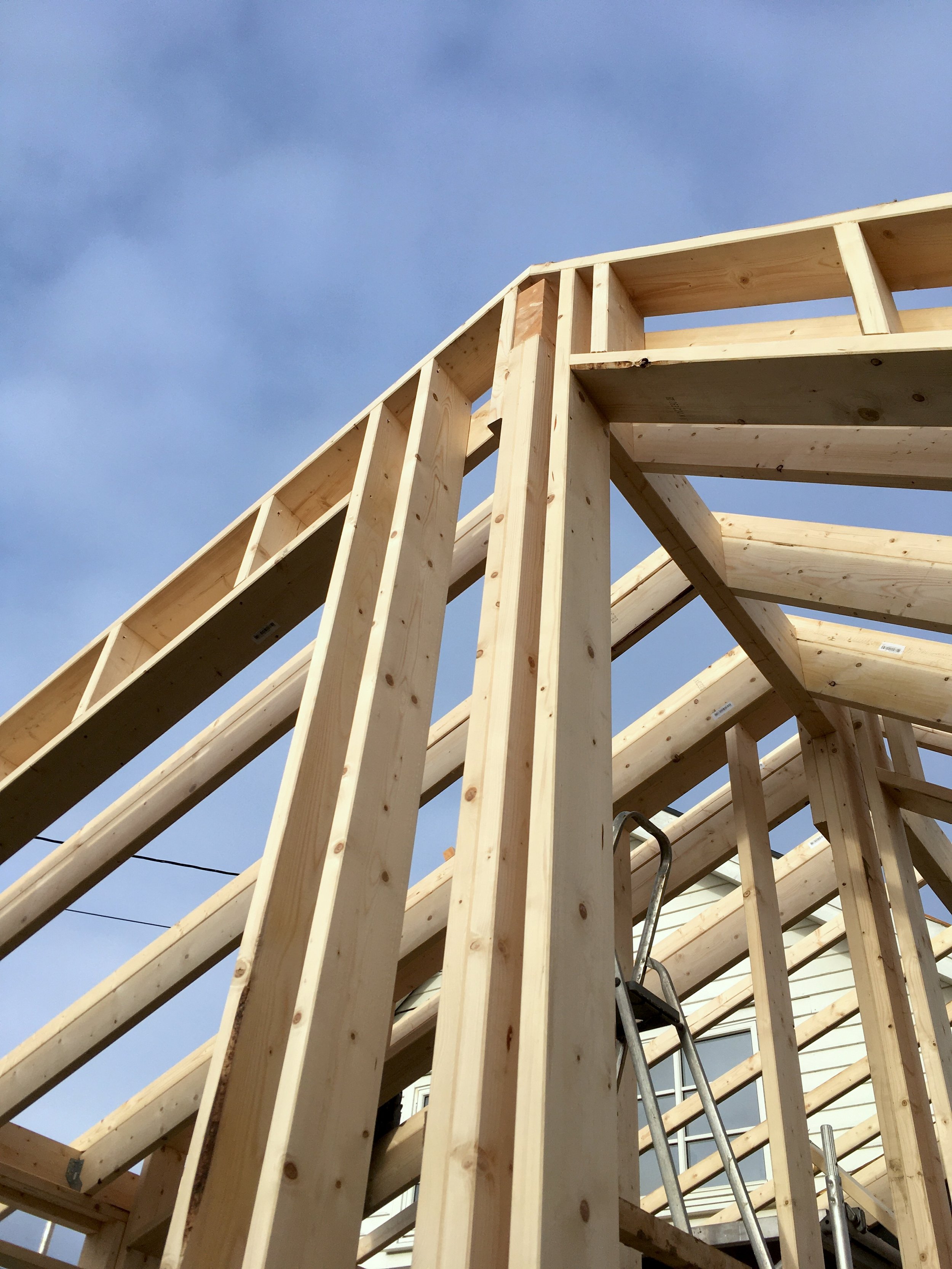
Building work has started on our family house remodel in Eidsvoll. with the timber framing of the new extension now completed.

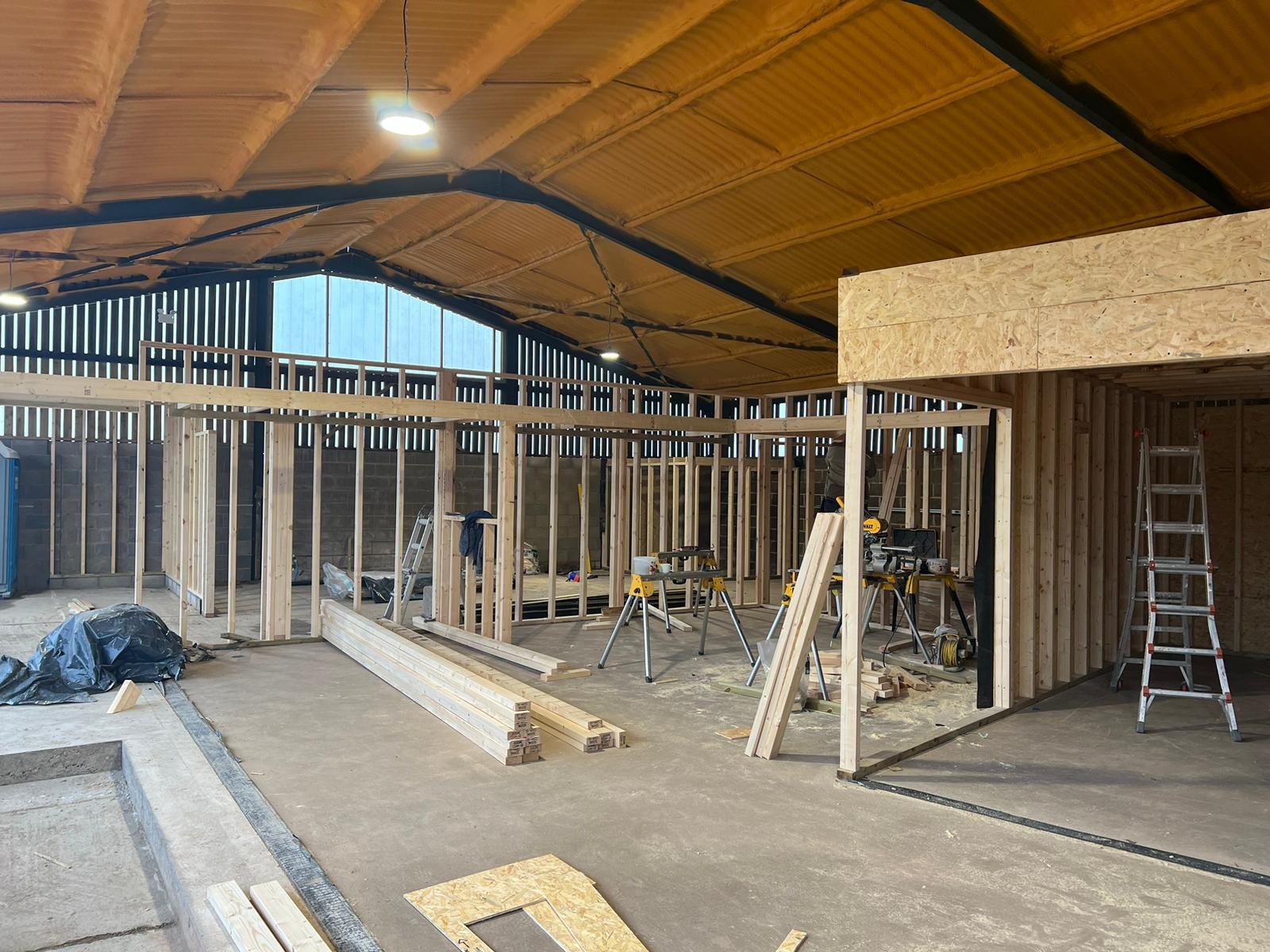
The timber frame of the new extension under construction


In this first phase of the construction process, this extension will be fully built and fitted with a new kitchen connected to a winter garden, before being integrated into the house. The second building phase will then start, whereby the old kitchen will be converted into an accessible master bedroom and a new modern bathroom.

This careful phasing informed the design process and was developed in collaboration with the clients to minimise disruption to the family life, allowing them to continue using the house throughout the construction period.


Thinking of remodelling your home while still living in it?

Oslo roof terrace getting ready for National Day

Thibaut Devulder

Most of the building work for our new roof terrace on a residential block in central Oslo is now completed, and the finishing work is progressing quick, on time for the festivity of the Norwegian national day in May!

New approach

Thibaut Devulder
Rendering of our proposed new approach, with a new entrance to the house linking it to the new garage

Our proposed new approach for the house, as seen from the street

As part of a larger remodelling and refurbishment of a family house in Vinterbro, we have put a particular focus on redesigning the house approach from the street, linking a new accessible and welcoming entrance to the home with a new woodworking workshop and garage.

The existing approach, as seen from the street

Portfolio project
The kitchen is the heart

Thibaut Devulder

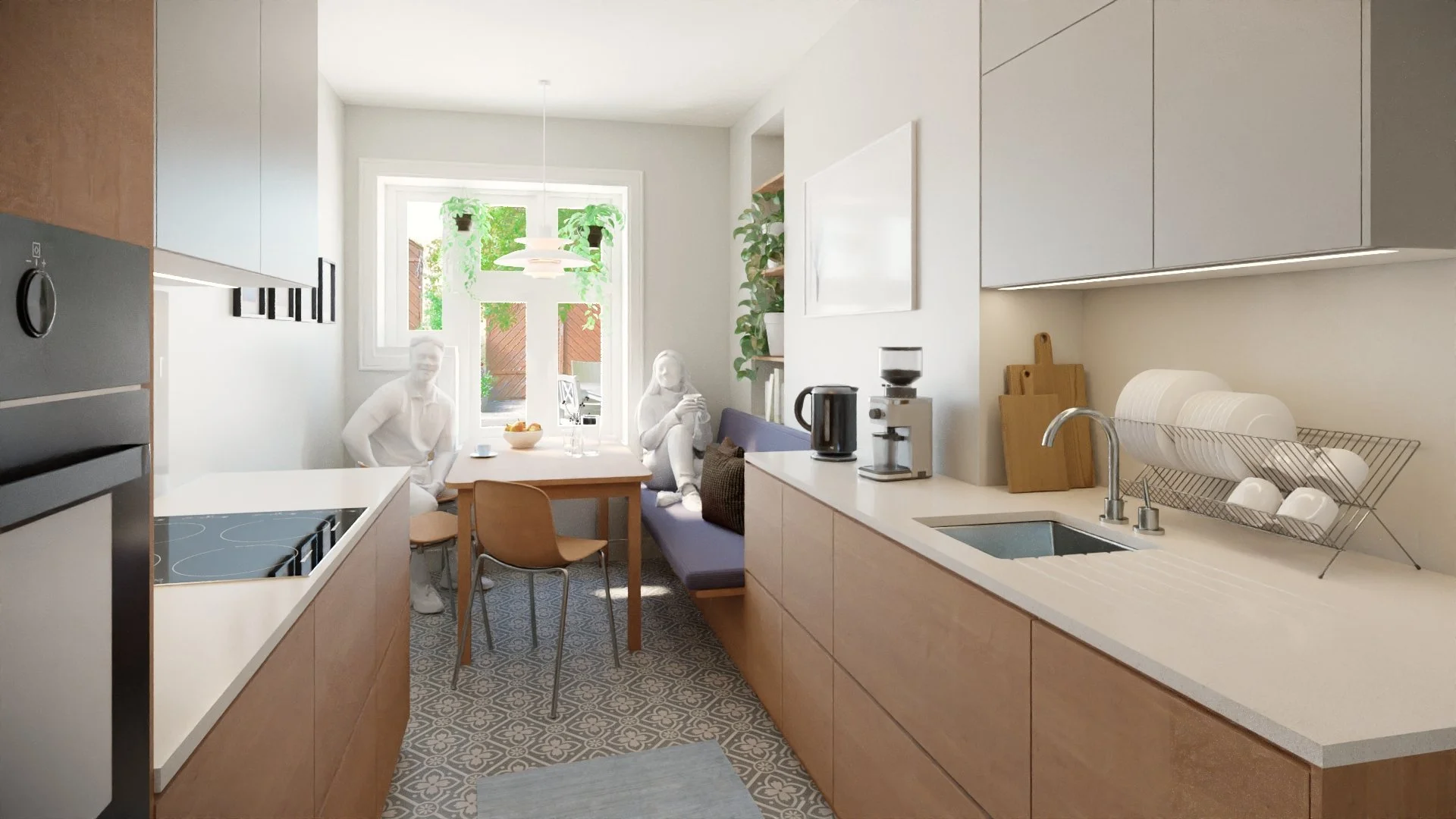
For this project, we helped our clients remodel their home to create a vibrant and flexible social space at its heart, where the whole family could share meals, be creative, work and entertain friends around a large communal table.

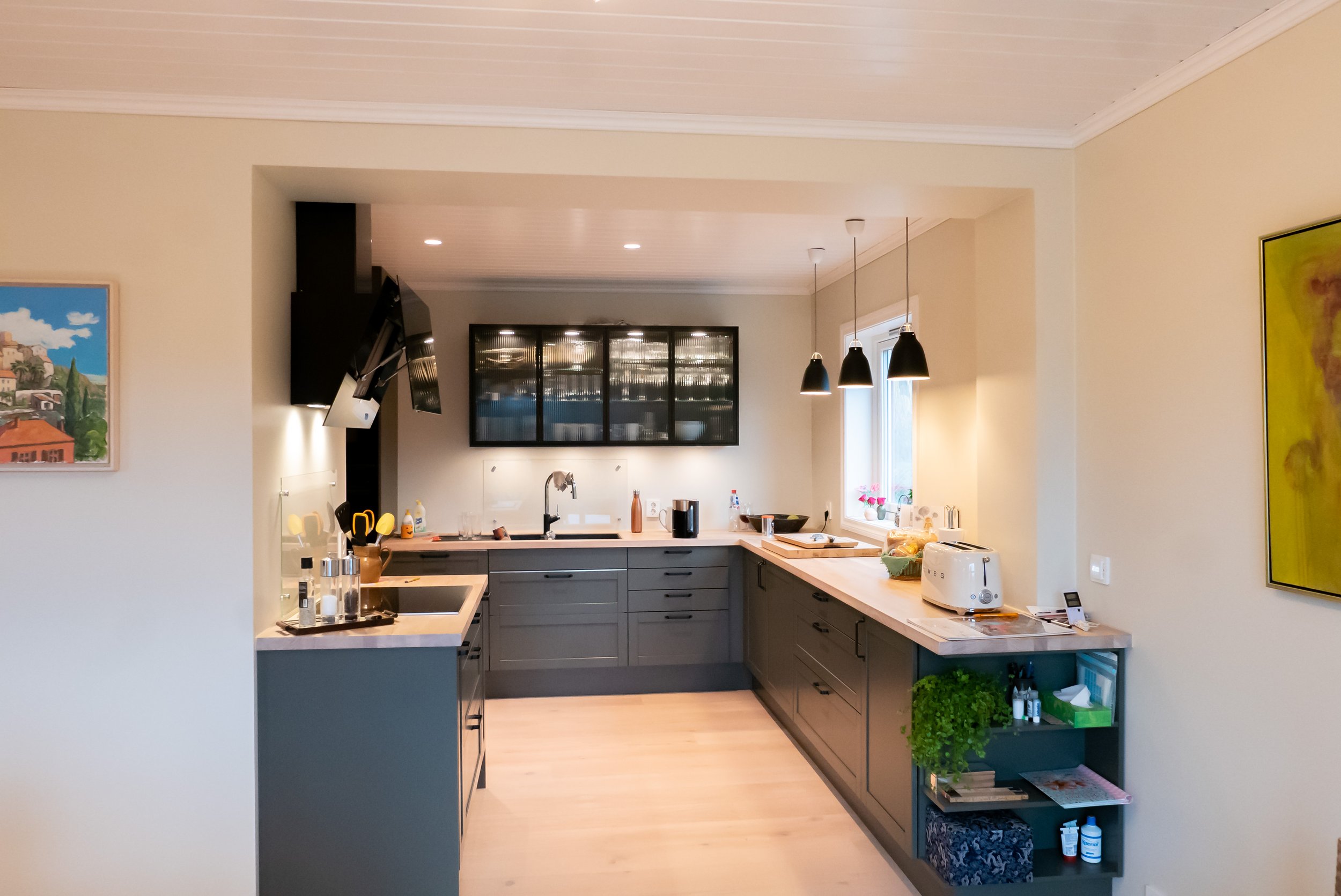
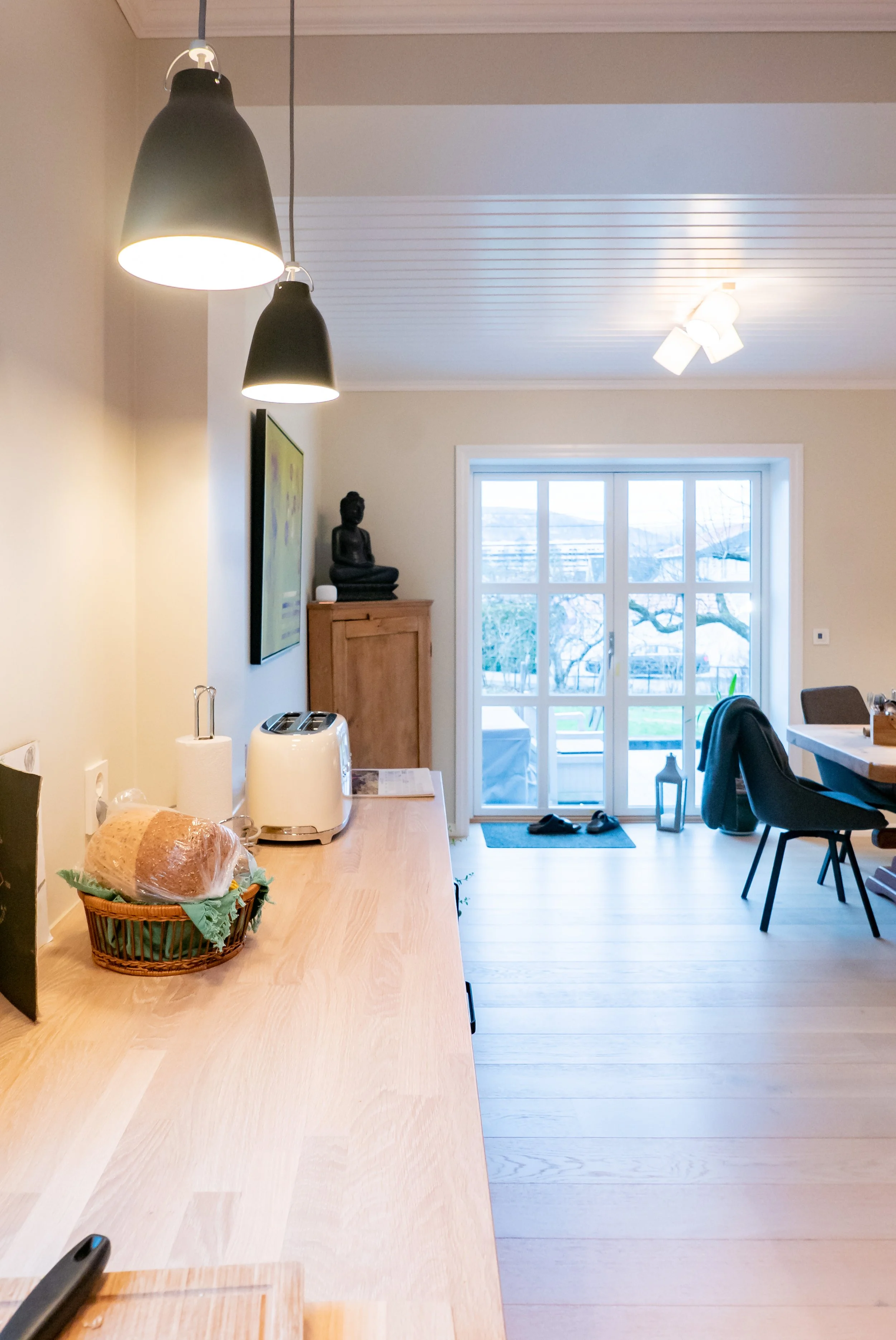
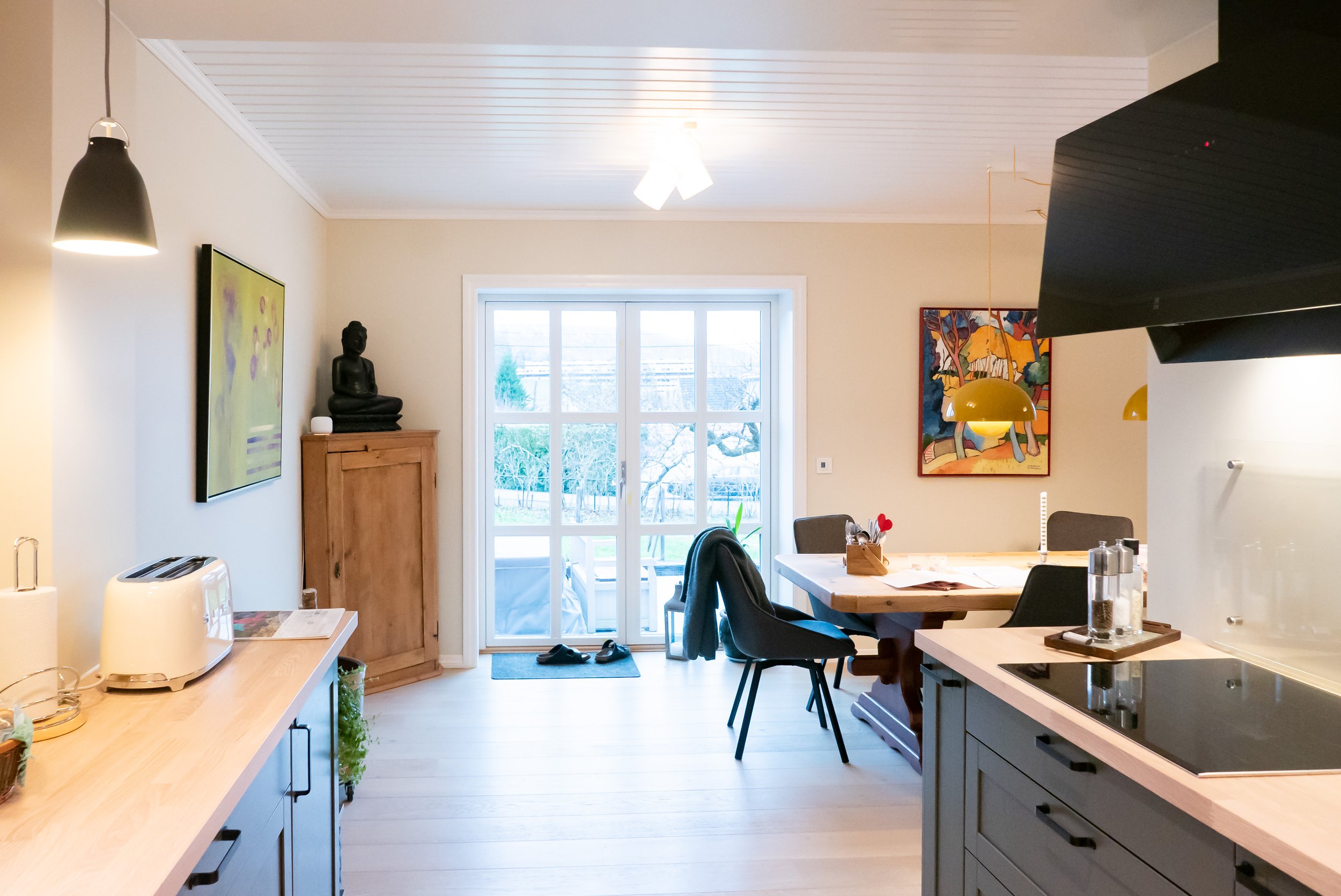
The remodelled kitchen, with its large communal table and views to the garden

Getting to know the existing house

The couple with their twin daughters had lived in this house, located in Bærum — not far from another remodelling projects of ours, for six years before they decided to remodel. Originally built in 1921 as a log house, it had been extended and altered several times over the course of a century.

The most recent of these extensions had caused the sole window of the existing small kitchen to be closed off, so that the only daylight was coming through an adjacent playroom. The neighbouring living-room, with its large windows towards the garden, was mostly used as a TV and music room. Despite its comfortable size, this room was surprisingly difficult to furnish, in part due to an awkwardly placed door to the outdoor terrace, and the large dining table at its centre was only used for occasional festive occasions.

Our analysis of the existing ground floor of the house

Developing a design brief

We sat down with the family to explore their needs and aspirations for their home, bringing in fond memories of former homes they inhabited and loved, and created together a concise brief for this project. Concentrating on three rooms on the ground floor, we were to create an attractive social space at the centre of the house, well connected to the beautiful garden and filled with daylight, to be shared by all members of the family for their daily activities: making food, sharing meals together and with guests, handicraft, playing the piano, doing homework (or home work!), etc. Occasionally, the family should also have the possibility to close off part of the ground floor when multiple activities should be kept separate.

Transforming the house

… and our design strategy to transform the spaces, explained step-by-step

With a clear brief defined, and the house carefully analysed, a solution to unlock the potential of a home can be sought. A seemingly simple change can thoroughly transform the way the home is being inhabited.

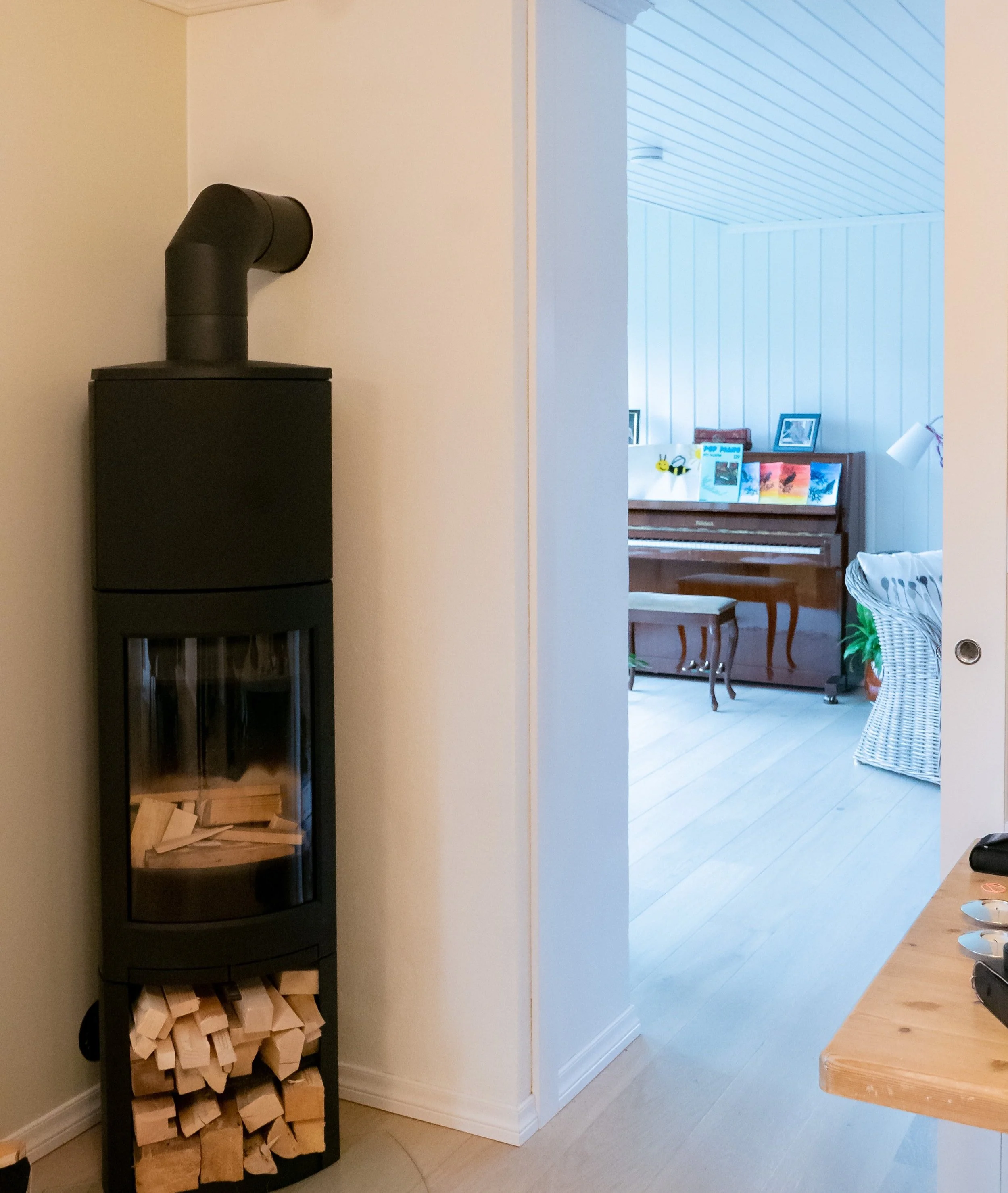
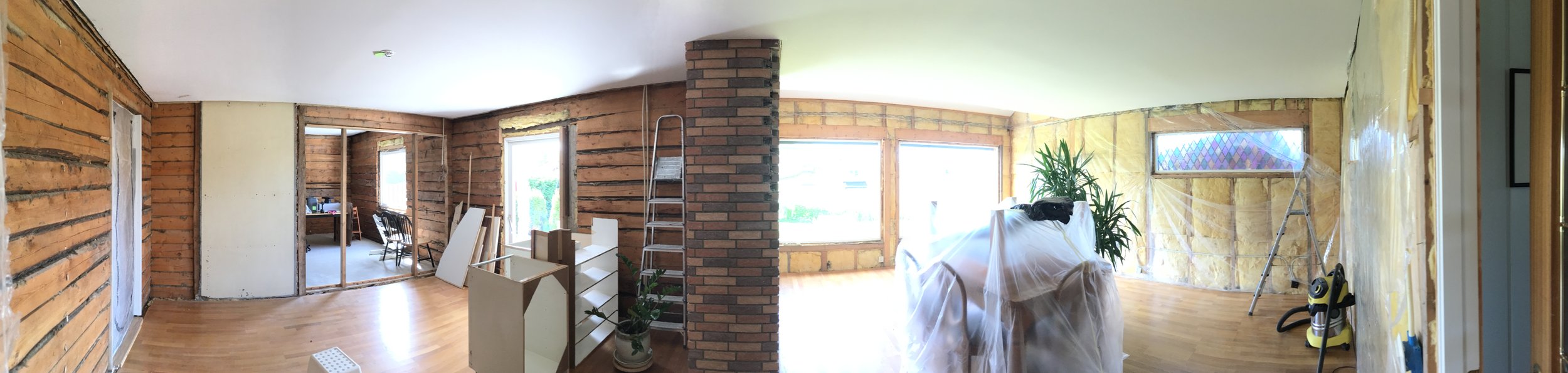
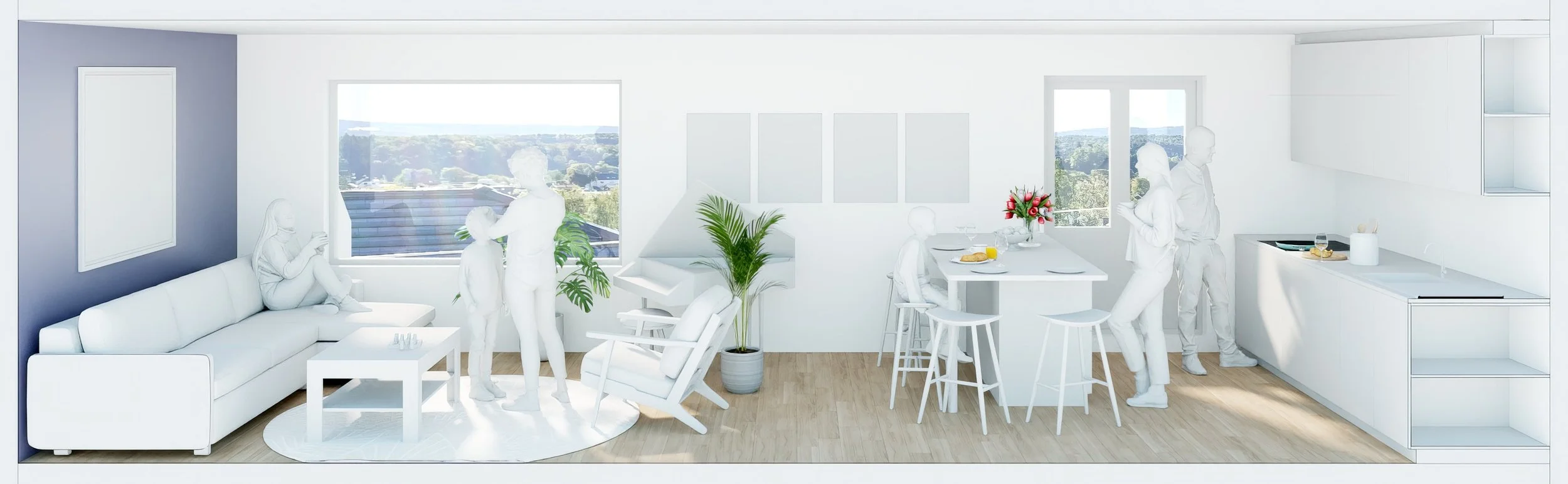
With minimal structural changes to the house, we reorganised the internal partitions and windows to create a spacious room with a large communal table as its centrepiece, wrapping the kitchen area around an existing chimney. This creates a unified space while maintaining a gradation of privacy between the more discrete food preparation workbenches of the kitchen, the central table and the desk area close to the new wood stove.

A large French door, aligned with the kitchen benches, opens views and easy access to the garden, seamlessly extending the dining area onto the large terrace outside.

The fully shelved partition, which accommodates on the kitchen side the bookshelves and communal desk space, and on the living-room side the television, creates a soft boundary between the social kitchen and more private living-room, which can be fully shut off by a hidden sliding door when required.

Our proposed new ground floor layout

With the large TV screen discretely tucked out of the way into the new partition, the space in front of the large living-room windows becomes a sort of winter garden overlooking the green areas outside, with a breakout sitting space filled with daylight and plants.

Between this interior “garden room” and the open terrace outside is the covered porch, now free of circulation and transformed into a sheltered sitting corner. Whatever the weather, there is always a comfortable place to sit and enjoy the garden!

And as with most of our projects, the remodelling work was also the opportunity to upgrade the comfort and energy efficiency of the building in a cost-effective manner, allowing for further external insulation of the walls when the external cladding needs changing in the future.

2hD approached our ideas with a completely fresh eye. They came up with a solution which, in retrospect, feels simple and natural, and yet completely changed the way we use our home to be together!
— Benedicte Kaltenborn

Canine Wellness Centre under construction

Tom Hughes

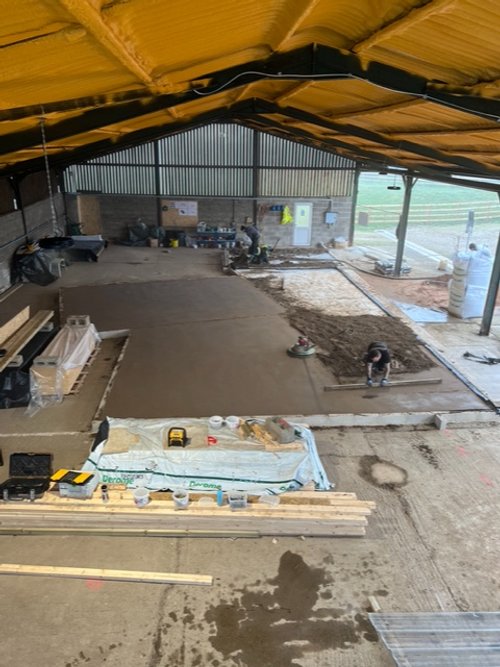
We are very pleased to see our Canine Wellness Centre project under construction by Sheltered Spaces.

Can’t wait to see it come to life (our dogs are looking forward to a spa day too!).


Planning application granted for Bølerveien 31

Thibaut Devulder

A rendered view of our proposed remodelled upper floor, overlooking the forest

We are delighted to announce that our remodelling and extension of a house in Bøler has been granted planning permission by Oslo Kommune.

The post-and-beam timber house, designed by architects Karlsen & Westbø
 in 1979, sits on a beautiful plot sloping into Bølerskogen, a wilderness reserve on the brink of lake of Østensjøvannet, in Oslo.

We are looking forward to finalising the detailed design and the interior design with our clients!


The sketch interior of the “skogsrom”, a new family room extending the ground floor, which we transformed into a parents’ wing

Portfolio project
Care Leavers' Accommodation

Tom Hughes

In August 2022, 2hD was involved in the early stages of a project for new care leavers’ accommodation, collaborating with Simon Middlecote Architecture. Our contribution was focussed on the research process and feasibility stage; with the ultimate aim of developing the design brief.

One of the several diagrams we produced for the study, here illustrating alternative accommodation types

Care leaves are young people aged 16 - 18 who have previously been in foster care, but have now chosen to live more independently. Care leavers’ accommodation acts as a bridging space where these young people can be self-sufficient and live alone, whilst being supported.

We researched case studies of many accommodation types, both past and present and found that most existing models have been found wanting.

One important issue in particular was that many are excessively institutional because of the way they foreground security, whilst others sacrifice safety measures to provide a more adult, independent environment. It was essential that we move on from these established patterns, in order to pinpoint the design challenges in the context of today’s social care.

Timeline for care leavers

Diagram illustrating the layering of security in accommodation

Their housing needs to have a careful balance between public, shared and private areas to provide security without seeming institutional.

Furthermore there is a wide range of support needed within this group that adds further complications. For example, some care leavers need provision that is similar to that of a childrens’ home, and on the other end of the spectrum some need near-total independence.

We arranged visits to existing care leaves’ accomodation to have meetings with staff and care leavers themselves to understand their needs and their views on how the accommodation could be improved. All the stakeholders of this project (such as the care leavers, social workers, staff and the local community) were consulted on their opinions and lived experiences.

The outcome of our work was a briefing document for Simon and his client that clearly identified the needs of the project stakeholders and the current context in which the project design will develop.


Converting a barn into a Canine Wellness Centre

Tom Hughes

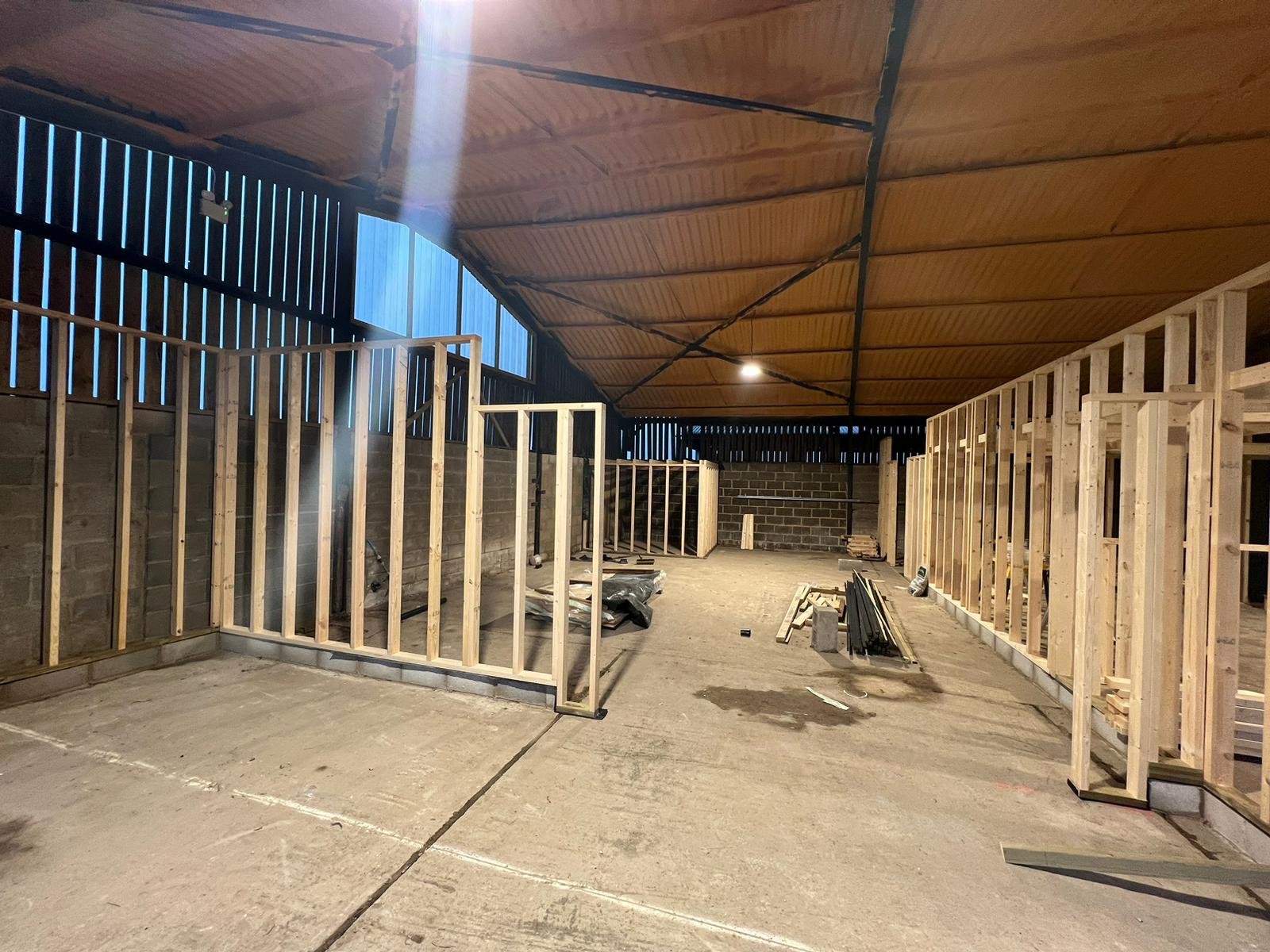
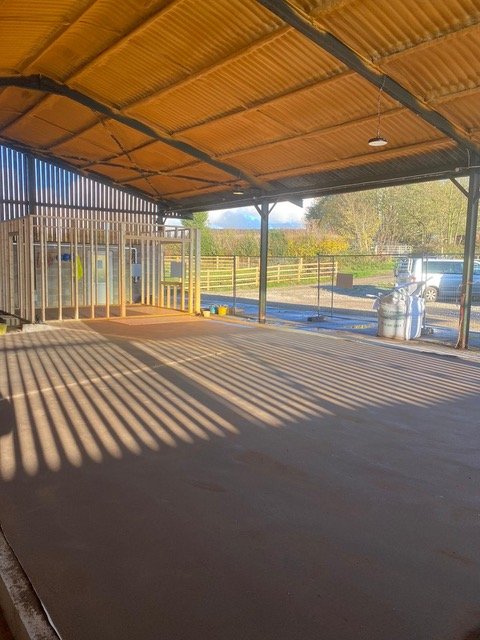
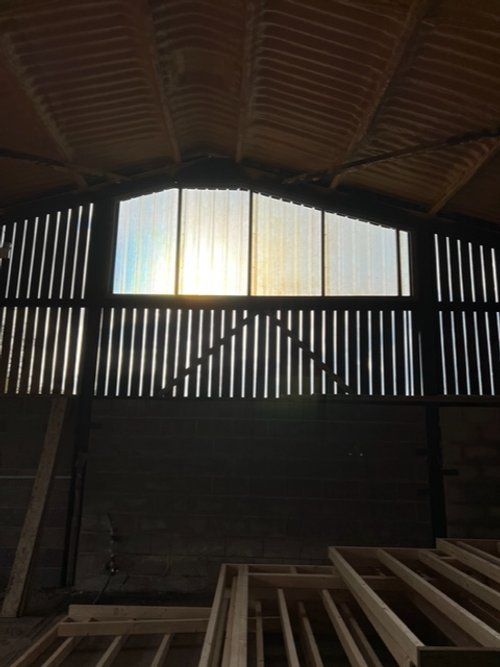
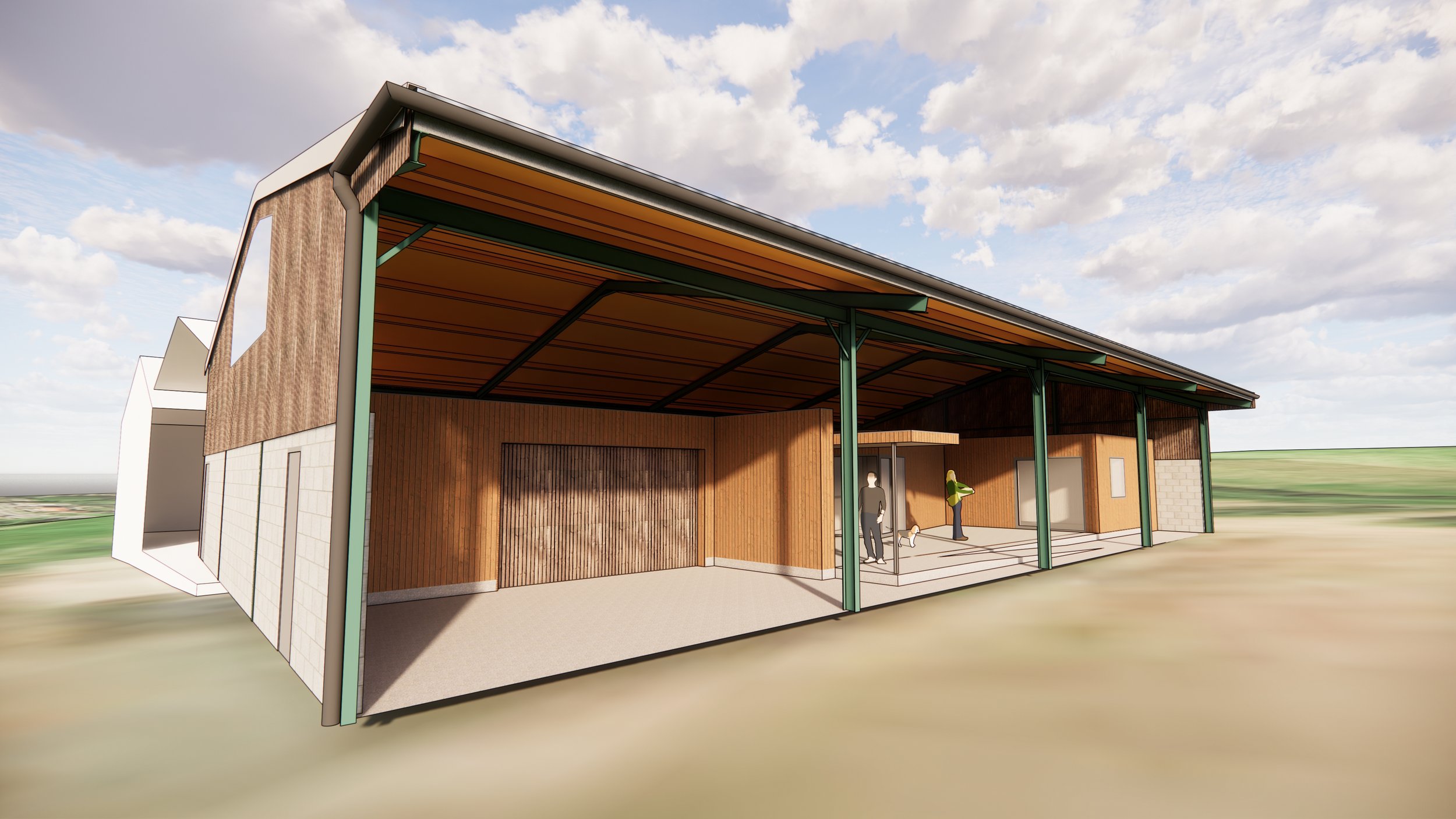
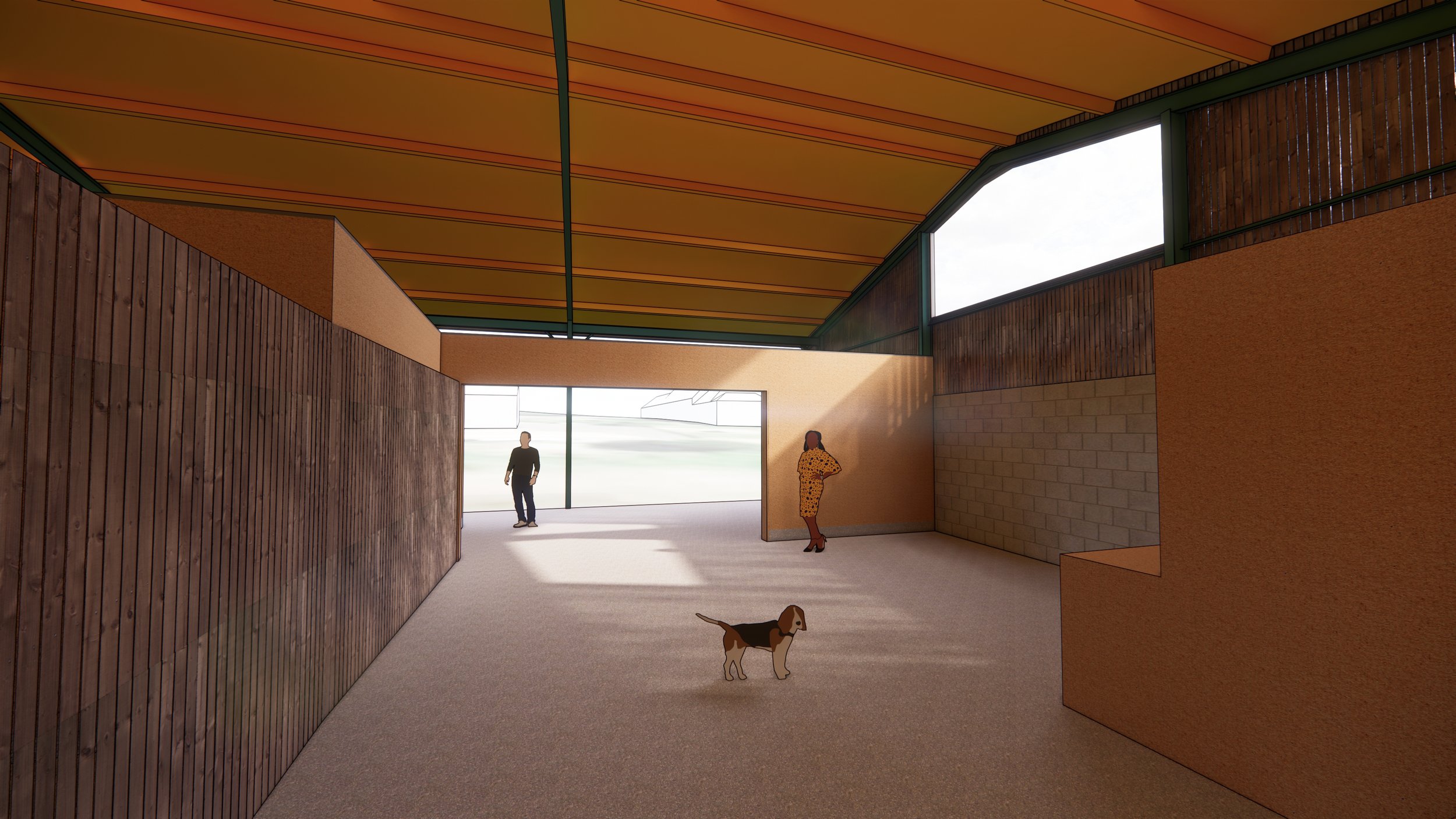
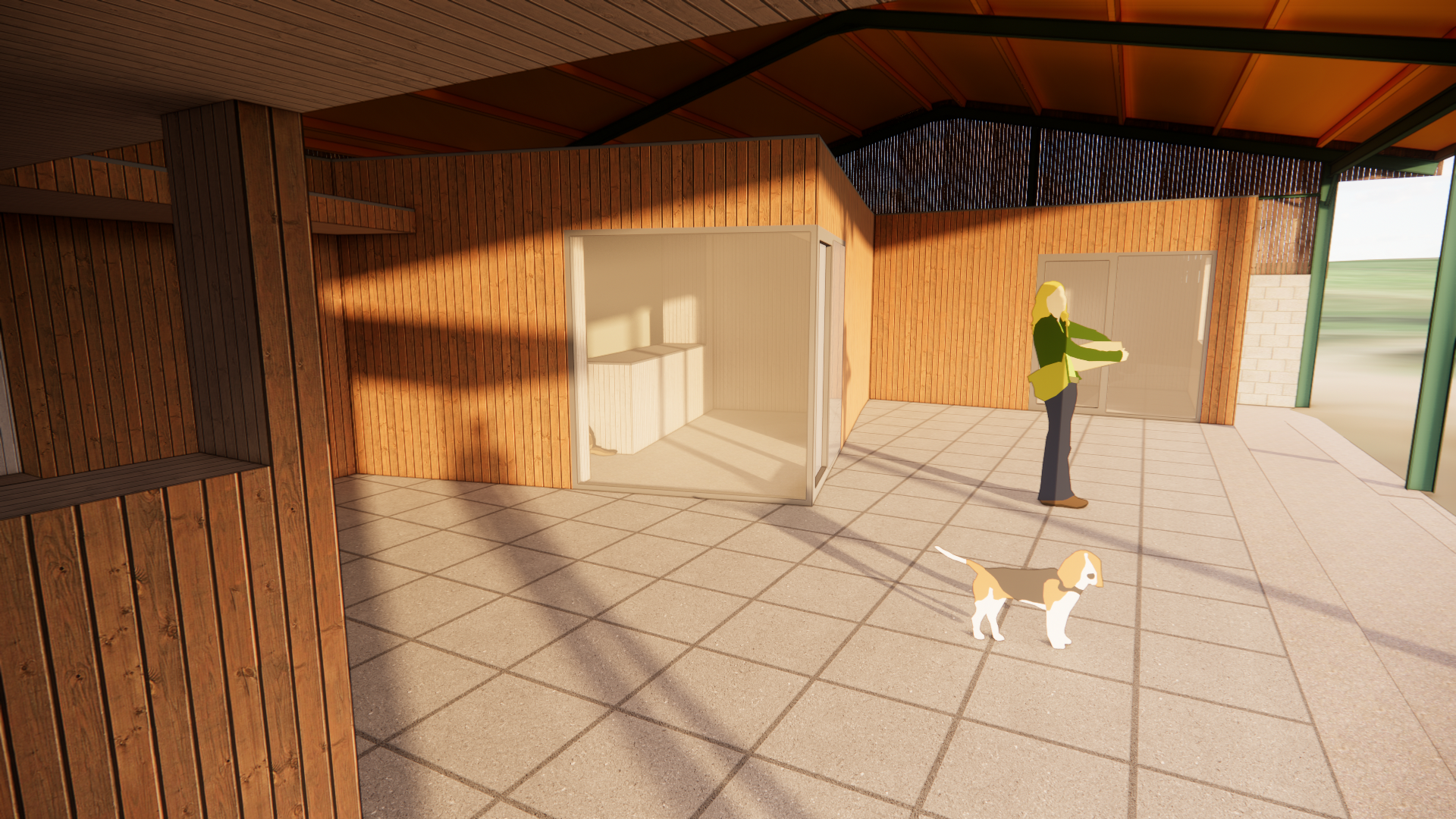
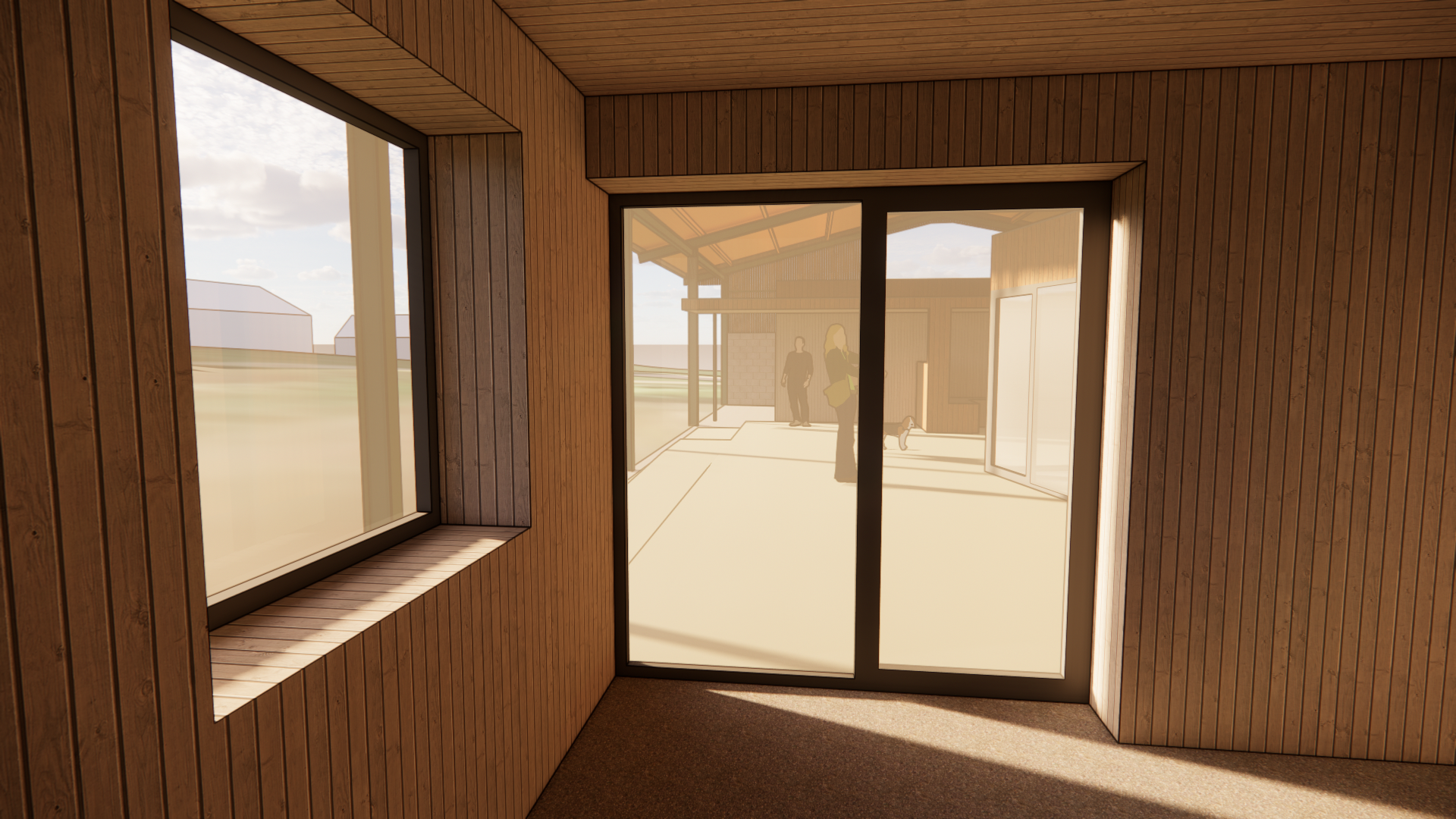
We have just completed this sketch design for a Canine Wellness Centre. Converting an existing steel framed agricultural barn, this change of use is enabled by Class R permitted developments — which allow agricultural buildings to be converted for flexible commercial use.

Do you have a barn you think could be developed?

3D-printing models

Tom Hughes

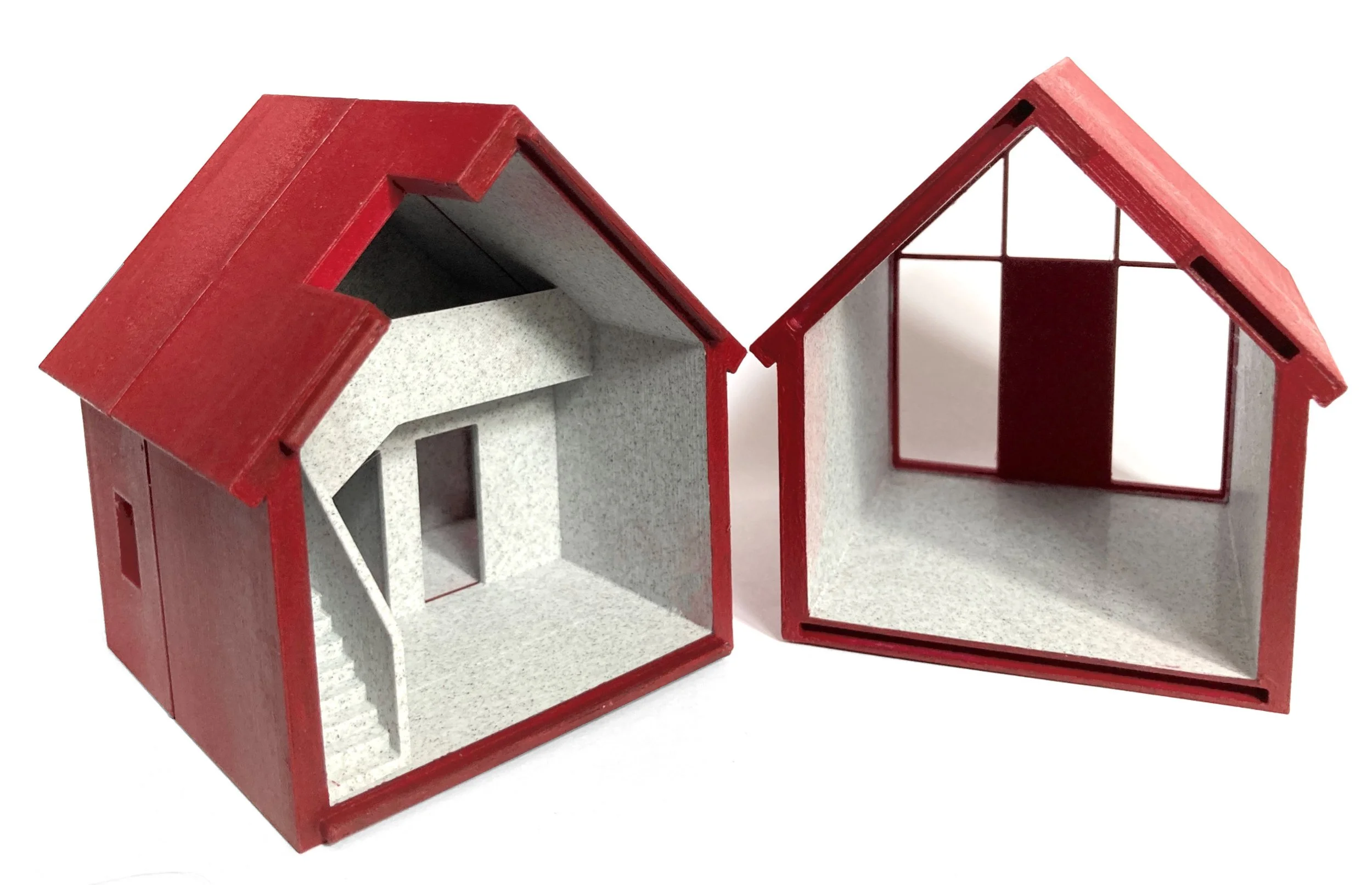
Although 3D software are essential tools at 2hD, we also love to make physical models — which have proved invaluable for communicating ideas to clients. Unfortunately, they can be time-consuming to make and we have recently missed using them as part of our design process. Could 3D printing be a solution?

I bought a Prusa MINI+ 3D printer, using a recent teaching award from Nottingham Trent University. The NTU architecture course has a real emphasis on hands-on making and craftsmanship, in conjunction with digital skills. Learning how to use the printer will bring benefits to both my practice of architecture and my teaching, allowing us to explore a range of ideas that we couldn’t before!

One of the Capybara trial prints

The results of our initial trials to learn the technology were interesting, to say the least, but after a few slightly strange capybara models made for my youngest daughter, I think I was getting there!

2hD is also part of a team brought together by Tristan Hessing of Future Makers, looking into the recycling of waste plastic in design and architecture. We don’t believe in creating waste, so we are very interested in using recycled filament in our model making.

Following on from my award for innovative ideas in construction, one of the things we are considering at the moment is the 3D-printing of complex junctions in buildings. And if we can use construction industry plastic waste to create these building components, we’ll be part of a truly circular economy.

Tom's teaching awards

Tom Hughes

I am a senior lecturer on the architecture course at Nottingham Trent University and am proud to say that I’ve been nominated for and won a few awards there recently.

The last couple of academic years have created enormous pressure for the staff and students as we’ve all had to adapt to Covid-19. It was great in 2021 to have my work on the integration of online learning and teaching techniques recognised with a Teaching and Support award from the School of Architecture, Design and the Built Environments (ADBE).

I learnt later this year, in April 2021, that the students had nominated me for a Student-Led Teaching Award, and, in July, I was awarded a second ADBE Teaching and Support award, this time specifically for my pastoral support and coaching of students.

This last award recognised the pastoral support system I put in place using Microsoft Bookings to create a “virtual open door” for students. It turns out that returning to face-to-face education has created almost as many pressures as did lockdown, so I’m happy to have helped in some way to mitigate the problems for some of our students.

Hands-on with traditional arch masonry

Thibaut Devulder

A dry stone arch built during the course, under testing!

While working on the restoration of century-old stables in central Oslo, I was invited to take part in a practical workshop on traditional arch masonry. The course was organised by the Norwegian Heritage Association (Fortidsminneforeningen) for mastermasons, handworkers and architects who are involved in the restoration of old masonry buildings in Norway.

We explored the complete process of building traditional stone arches, using both dry stone techniques and traditional brick and lime mortar masonry, Over five intensive days, we built from scratch five different types of arches, starting with the design and fabrication of the formworks, the preparation and mixing of traditional lime mortar, the shaping of natural stones and, finally, the erection of the arches themselves.

This was a fantastic opportunity to learn new practical skills to develop our continued interest in historical buildings, as well as to network with talented craftsmen from all over Norway, for future collaborations.

You can admire the completed arches in Oslo’s Medieval park (Middelalderparken), next to the ruins of St Mary’s Church.

Ever dreamt of giving a new life to an old building?

Roof garden under construction

Thibaut Devulder

After getting planning permission more than a year ago , the roof terrace we designed on top of a residential building in central Oslo is finally under construction. The work on site is taking place under a “roof over the roof”, so that the construction of the new staircase and roof garden can take place with minimum disruption to the inhabitants.

Construction in progress: the demolished existing roof, under the temporary scaffolding cover…