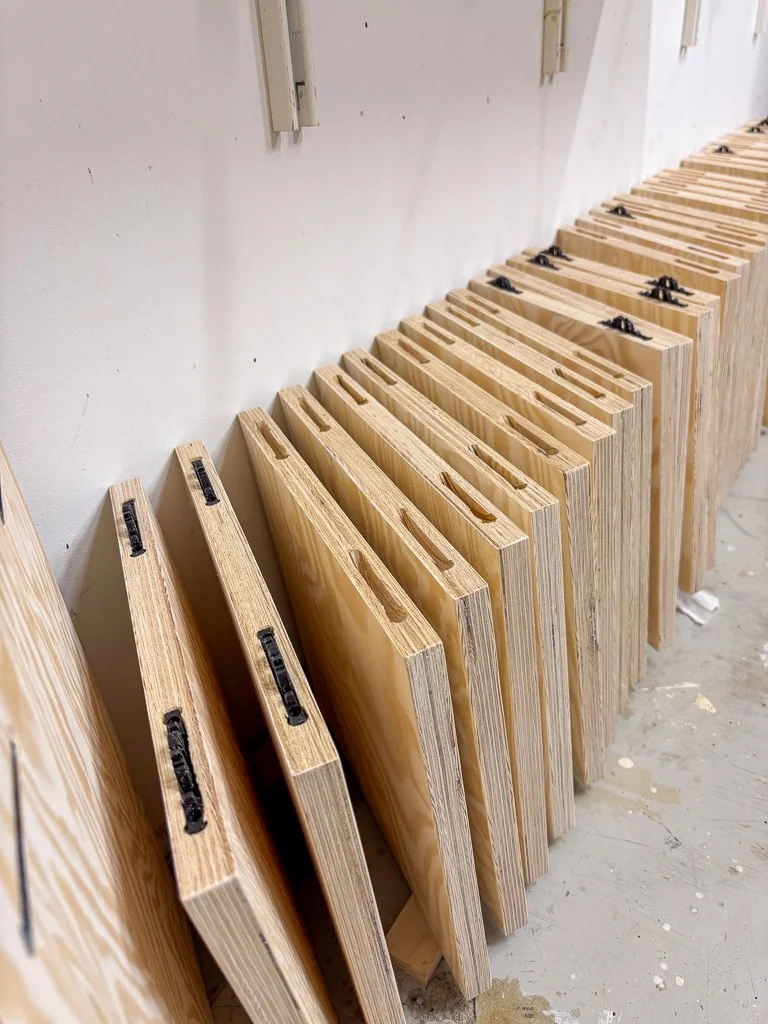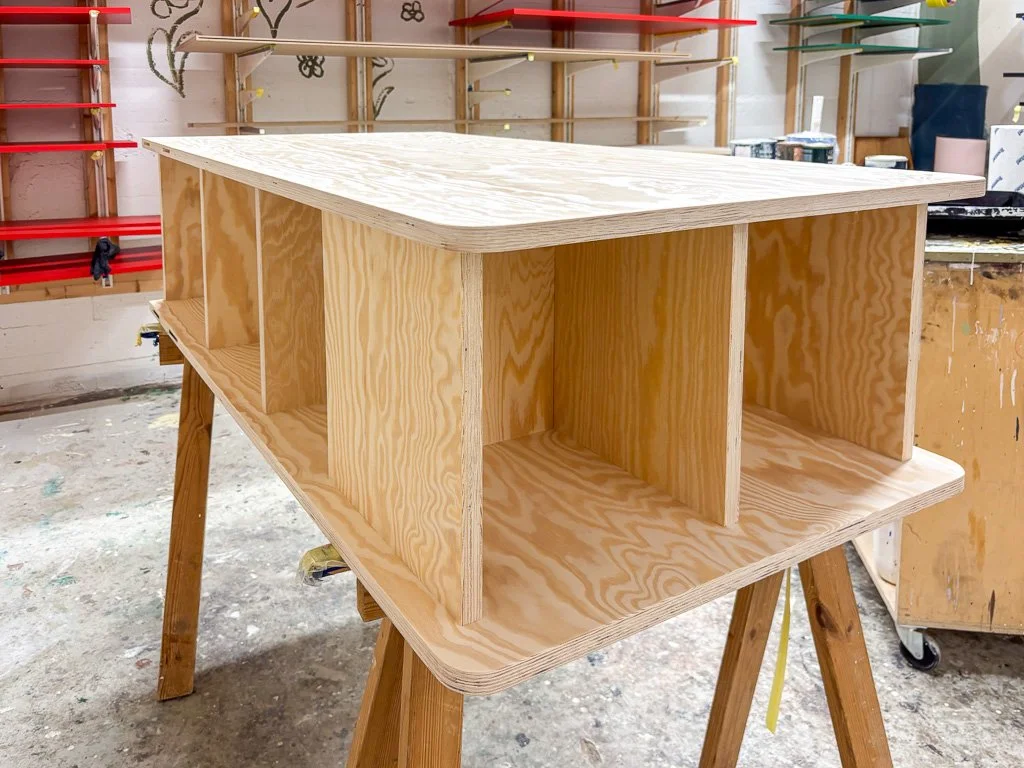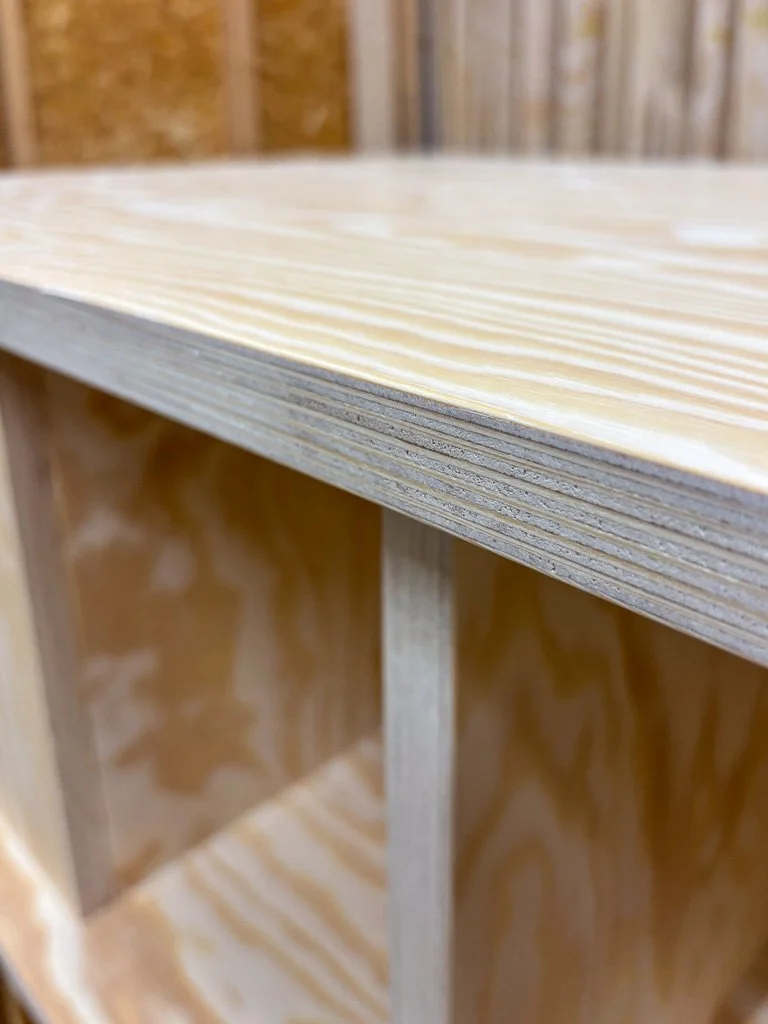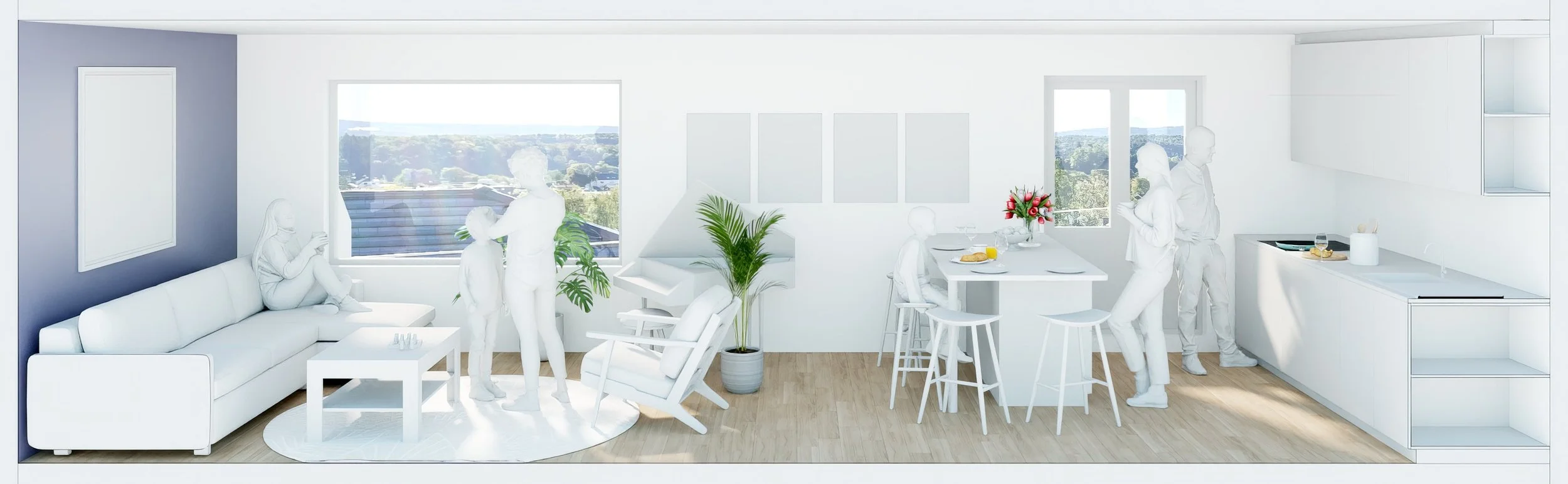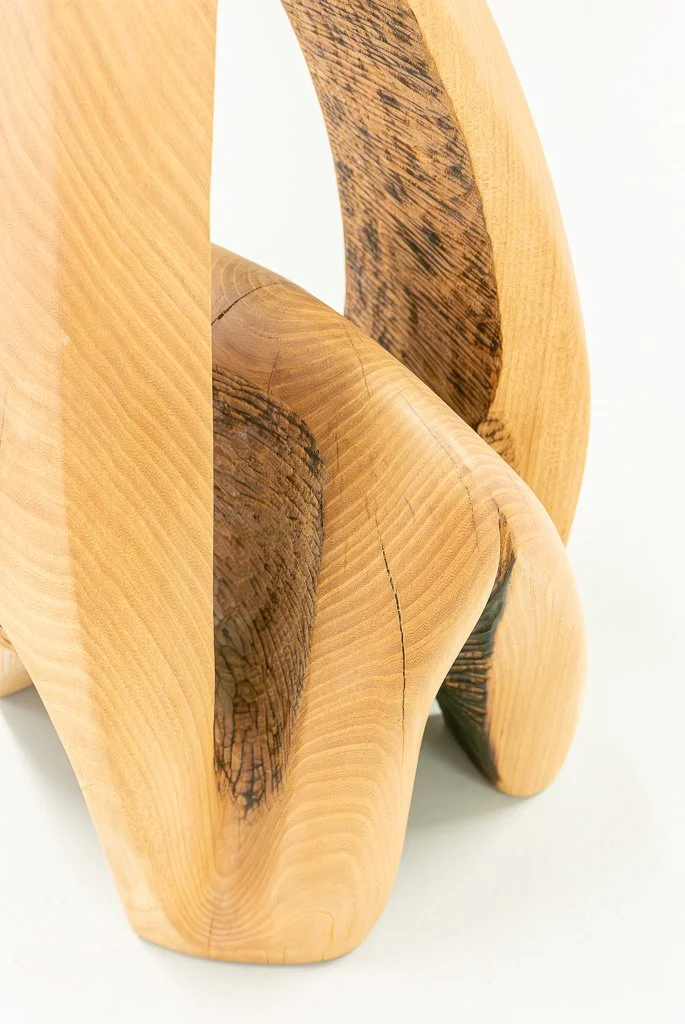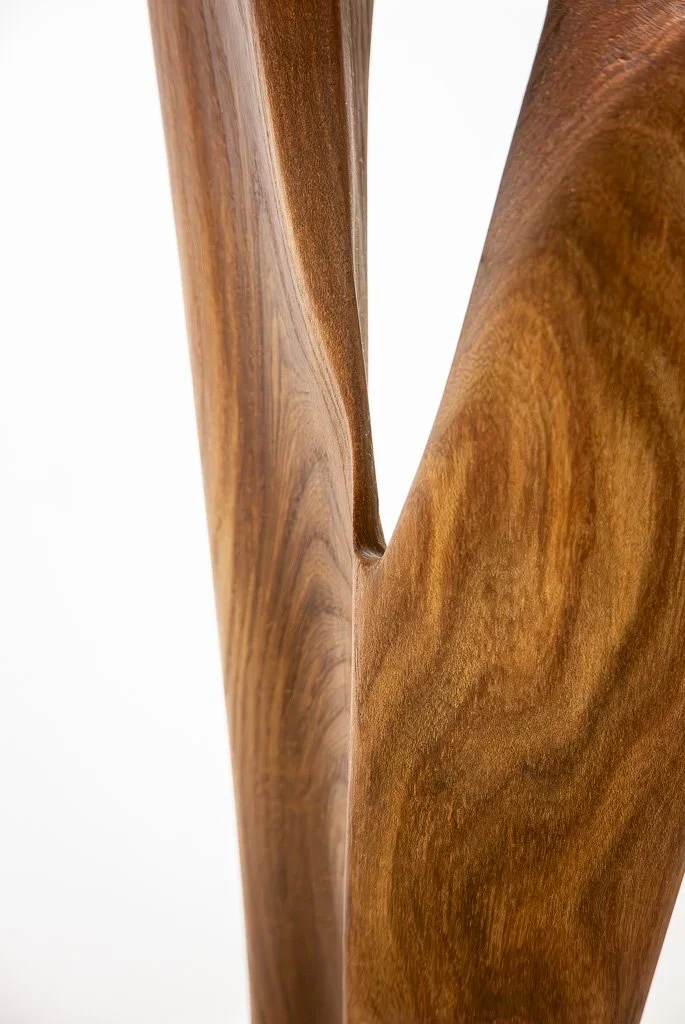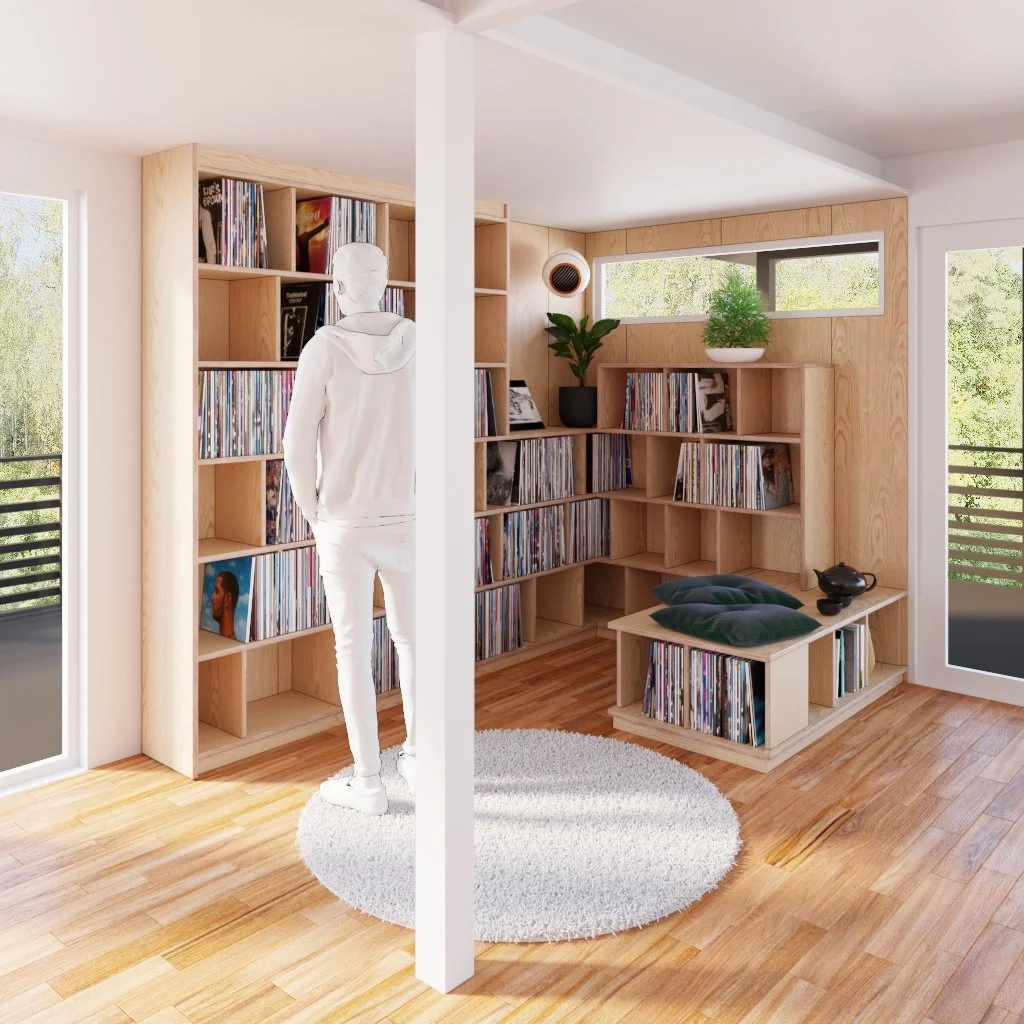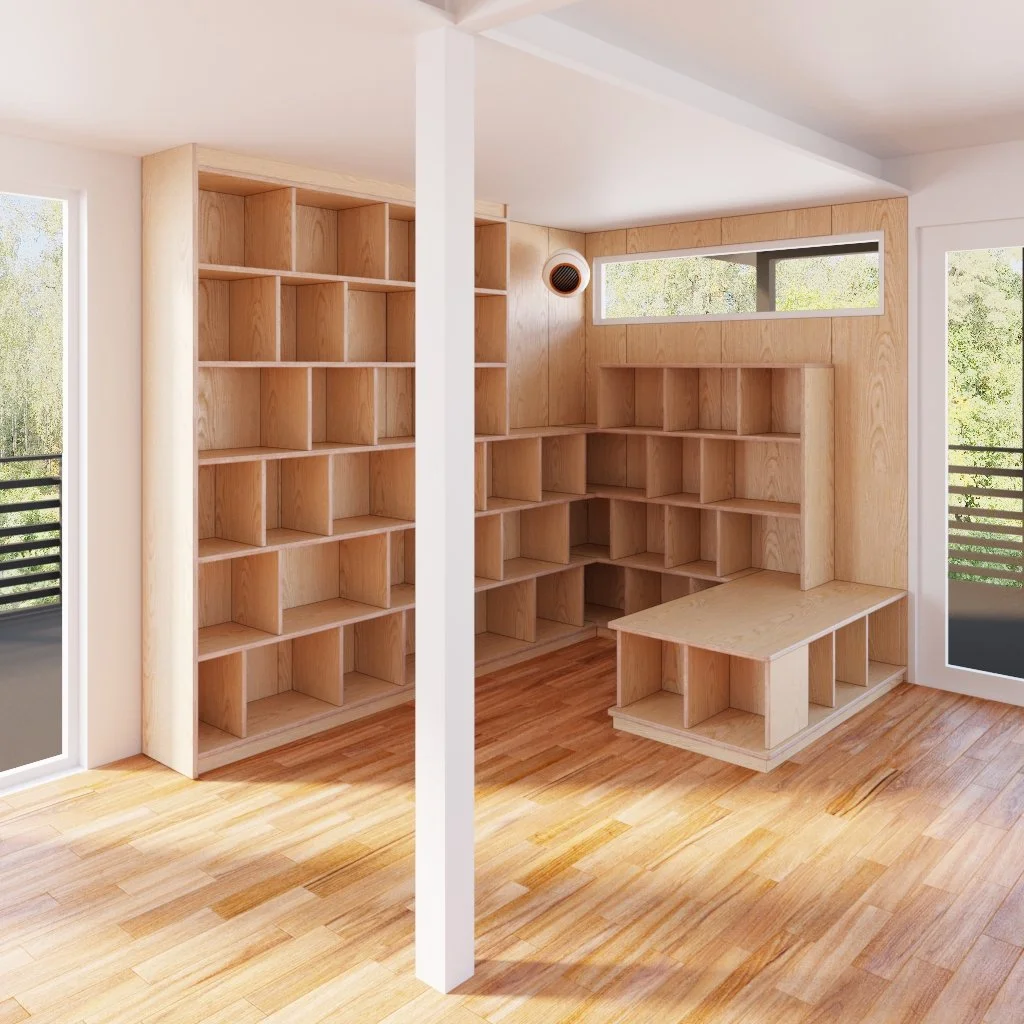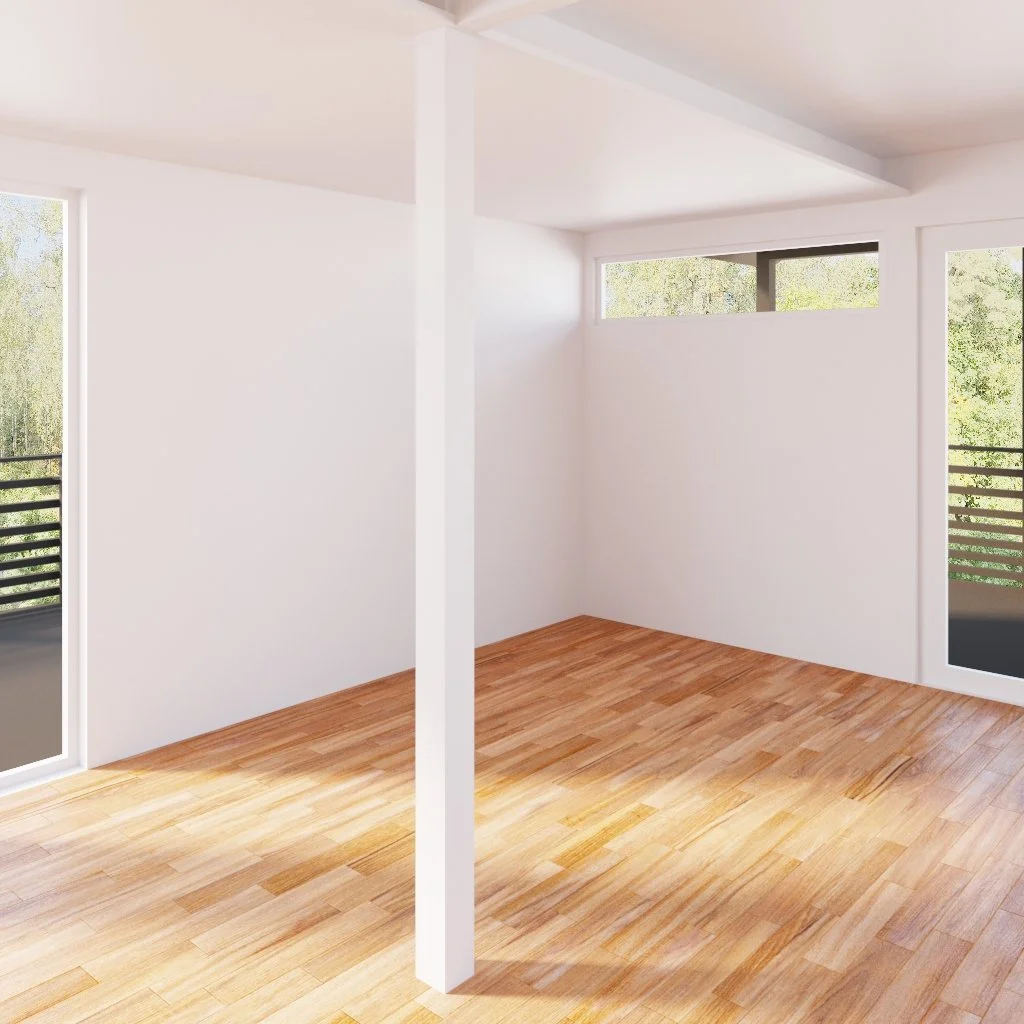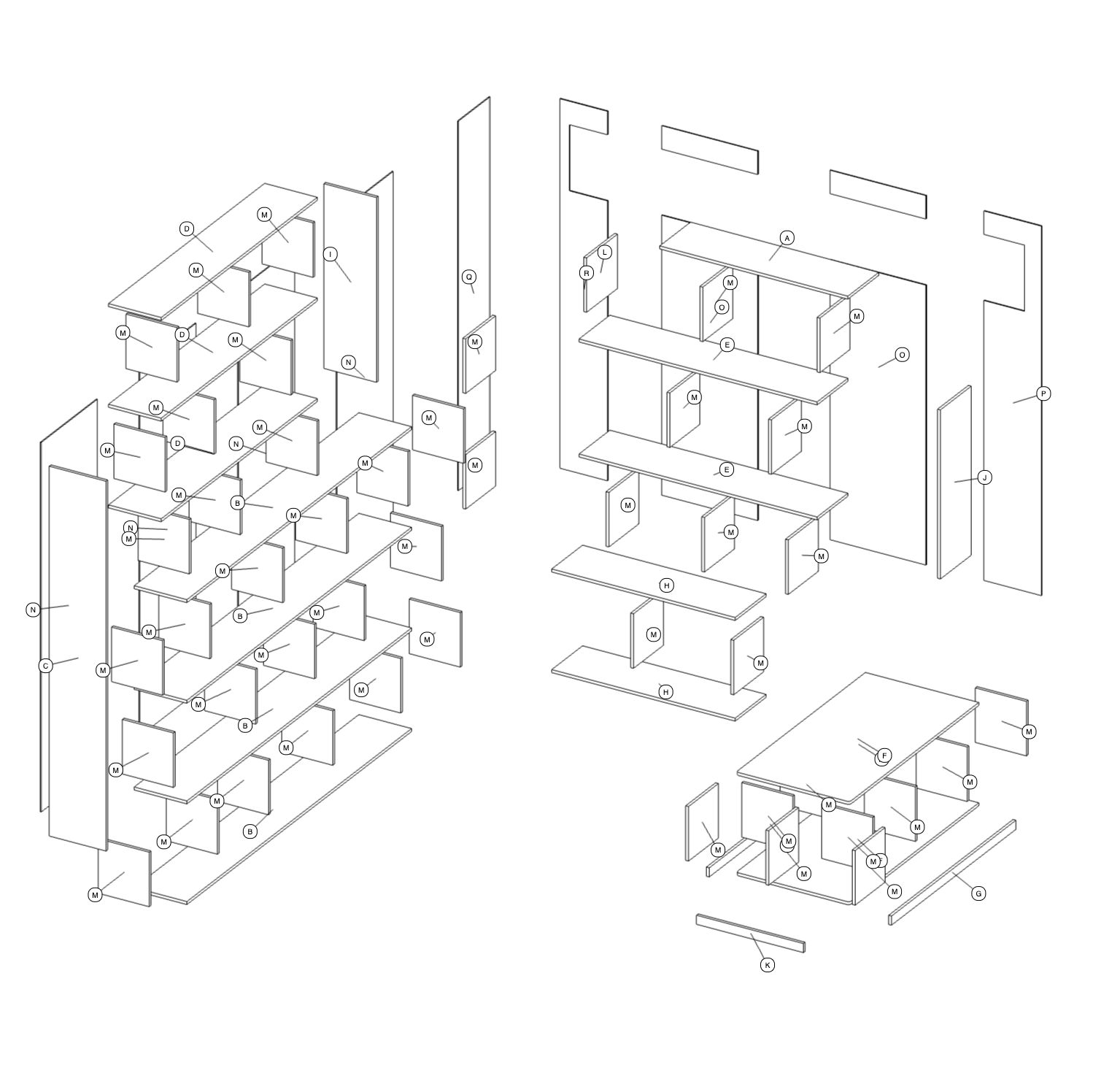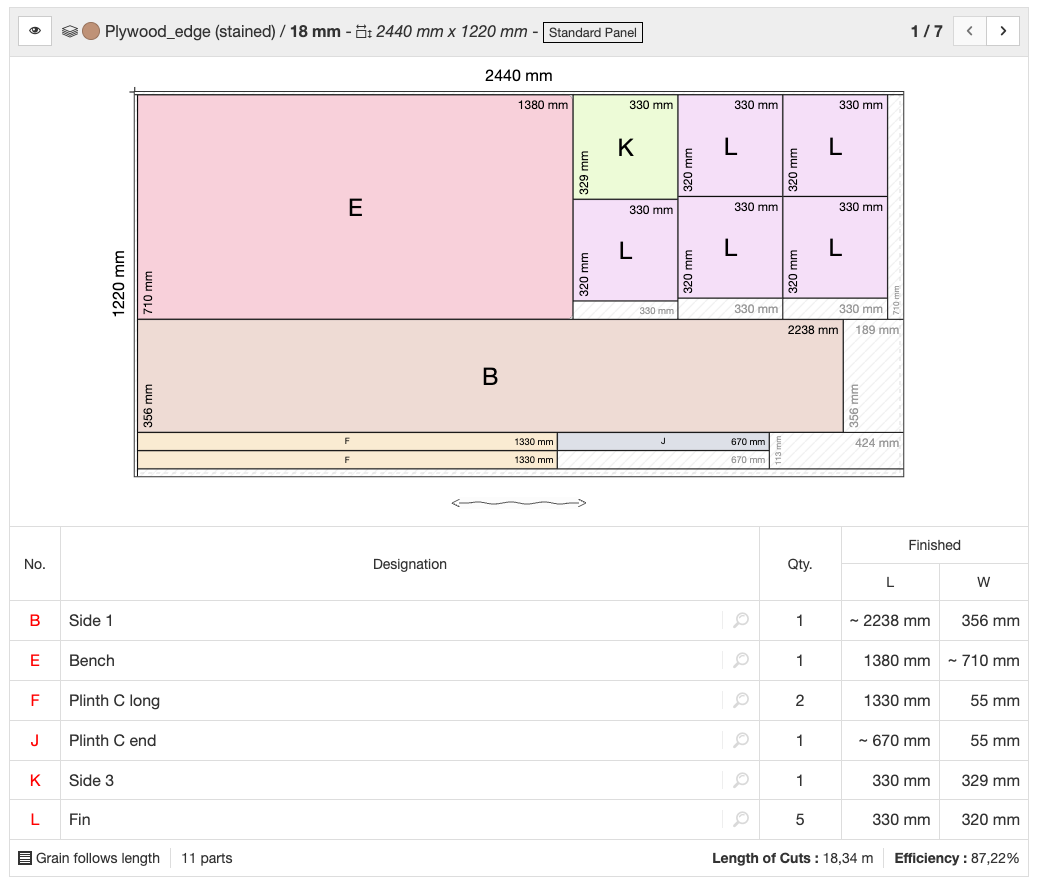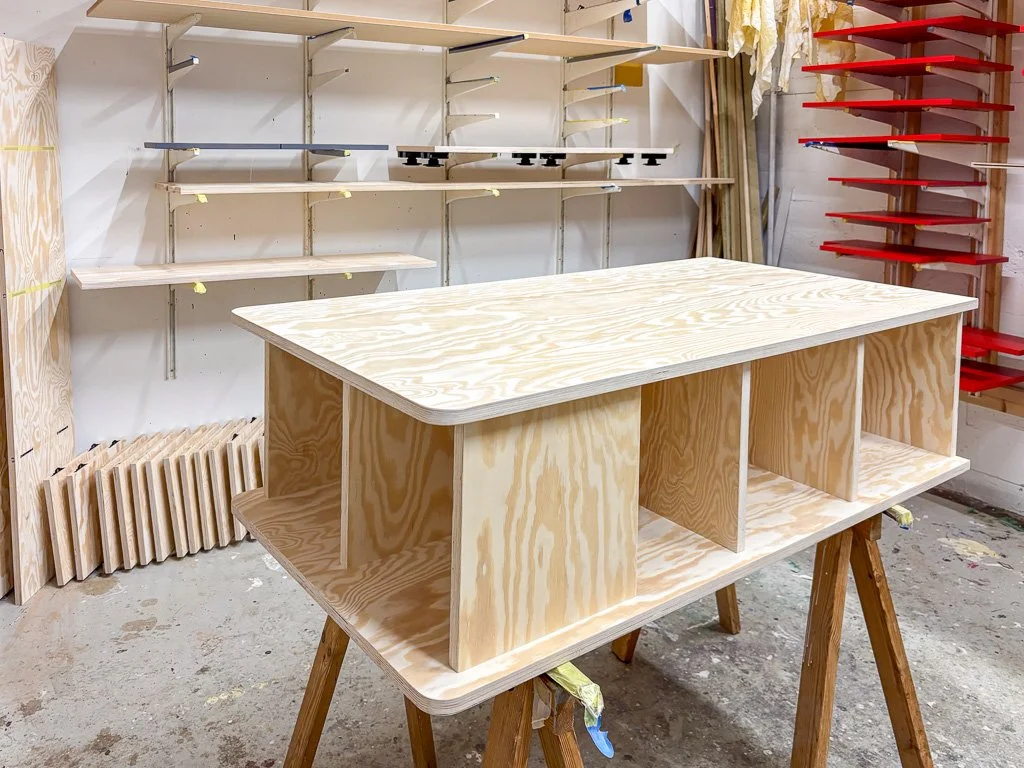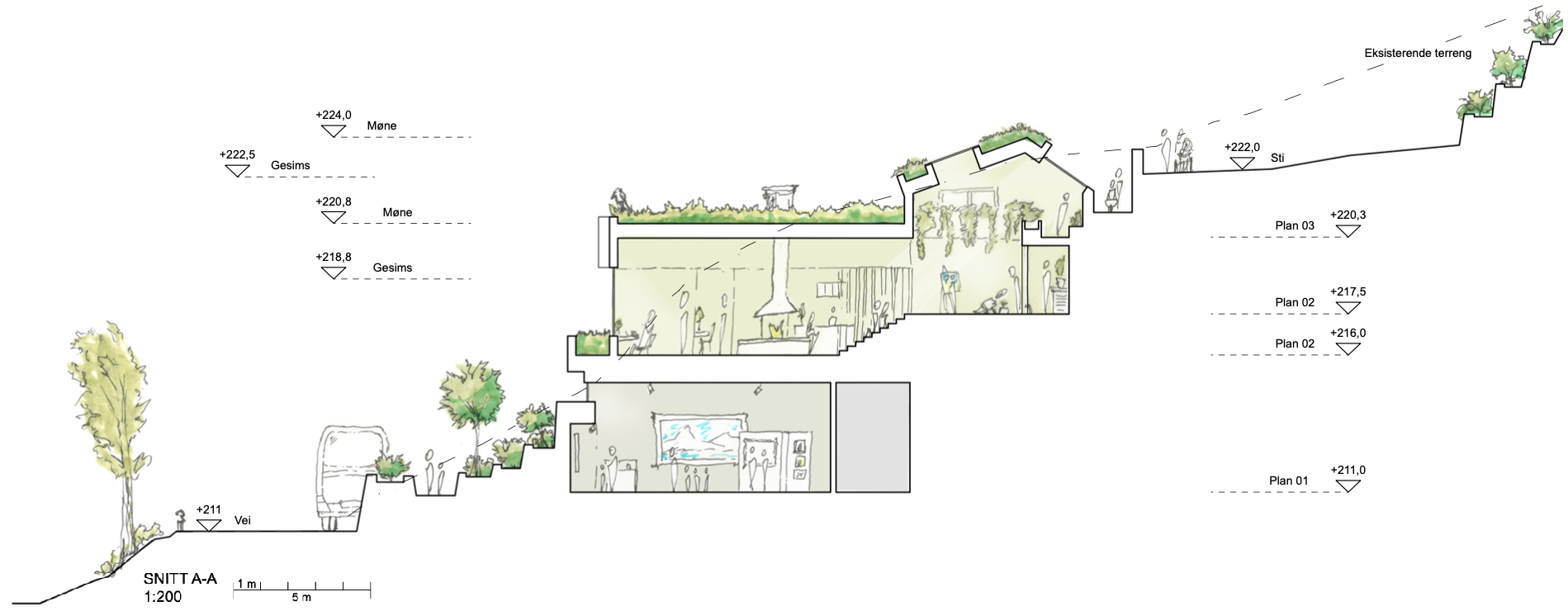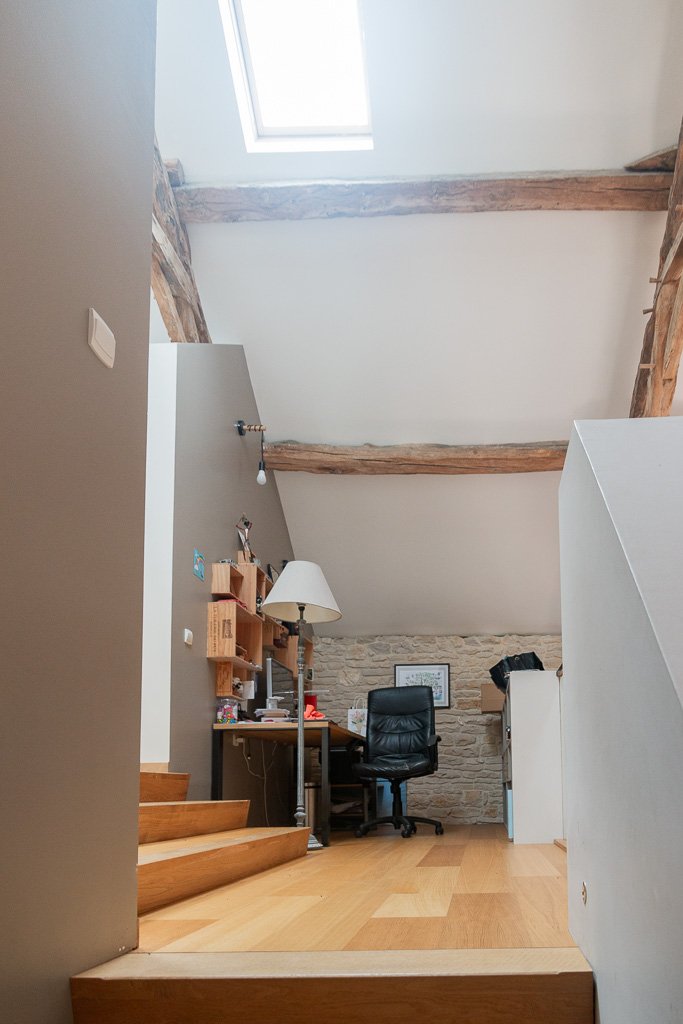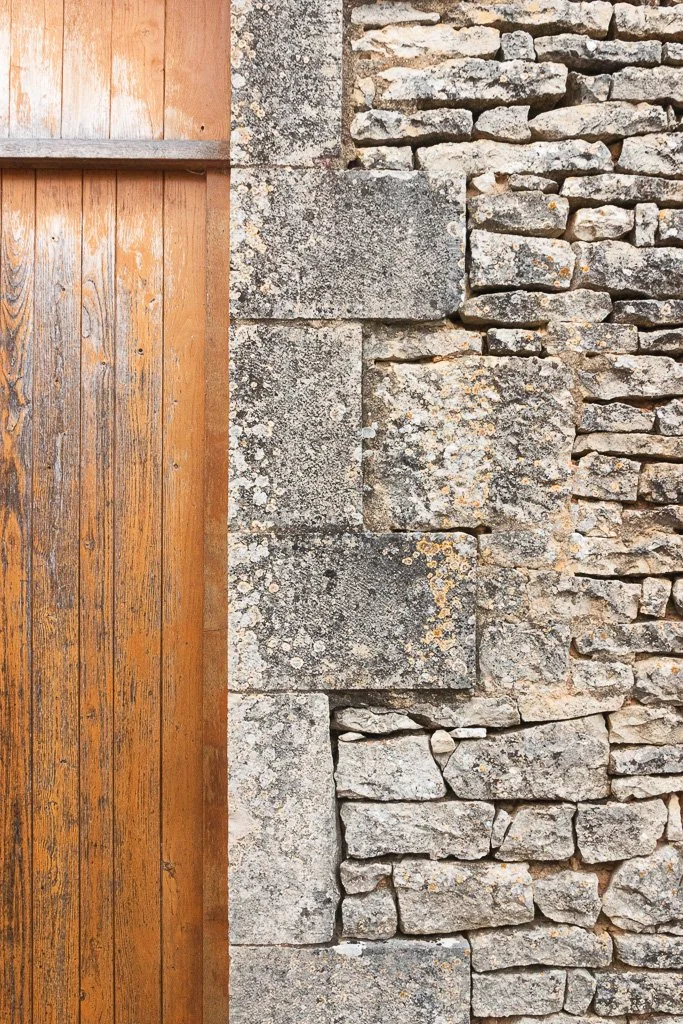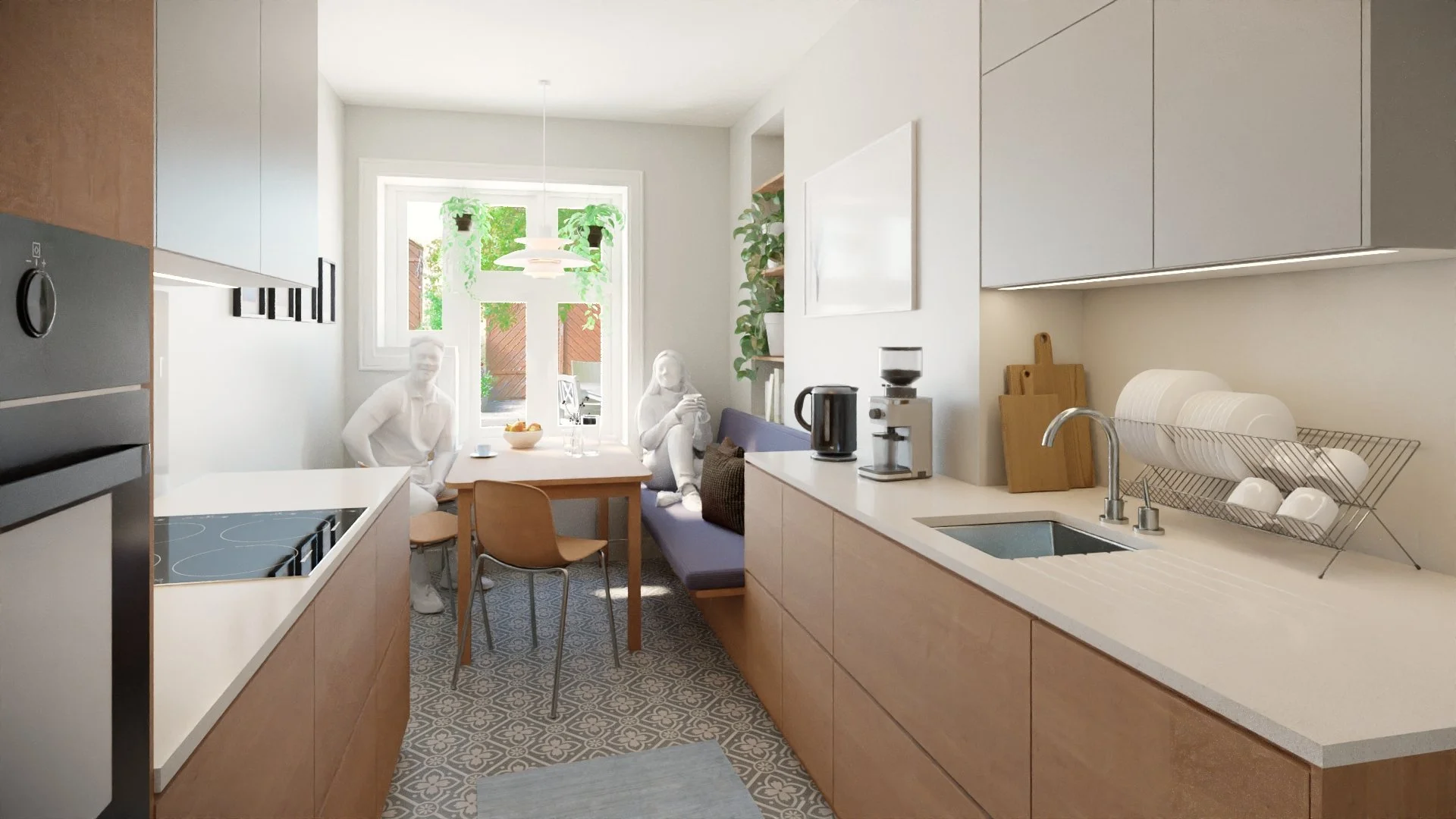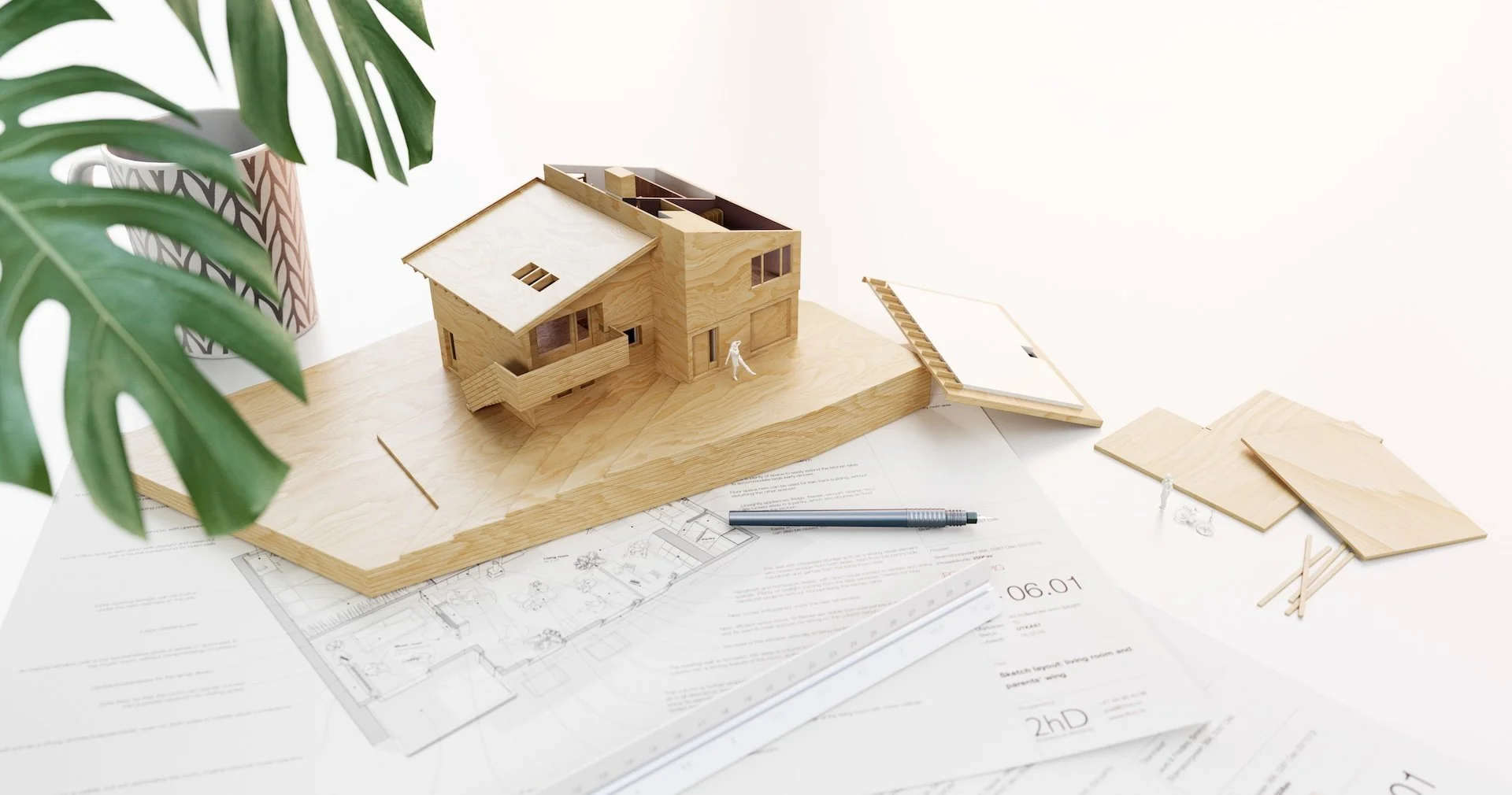
With the detailed design completed and a building contract signed, our remodelled apartment in central Oslo is ready for construction work to start April 2026.
Planning permission granted on Montebello-Hoff
We have been granted planning permission for our conversion and remodelling of a terrace house on the heights of Montebello-Hoff, in Western Oslo. Building work will start in April 2026.
Portfolio project
In memory of Frithjof Reppen
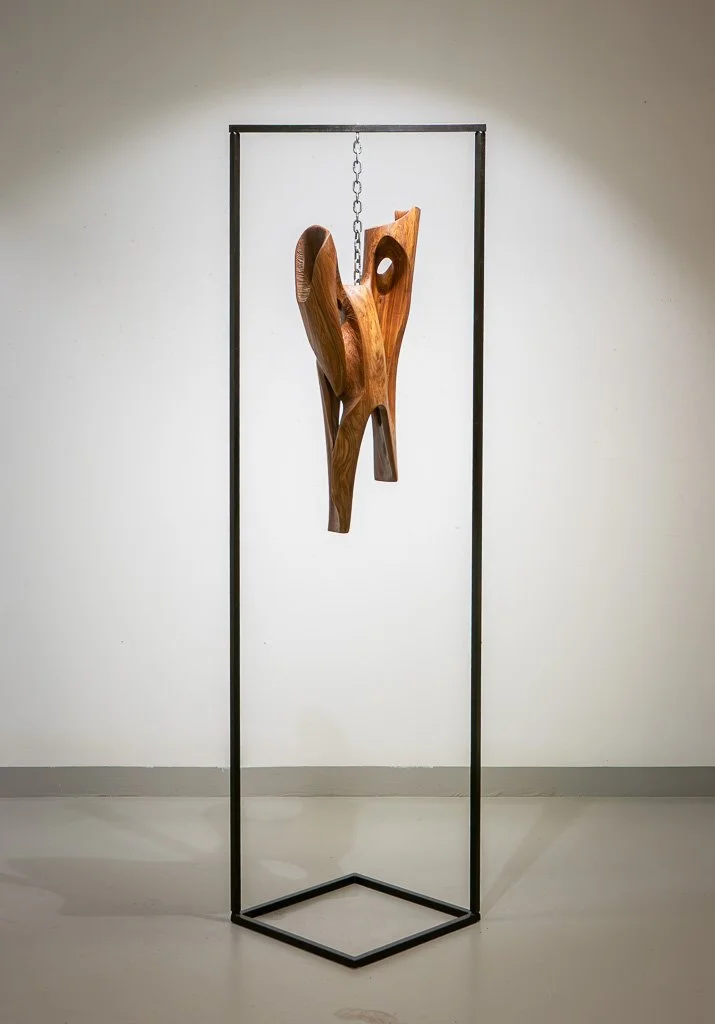
Our second collaboration for the Synergi exhibition in Oslo was with artist Carlos Martin, to create an engraved table as a memorial for Norwegian architect and resistant Frithjof Reppen (1893–1945).
One of the first Norwegian architects to introduce the modernist movement to Oslo, Reppen was arrested in 1941 and imprisoned for being part of a group publishing and distributing Jøssingposten, a newspaper opposing the nazi occupation. Deported to a concentration camp near Vienna, he was eventually shot dead by his captors in 1945.
The starting point for this installation was to transform an existing wooden picnic table, located in the garden of Reppen’s housing block on Professor Dahls gate 31-33, his most emblematic architectural project in Oslo.
With no apparent connection to Reppen, this mundane object — a standard garden furniture mass produced in cheap wood during the 1980s — was transformed into a receptacle for the memories of the residents of the housing block.
Detail of the engraved surface of the new ore-pine table
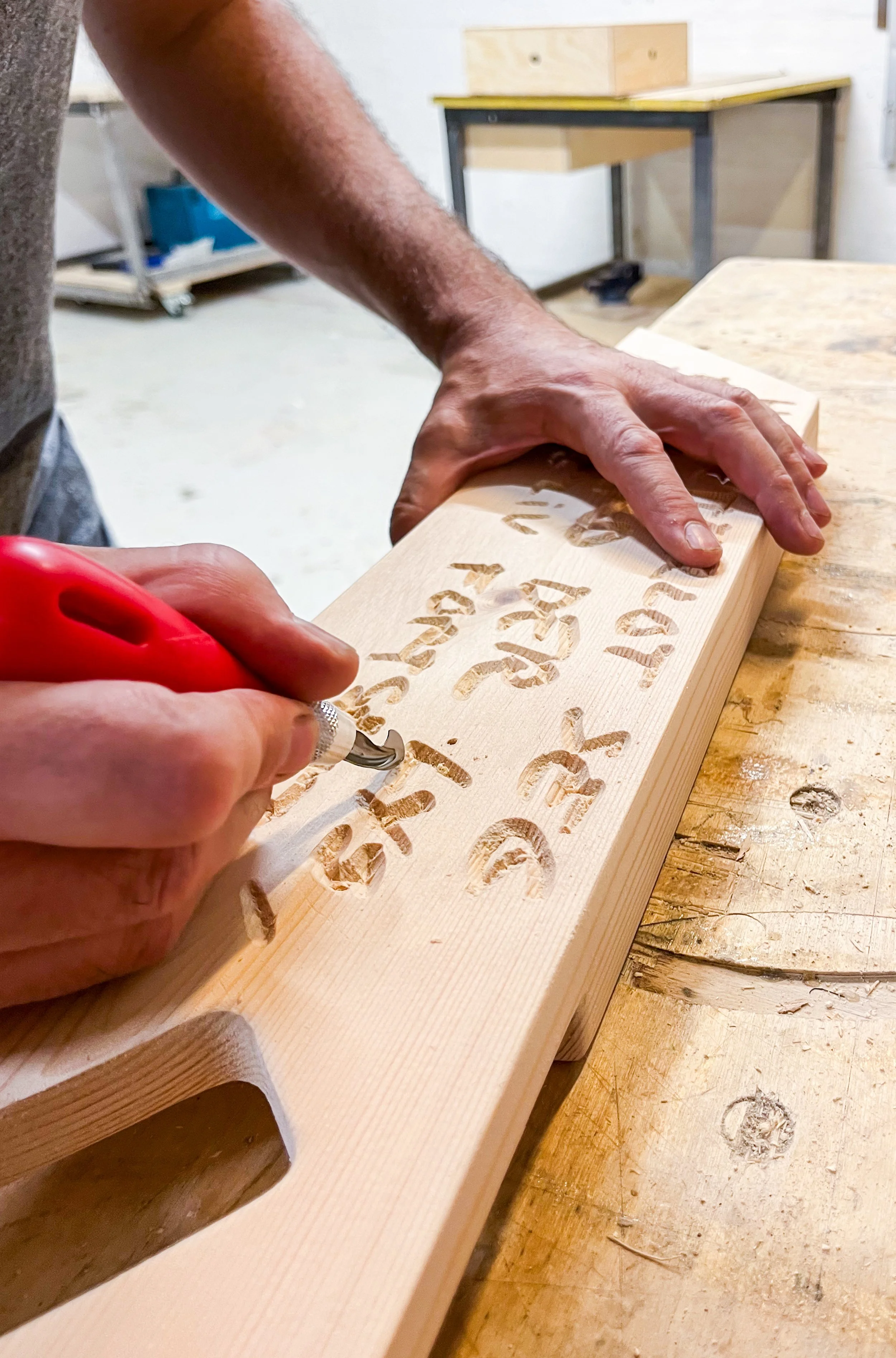
We then fabricated an exact copy of the existing table. But rather than using the impregnated wood of the original, the new copy was made with ore-wood (Malmfuru, in Norwegian), a cured heartwood from old-growth mountain pines, the same highly durable wood famously used in Norwegian stave churches dating back from the 12th century.
In parallel, the residents of the housing block were invited to reflect upon Frithjof Reppen’s history and to adorn the old table with their thoughts, using white paint markers. These writing were then digitalised and carved them into the new table, creating an identically engraved copy.
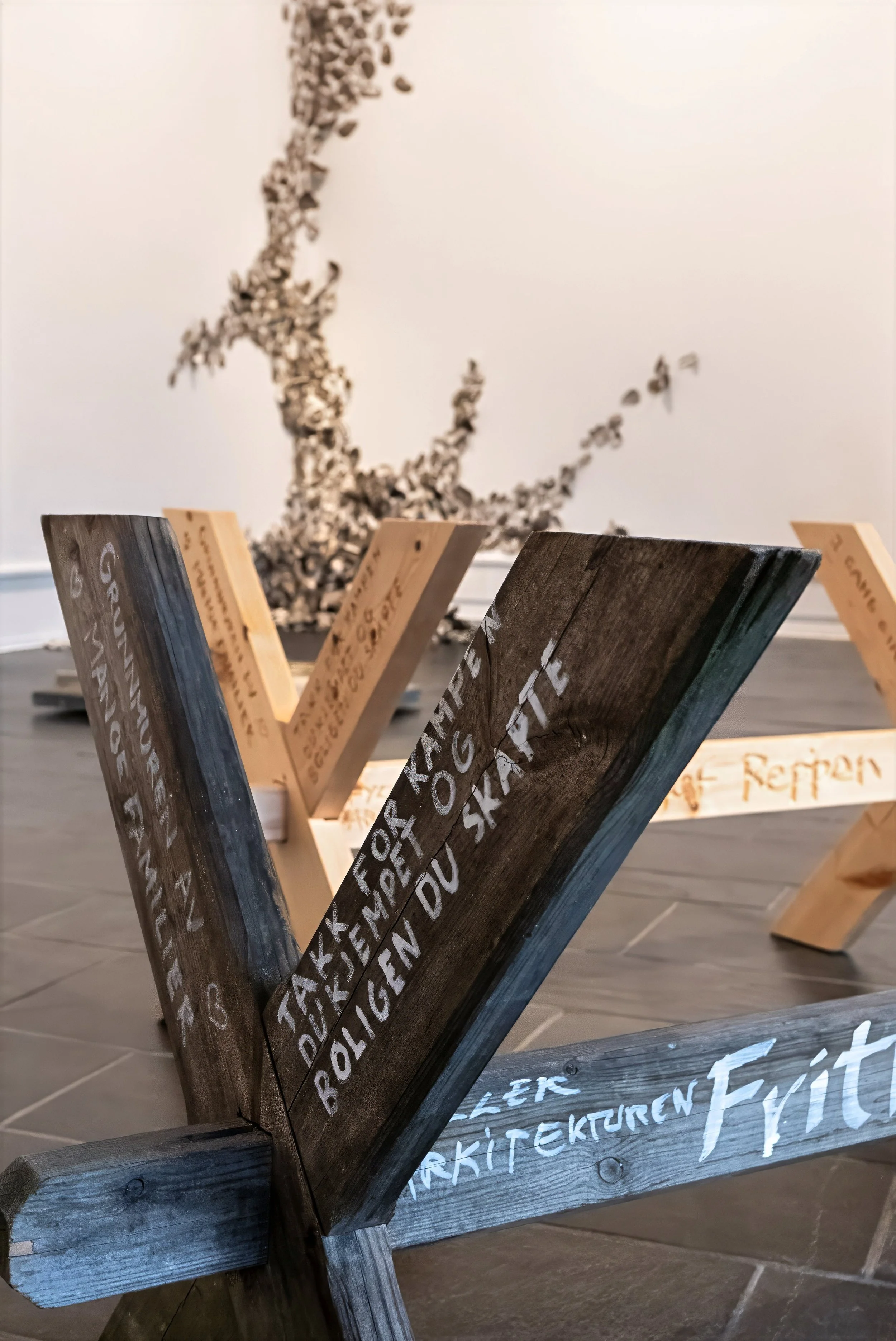
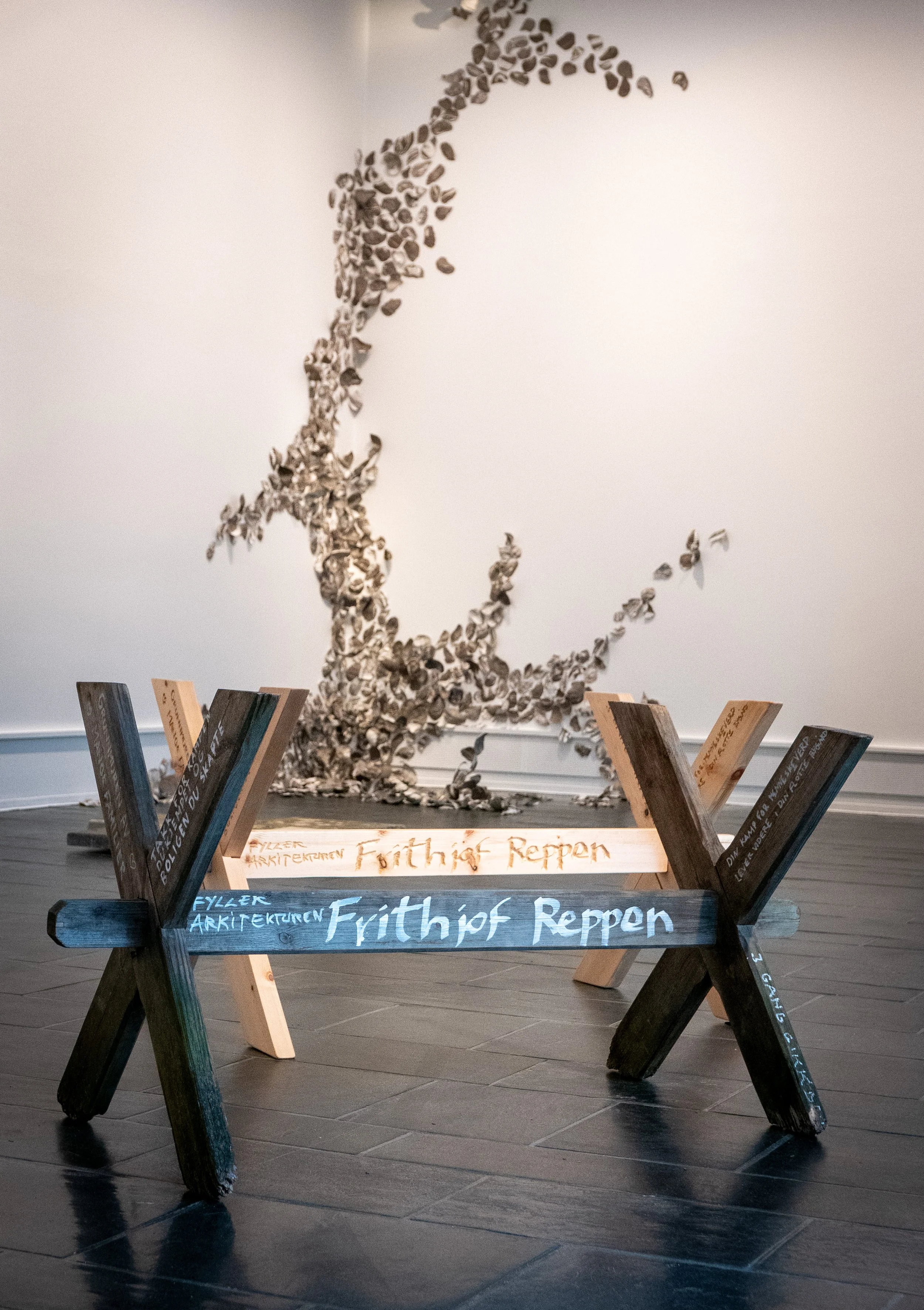
The exhibition presented the frames of the two tables side by side, collecting the story of Frithjof Reppen: the dilapidated old table with its paint writings, and our new, engraved ore-pine version.
A contrast between the mundane masss-produced picnic table treated with environmentally harmful preservatives, and the new identical table, with memories engraved into the historically relevant material.
At the end of the exhibition, the new table replaced the old one in the courtyard of Reppen’s housing block, and became the material support for a community-based piece of memory of architectural, political and social history.
Thanks
We would like to thank Kroloftet and Sameiet Professor Dahls gate 31/33 for their financial support, as well as Peter Magnus for his assistance during fabrication. The ore-pine was supplied by the excellent Svenneby Sag og Høvleri.
Nascence: the tactility of ceramics
As part of the SYNERGI exhibition, organised by Kroloftet, I collaborated with Swedish ceramic artist Amanda Krantz to create a multi-sensorial ceramic sculpture, titled ´Nascence´.
This is a continuation of my experiments in induced synæsthesia — when our senses overlap and weave into one another — through installations and performances that actively blur the boundaries between our visual, acoustic and haptic perceptions. Visually amplifying touch in Ooo-Ya-Tsu, shaping images with music in Symetriades, and now feeling soundscapes with the fingers…
This collaborative piece is based on the idea of combining sculpture, made from the residual clay from Kroloftet’s ceramic workshop, with mixed sound recordings from the process of reclaiming and reusing the material.
The clay recycling process itself involves gathering waste clays from used tools, filtering, dehydrating and kneading the materials together before reintroducing them, in its new amalgamated form, into the creative process of ceramic art.
Here are some images of the clay recycling process, at the ceramic workshop in Kroloftet:
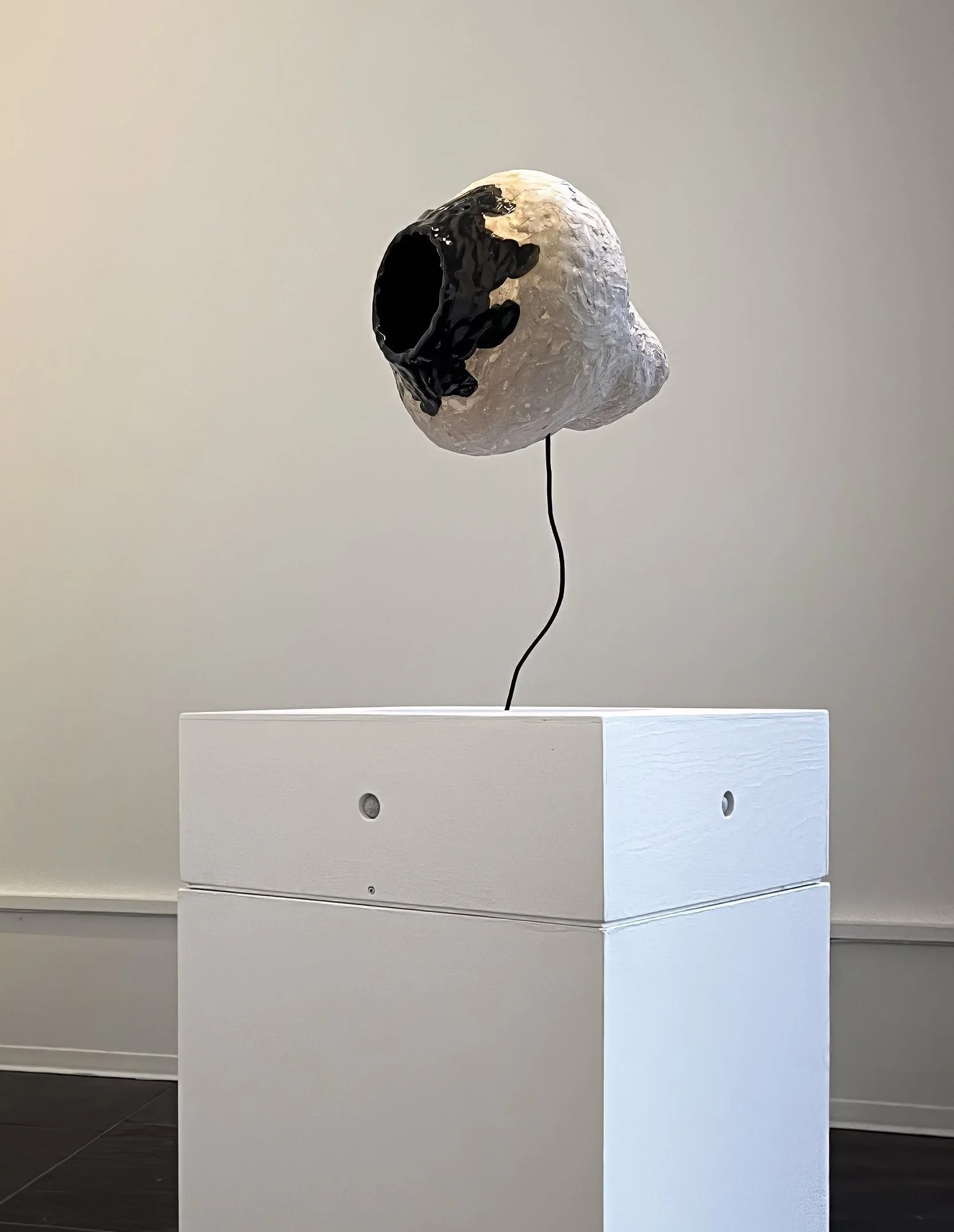
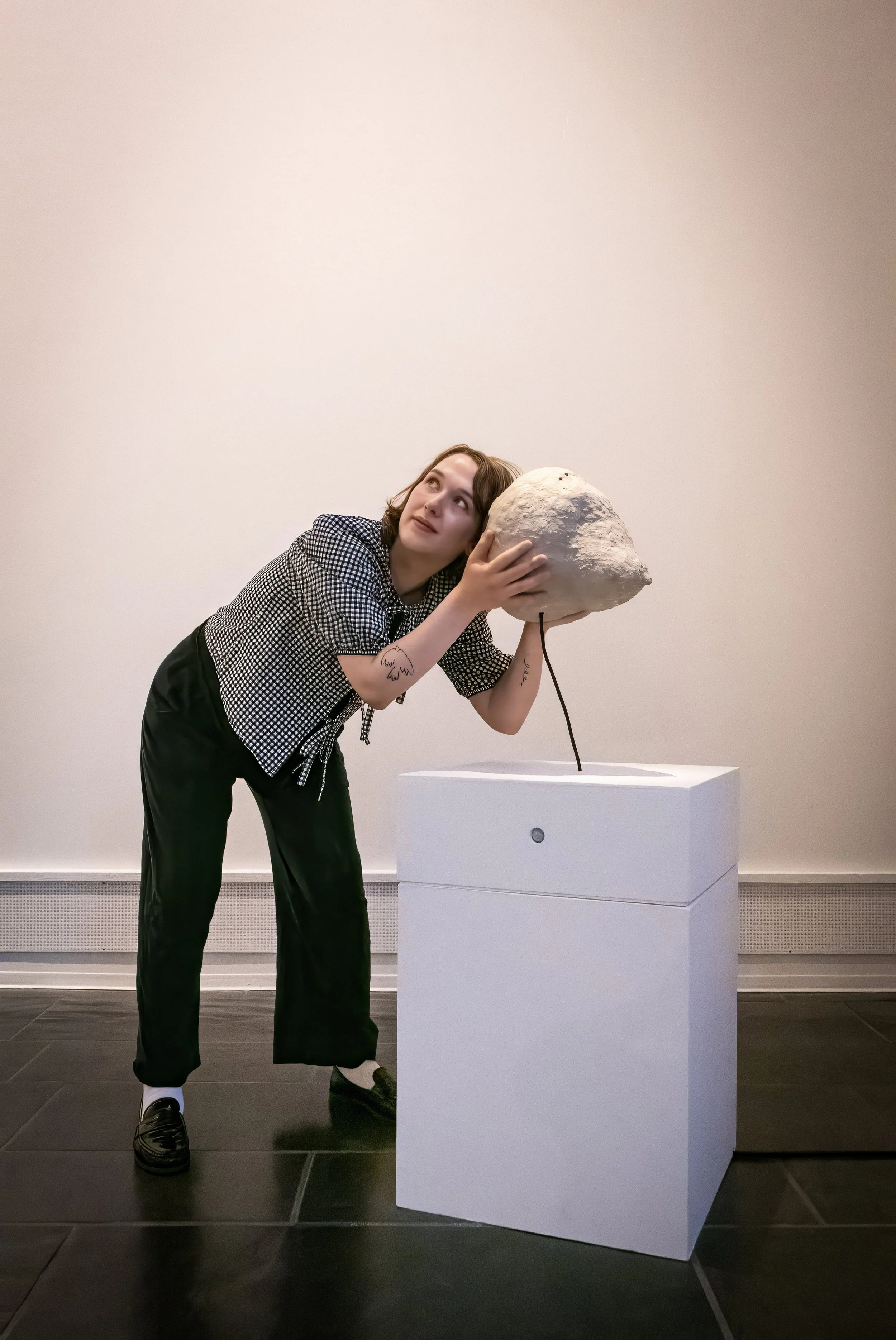
Our installation takes form as a ceramic vessel with the title ‘Nascence’, which alludes to the regenerative and physical aspects of the material and its relation to the body. The sculpture is levitating in mid-air over a pedestal, only connected to it by a thin textile umbilical cord. A small tactile transducer inside the sculpture softly vibrates it, conducting through its matter the sounds recorded during the clay recycling process.
Acting both as a sound filter and as a resonator, the ceramic vessel interprets and conveys elements of its own history and materiality. Nascence explores how the recycling process can be expressed by the ceramic object itself — beyond its visual appearance — through the tactile experience of the material and movement.
The installation reacts to the presence of a visitor, producing intriguing noises that lure you closer and encourage you to touch the clay vessel to explore its tactile qualities. Upon contact, you experience these sound vibrations through your hands, hearing them through your fingers, adding a new dimension to the touch.
As you bring Nascence to your ear, the feeling is reminiscent of seashells children hold to their ears to hear the sea: how much of the sounds you hear are traces of a forgotten past? A resonance of sounds in the space around you? The friction of your fingers holding the vessel? Or your own body pulsing in your ear?
Extract from the Nascence installation, Gamle Much Museum, Oslo, 2025
Nascence is on display and awaiting your touch as part of Kroloftet’s SYNERGI exhibition at the Gamle Munch Museum in Oslo, open until 21st September 2025. You can also discover more about Amanda’s fascinating work on her Instagram account.
Update: Nascence is exhibited in Kruttverket’s Glasshouse gallery until the end of November 2025!
Setting up the Synergi exhibition
Some images from the SYNERGI exhibition setup, at Gamle Munch Museum last week…
Vernissage of the Synergi exhibition
The new Synergi exhibition organised by Kroloftet opens at the Gamle Munch Museum on Friday 5th September. I have contributed two collaborative pieces to the exhibition, which will be on display until 21st September.
I have been working over the summer on this project, together with creative people at the Kroloftet collective, where our Norwegian office has its office and workshops.
Based on the concept of synergy, our exhibition will display 11 projects, each developed as a synergetic collaborations between creatives from different disciplines at Kroloftet, spanning across ceramics, architecture, poetry, photography, sound art, biology, woodworking, illustration, history, micro-edition and crystallography!
We kickstarted this concept four months ago with a fun “creative speed-dating” event: meet each person at Kroloftet for a 3-minute chat (with timer!) and explore new creative possibilities for cross-disciplinary art!
I will present two collaborative pieces:
Nascence — a tactile sound installation in collaboration with ceramic artist Amanda Krantz
Memory Table — a commemorative engraved wooden table celebrating architecture, community and the free press, in collaboration with artist Carlos Martin Román.
The vernissage is on Friday 5th September 2025 at 17:00 at the Gamle Munch Museum (former Munch Museum) in Oslo. The event and exhibition are free and open to all.
Come and join us!
Fitted floor boards
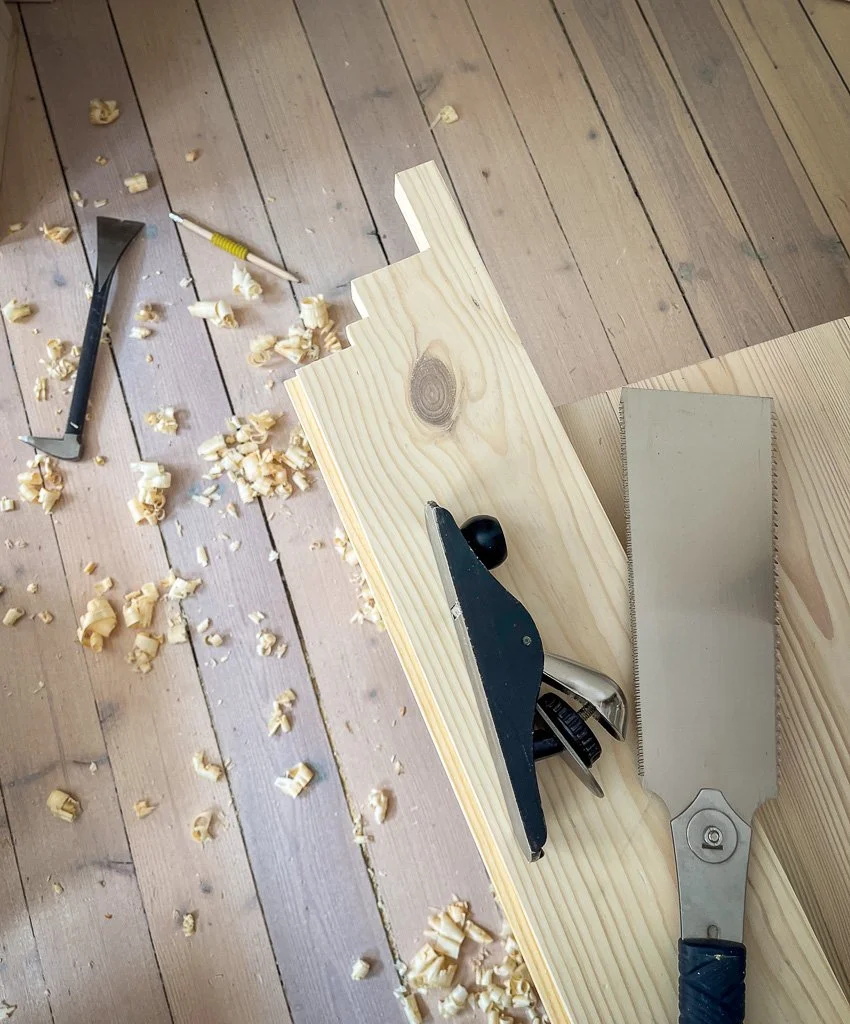
Some hands-on carpentry in a flat refurbishment in central Oslo. using hand tools.
Vintage shop opening at Gaarder Gård
All construction work and upgrade of the annex building at Gaarder Gård is now completed, and the new 7th Heaven Vintage shop — hosted in the transformed listed building — opened its door to the public this weekend!
We were responsible for converting this unused garage space into a commercial space in a listed building in the centre of Eidsvoll. Despite stringent conservation requirements for the facades and being located within the flood zone of the Vorma river, we successfully collaborated with our client and Eidsvoll municipality to secure planning permission, infusing new life into an otherwise abandoned urban space.
Visualisation for new build house
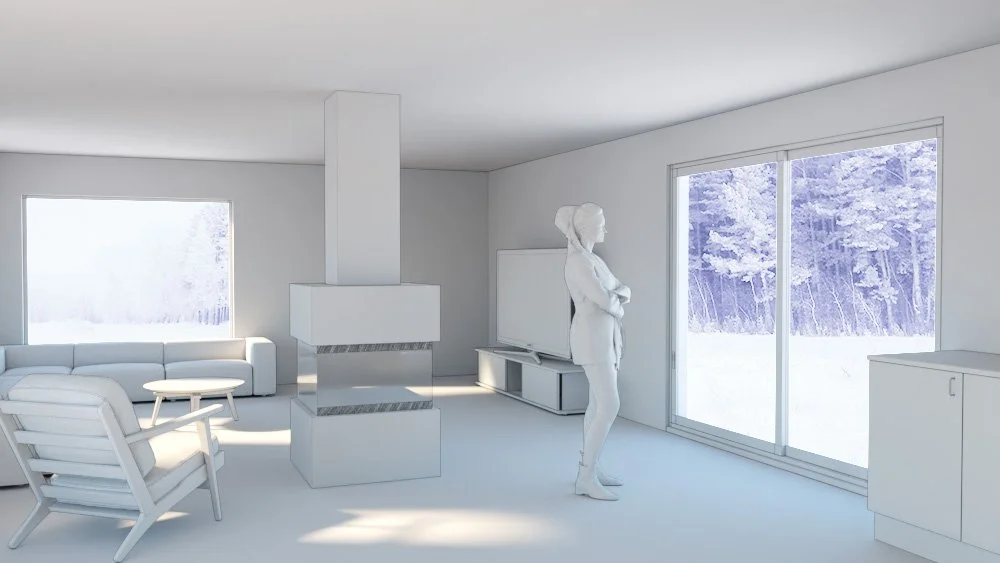
Some marketing visualisations we produced for our developer client, for a new build house we designed last year. With a planning application granted, building work should start this summer.
Opening a window
Visualising the effect of a new window in an existing kitchen, early in the design process to explore ideas with our clients…
Planning application granted to new-build house in Eidsvoll
We have just been granted planning permission for our new-build family house on a steep hillside in Eidsvoll, Norway.
Portfolio project
From basement to master wing
Our transformation of a family house in Oslo in now complete and our delighted clients can move into the brand new master wing of their home, converted from an existing disused basement.
The brief
Our clients wished to create a parent wing to their family home — a single floor on a two-unit house in Oslo. The new quarters were to accommodate their new master bedroom, together with a comfortable bathroom, home office and kitchen space. With the children growing up, the clients also liked the possibility of renting out part of the house in the future,
It was not possible to extend the house further onto the site, but the apartment had access to an existing basement, mostly unused. This low ceiling space was dark and uninsulated, and therefore cold and damp, and had no fire escape. High levels of radon gas were also measured in the underground space, making it further unsuitable to use as a living space. To complicate matters, this basement could only be accessed through a steep staircase, from a shared area outside the flat.
A new wing, filled with sunlight…
We focused our approach on creating new spaces that felt integrated into the existing home, with a sense of privacy yet avoiding the common claustrophobic feeling of converted basement spaces.
Since the conversion of the basement needed new fire escapes, we made the most of these required new openings, transforming them into landscaped staircase and planted light wells, bringing daylight and views from the garden deep into the new spaces. Transforming technical constraints into creative opportunities!
With minimum changes to the existing structure and services of the house, we relocated the staircase to the inside of the flat, connecting the new space below to the existing circulation, so that it became a natural extension of the home. All technical functions were concentrated in the middle of the plan, with a large bedroom, home office, gym space, kitchen and modern bathroom wrapping around them along the new large windows. Deeper into the floor plan, where no daylight could be brought, we tucked efficient storage space for the family.
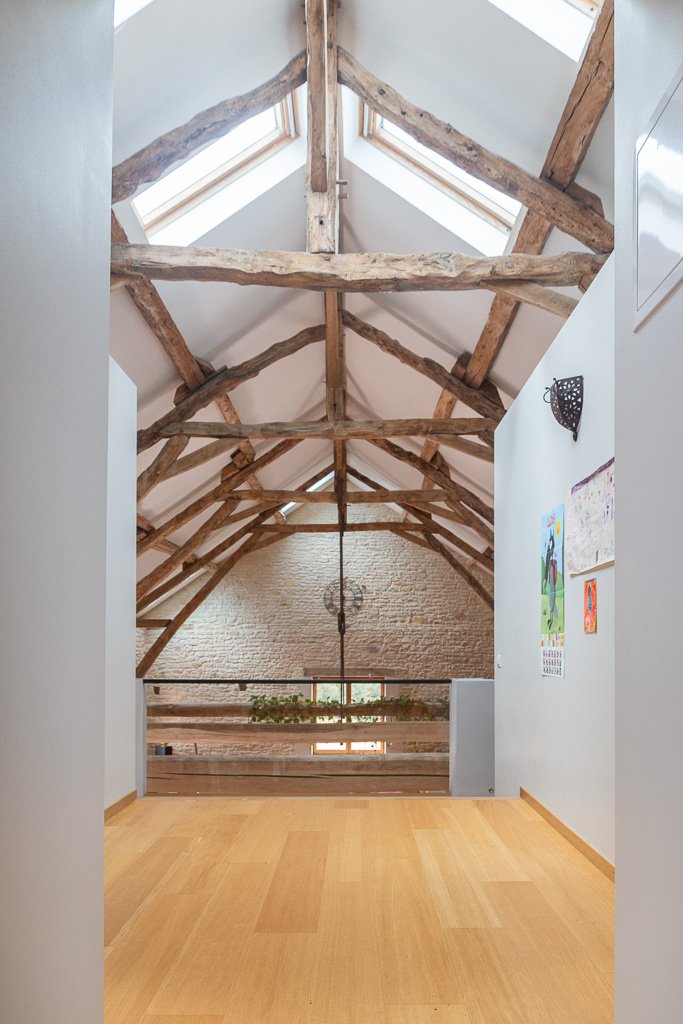
The new lower floor has generous access to the garden, through a cascading timber terrace, transforming what could have been a dark access staircase into a attractive and private exterior space, streaming sunlight into the new bedroom.
“2hD has helped us to evolve an old, dusty and mouldy basement into a place we love to spend our time at home”
Comfortable and future-proof
Our remodelling strategy integrated a full upgrade to the basement fabric, adding high insulation levels in the new lowered basement floor and existing walls — greatly improving both thermal comfort and energy efficiency — as well as in the ceiling to create acoustic privacy from the upper floor.
In the long-term future, renting out the lower floor as a separate apartment will be as simple as closing a couple of doors, to separate a fully living unit equipped with kitchen, bathroom and wood oven, and with direct access from the street through its private terraced exterior staircase.
Do you want to breathe new life into unused parts of your home?
Photos of the converted barn in Gabillou
I got a chance over the summer to visit the fully converted stone barn that we designed in Gabillou, in south-west France.
This 19th century agricultural building was transformed into a stunning home between 2007 and 2018, by our self-builder clients themselves, who lived in the building over the course of the conversion process, thanks to our phased construction design approach.
With an amazing attention to detail and a lot of enthusiasm, the couple has now become expert self-builders and joiners, already looking forward to a new conversion project to use their skills!
Below is a collection of pictures I took of the finished barn this August.
Dreaming of converting a historical building into your new home?
Møllenberg: Urban gardening in Trondheim
We have just collaborated with Ur Arkitekter on a prequalification entry for the masterplanning competition of the Møllenberg neighbourhood in Trondheim, Norway..
Rethinking the identity and social dynamics of this historical neighbourhood in the centre of Trondheim — today mostly populated by students — our concept proposal explores how communal urban farming can be used as a catalyst to foster social diversity and renew community engagement in the city.
Portfolio project
Riddle: a sculpture from waste plastic
Future Makers is a Nottingham-based creative studio who has been spending the last five years researching the potential of waste plastic, bringing together the local community, design creatives and artists to create innovative artwork and products.
Having recently acquired a whole set of waste plastic recycling and manufacturing equipment (which we have already started experimenting with), they announced an open call for a lead artist to craft an outdoor public artwork in front of their building, using one tonne of locally-sourced plastic waste.
The street facade of the existing Waste Plastic Studio (photo © Future Makers)
Our proposal
Continuing our exploration of community-built urban interventions in Nottingham, we responded to this open call with a diaphanous facade sculpture, to transform the Future Makers' building itself into a large art piece, and create a visually striking and intriguing street presence that hovers over the public space.
Questioning the ubiquitous nature of plastics in today's built environment and consumer society, the sculpture takes the form of a diaphanous mesh appearing to deform in and out of the building facades, to exude from the fabric of the building itself: the manifestation of the presence of plastics in a new, recycled form — and its metamorphosis from undesirable waste to creative potential. This large undulating sculptural mesh creates a unified identity across the site, linking the public space, the building entrance and the large industrial shed at the back.
How we use recycled plastic
Despite its visual complexity, the mesh of the sculpture is created entirely out of identical recycled plastic modules, assembled in a repeating reciprocal pattern. The mesh derives its three-dimensional shape from the pattern of assembly of these modular components, linked together with a simple zip-tie-like "cilium" component.
Building the sculpture
The form of the sculpture emerges not from the complexity of its components, but from the assembly process itself: simply varying the pattern of assembly along the mesh allows shear, deformation and stiffening of the surface into a complex shape that symbolically intersects with the building's facades.
Assembling the sculpture is deceptively simple and can happen almost entirely on the ground, before being attached to the facades. The assembly and erection of the different sections of the sculpture will be carried out during community workshops involving neighbours, local schools and fellow artists, creating a sense of ownership while introducing a large audience to the potential of recycled plastics as a creative material, through practical, hands-on workshops.
Continuing our journey
Since its inception, 2hD has explored the relationship between architecture, visual arts and community engagement, through a series of successful international art projects ranging from architectural pavilions to collective sculptural work, interactive installations, scenography and audio-visual performances.
The common thread through all these different projects is our personal research into architectural elements as a receptacle for our own stories, emotions and daydreams, introducing a fractional dimension to surfaces to invite this projection — and exploring how, in turn, it affects how we perceive and inhabit the spaces they define.
This proposal also keys in with our love for reusing ubiquitous and repurposed materials: transformed cardboard boxes for collective community sculptures in The Lost Cuckoo, recycled plastic tubing to introduce school children and architecture students to complex geometries during hands-on teaching sessions, and natural fiber broom heads to clad an entire building for our Mission Control micro-office.