Portfolio project
In memory of Frithjof Reppen

Thibaut Devulder

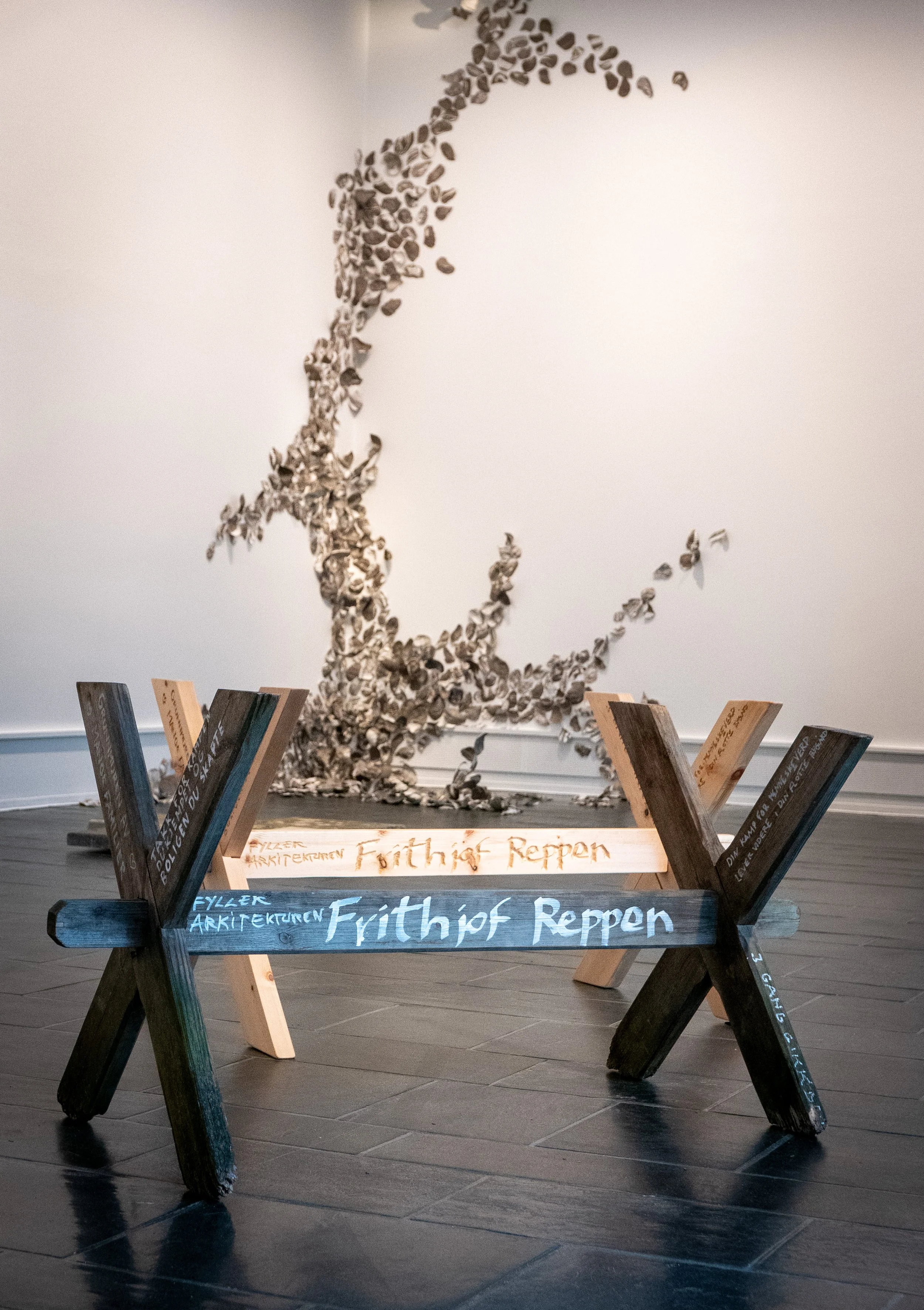
Our second collaboration for the Synergi exhibition in Oslo was with artist Carlos Martin, to create an engraved table as a memorial for Norwegian architect and resistant Frithjof Reppen (1893–1945).

The frame of the old table with its painted inscriptions, in front of the the new carved frame in ore pine (displayed at the Synergi exhibition, in Oslo)

One of the first Norwegian architects to introduce the modernist movement to Oslo, Reppen was arrested in 1941 and imprisoned for being part of a group publishing and distributing Jøssingposten, a newspaper opposing the nazi occupation. Deported to a concentration camp near Vienna, he was eventually shot dead by his captors in 1945.

The starting point for this installation was to transform an existing wooden picnic table, located in the garden of Reppen’s housing block on Professor Dahls gate 31-33, his most emblematic architectural project in Oslo.

With no apparent connection to Reppen, this mundane object — a standard garden furniture mass produced in cheap wood during the 1980s  — was transformed into a receptacle for the memories of the residents of the housing block.


We then fabricated an exact copy of the existing table. But rather than using the impregnated wood of the original, the new copy was made with ore-wood (Malmfuru, in Norwegian), a cured heartwood from old-growth mountain pines, the same highly durable wood famously used in Norwegian stave churches dating back from the 12th century.

In parallel, the residents of the housing block were invited to reflect upon Frithjof Reppen’s history and to adorn the old table with their thoughts, using white paint markers.

These writing were finally digitalised and carved into the new table, creating an identically engraved copy.
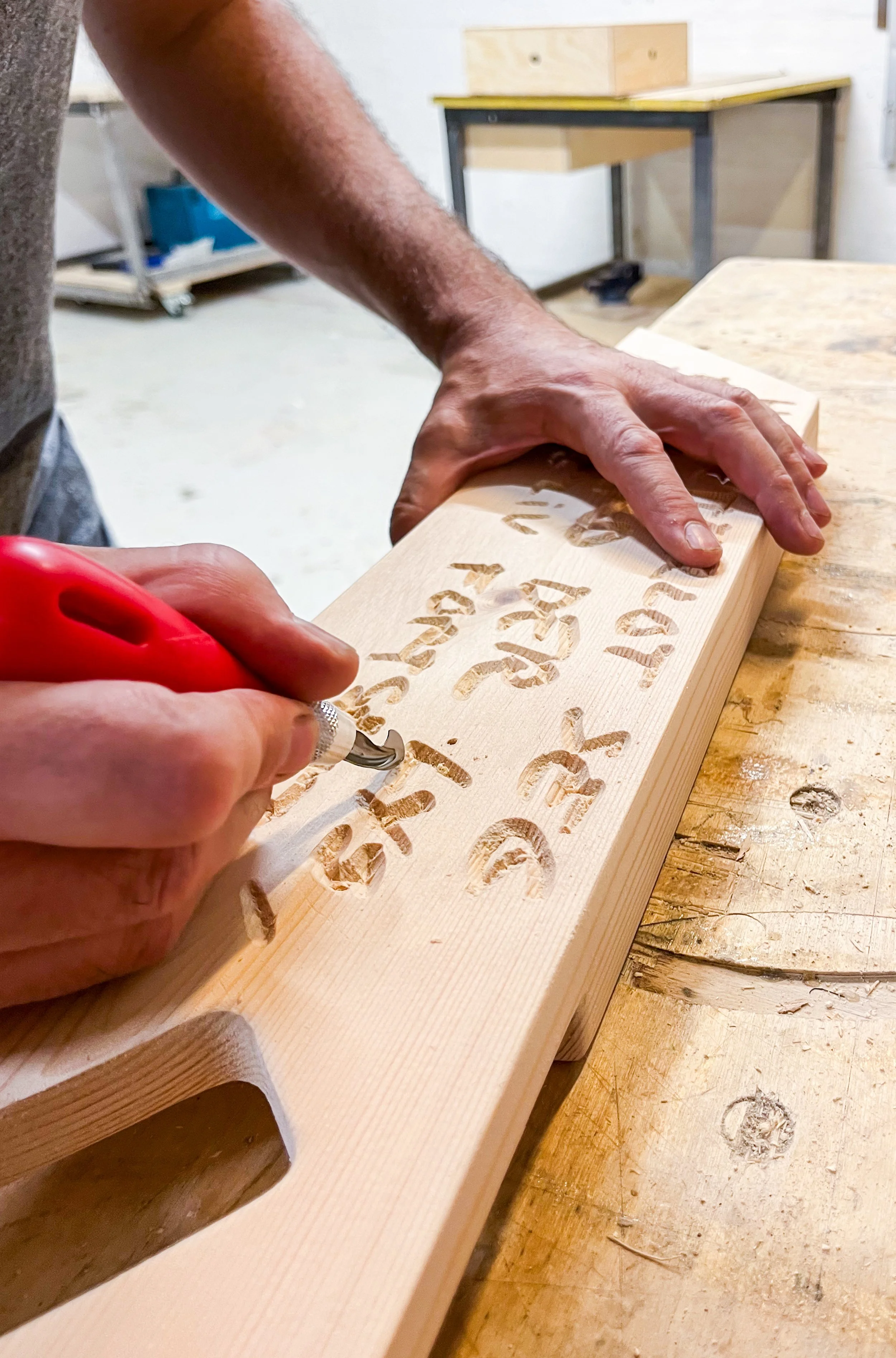
Detail of the engraved surface of the new ore-pine table

The exhibition presented the frames of the two tables side by side, collecting the story of Frithjof Reppen: the dilapidated old table with its paint writings, and our new, engraved ore-pine version. A contrast between the mundane mass-produced picnic table treated with environmentally harmful preservatives, and the new identical table, with memories engraved into its naturally durable material.

At the end of the exhibition, the new table replaced the old one in the courtyard of Reppen’s housing block, and became the material support for a community-based piece of memory of architectural, political and social history.

The new engraved table in the garden of Reppen's housing block on Professor Dahls gate 31-33, Oslo


We would like to thank Kroloftet and Sameiet Professor Dahls gate 31/33 for their financial support, as well as Peter Magnus for his assistance during fabrication. The ore-pine was supplied by the excellent Svenneby Sag og Høvleri.

Portfolio project
Nascence: the tactility of ceramics

Thibaut Devulder

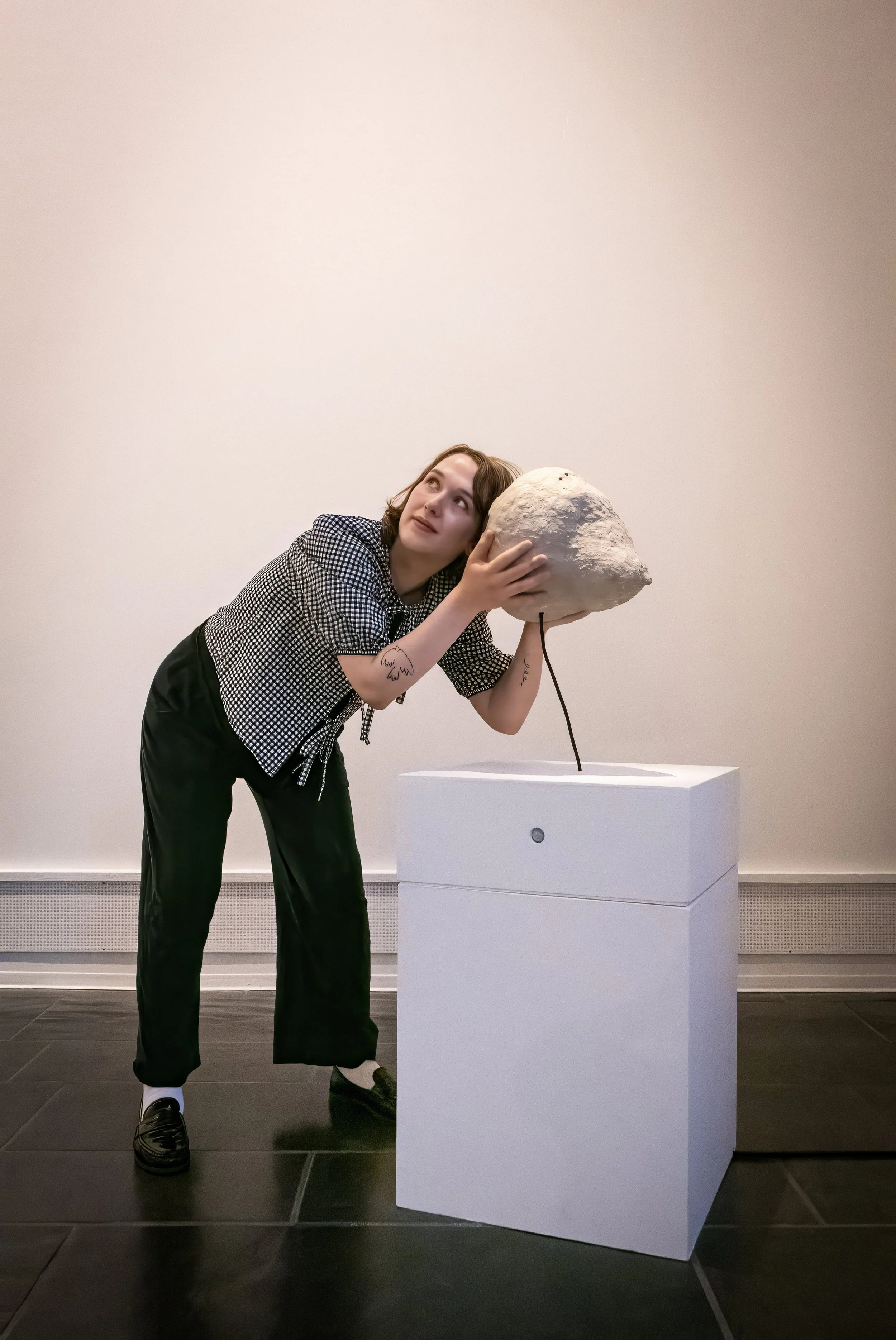
Ceramic artist Amanda Krantz, holding the Nascence vessel

As part of the SYNERGI exhibition, organised by Kroloftet, I collaborated with Swedish ceramic artist Amanda Krantz to create a multi-sensorial ceramic sculpture, titled ´Nascence´.
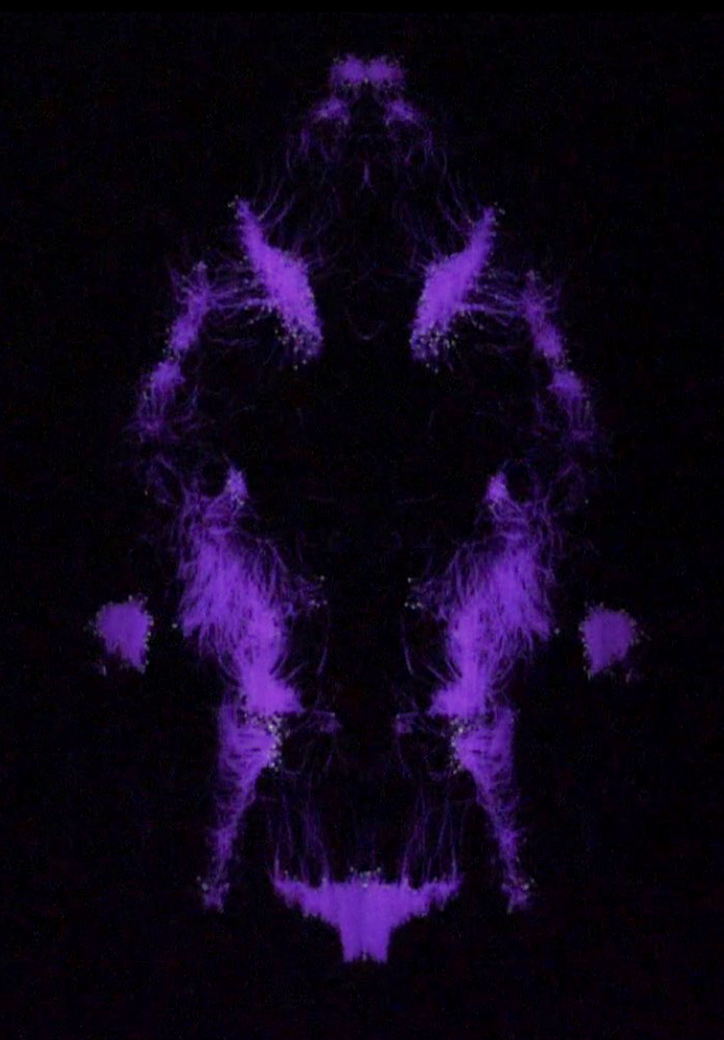
This is a continuation of my experiments in induced synesthesia — when our senses overlap and weave into one another — through installations and performances that actively blur the boundaries between our visual, acoustic and haptic perceptions. Visually amplifying touch in Ooo-Ya-Tsu, shaping images with music in Symetriades, and now feeling soundscapes with the fingers…
This collaborative piece is based on the idea of combining sculpture, made from the residual clay from Kroloftet’s ceramic workshop, with mixed sound recordings from the process of reclaiming and reusing the material.

The clay recycling process itself involves gathering waste clays from used tools, filtering, dehydrating and kneading the materials together before reintroducing them, in its new amalgamated form, into the creative process of ceramic art.

Here are some images of the clay recycling process, at the ceramic workshop in Kroloftet:

Close-up of the Nascence installation

Our installation takes form as a ceramic vessel with the title ‘Nascence’, which alludes to the regenerative and physical aspects of the material and its relation to the body. The sculpture is levitating in mid-air over a pedestal, only connected to it by a thin textile umbilical cord. A small tactile transducer inside the sculpture softly vibrates it, conducting through its matter the sounds recorded during the clay recycling process.

Acting both as a sound filter and as a resonator, the ceramic vessel interprets and conveys elements of its own history and materiality. Nascence explores how the recycling process can be expressed by the ceramic object itself — beyond its visual appearance — through the tactile experience of the material and movement.

The installation reacts to the presence of a visitor, producing intriguing noises that lure you closer and encourage you to touch the clay vessel to explore its tactile qualities. Upon contact, you experience these sound vibrations through your hands, hearing them through your fingers, adding a new dimension to the touch.

As you bring Nascence to your ear, the feeling is reminiscent of seashells children hold to their ears to hear the sea: how much of the sounds you hear are traces of a forgotten past? A resonance of sounds in the space around you? The friction of your fingers holding the vessel? Or your own body pulsing in your ear?

Extract from the Nascence installation, Gamle Much Museum, Oslo, 2025


Nascence is on display and awaiting your touch as part of Kroloftet’s SYNERGI exhibition at the Gamle Munch Museum in Oslo, open until 21st September 2025. You can also discover more about Amanda’s fascinating work on her Instagram account.

Update: Nascence is exhibited in Kruttverket’s Glasshouse gallery until the end of November 2025!

Portfolio project
From basement to master wing

Thibaut Devulder

Our transformation of a family house in Oslo in now complete and our delighted clients can move into the brand new master wing of their home, converted from an existing disused basement.

View from the window of the master wing, looking onto the new landscaped stair linking it to the garden


The brief

Our clients wished to create a parent wing to their family home — a single floor on a two-unit house in Oslo. The new quarters were to accommodate their new master bedroom, together with a comfortable bathroom, home office and kitchen space. With the children growing up, the clients also liked the possibility of renting out part of the house in the future,

It was not possible to extend the house further onto the site, but the apartment had access to an existing basement, mostly unused. This low ceiling space was dark and uninsulated, and therefore cold and damp, and had no fire escape. High levels of radon gas were also measured in the underground space, making it further unsuitable to use as a living space. To complicate matters, this basement could only be accessed through a steep staircase, from a shared area outside the flat.

The dark and damp basement space, before the conversion


The new master bedroom (photo © Ann-Kristin Syversen)

A new wing, filled with sunlight…

We focused our approach on creating new spaces that felt integrated into the existing home, with a sense of privacy yet avoiding the common claustrophobic feeling of converted basement spaces.

Since the conversion of the basement needed new fire escapes, we made the most of these required new openings, transforming them into landscaped staircase and planted light wells, bringing daylight and views from the garden deep into the new spaces. Transforming technical constraints into creative opportunities!

With minimum changes to the existing structure and services of the house, we relocated the staircase to the inside of the flat, connecting the new space below to the existing circulation, so that it became a natural extension of the home. All technical functions were concentrated in the middle of the plan, with a large bedroom, home office, gym space, kitchen and modern bathroom wrapping around them along the new large windows. Deeper into the floor plan, where no daylight could be brought, we tucked efficient storage space for the family.

The new lower floor has generous access to the garden, through a cascading timber terrace, transforming what could have been a dark access staircase into a attractive and private exterior space, streaming sunlight into the new bedroom.

2hD has helped us to evolve an old, dusty and mouldy basement into a place we love to spend our time at home
Ann-Kristin Syversen, client and user


Comfortable and future-proof

Our remodelling strategy integrated a full upgrade to the basement fabric, adding high insulation levels in the new lowered basement floor and existing walls — greatly improving both thermal comfort and energy efficiency — as well as in the ceiling to create acoustic privacy from the upper floor.

In the long-term future, renting out the lower floor as a separate apartment will be as simple as closing a couple of doors, to separate a fully living unit equipped with kitchen, bathroom and wood oven, and with direct access from the street through its private terraced exterior staircase.


Early in the design process, we developed technical solutions to bringing daylight and thermal comfort to the basement, later specified in details for the tender documents and the construction phase

Exterior view of the apartment house, with terraced staircase to the new lower floor

The existing apartment house, with the new terraced staircase, leading discretely down to the transformed lower floor

Do you want to breathe new life into unused parts of your home?

Portfolio project
Riddle: a sculpture from waste plastic

Thibaut Devulder

Future Makers is a Nottingham-based creative studio who has been spending the last five years researching the potential of waste plastic, bringing together the local community, design creatives and artists to create innovative artwork and products.

Having recently acquired a whole set of waste plastic recycling and manufacturing equipment (which we have already started experimenting with), they announced an open call for a lead artist to craft an outdoor public artwork in front of their building, using one tonne of locally-sourced plastic waste.

The street facade of the existing Waste Plastic Studio (photo © Future Makers)


Our proposal

Continuing our exploration of community-built urban interventions in Nottingham, we responded to this open call with a diaphanous facade sculpture, to transform the Future Makers' building itself into a large art piece, and create a visually striking and intriguing street presence that hovers over the public space.

Questioning the ubiquitous nature of plastics in today's built environment and consumer society, the sculpture takes the form of a diaphanous mesh appearing to deform in and out of the building facades, to exude from the fabric of the building itself: the manifestation of the presence of plastics in a new, recycled form — and its metamorphosis from undesirable waste to creative potential. This large undulating sculptural mesh creates a unified identity across the site, linking the public space, the building entrance and the large industrial shed at the back.


How we use recycled plastic

Despite its visual complexity, the mesh of the sculpture is created entirely out of identical recycled plastic modules, assembled in a repeating reciprocal pattern. The mesh derives its three-dimensional shape from the pattern of assembly of these modular components, linked together with a simple zip-tie-like "cilium" component.

Building the sculpture

The form of the sculpture emerges not from the complexity of its components, but from the assembly process itself: simply varying the pattern of assembly along the mesh allows shear, deformation and stiffening of the surface into a complex shape that symbolically intersects with the building's facades.

Assembling the sculpture is deceptively simple and can happen almost entirely on the ground, before being attached to the facades. The assembly and erection of the different sections of the sculpture will be carried out during community workshops involving neighbours, local schools and fellow artists, creating a sense of ownership while introducing a large audience to the potential of recycled plastics as a creative material, through practical, hands-on workshops.

Examples of alternative assembly patterns for the modules that can be combined to create different levels of curvature and stiffness, and achieve the desired three-dimensional mesh form


Continuing our journey

Since its inception, 2hD has explored the relationship between architecture, visual arts and community engagement, through a series of successful international art projects ranging from architectural pavilions to collective sculptural work, interactive installations, scenography and audio-visual performances.

The common thread through all these different projects is our personal research into architectural elements as a receptacle for our own stories, emotions and daydreams, introducing a fractional dimension to surfaces to invite this projection — and exploring how, in turn, it affects how we perceive and inhabit the spaces they define.

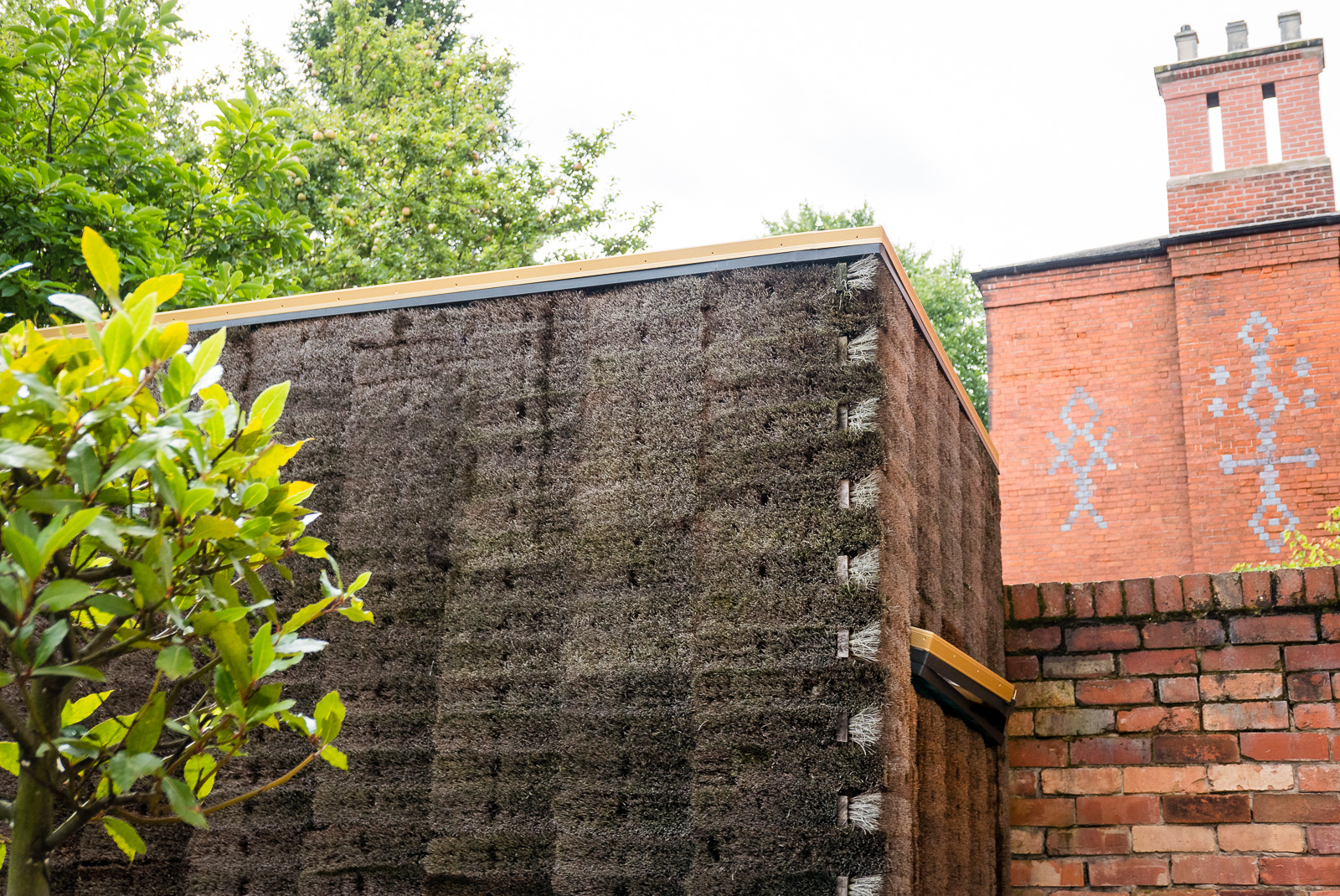
This proposal also keys in with our love for reusing ubiquitous and repurposed materials: transformed cardboard boxes for collective community sculptures in The Lost Cuckoo, recycled plastic tubing to introduce school children and architecture students to complex geometries during hands-on teaching sessions, and natural fiber broom heads to clad an entire building for our Mission Control micro-office.


Portfolio project
Creative solutions for plastic waste

Tom Hughes

Plastic is a material that we’ve tended to avoid, put off by our awareness of the environmental problems that its irresponsible use has created. The reduction in plastic use, finding more ecologically friendly alternatives, is still a great idea. But what about the mountains of plastic waste that already exist? Can we contribute in some way to preventing these carbon-intensive materials from ending up in landfill, or in the gullets of turtles, fish and sea birds?

At Future Makers, a creative hub in Nottingham, we’ve been learning about plastic waste and helping set up facilities for turning it in to useful recycled (and recyclable) products. Adding value to a waste product makes the process of collecting and recycling it worthwhile and cost effective. The Future Makers ethos is to approach these problems in a creative way; they bring together the infrastructure required with the expertise and knowledge that enables artists and designers to explore new ways of working.

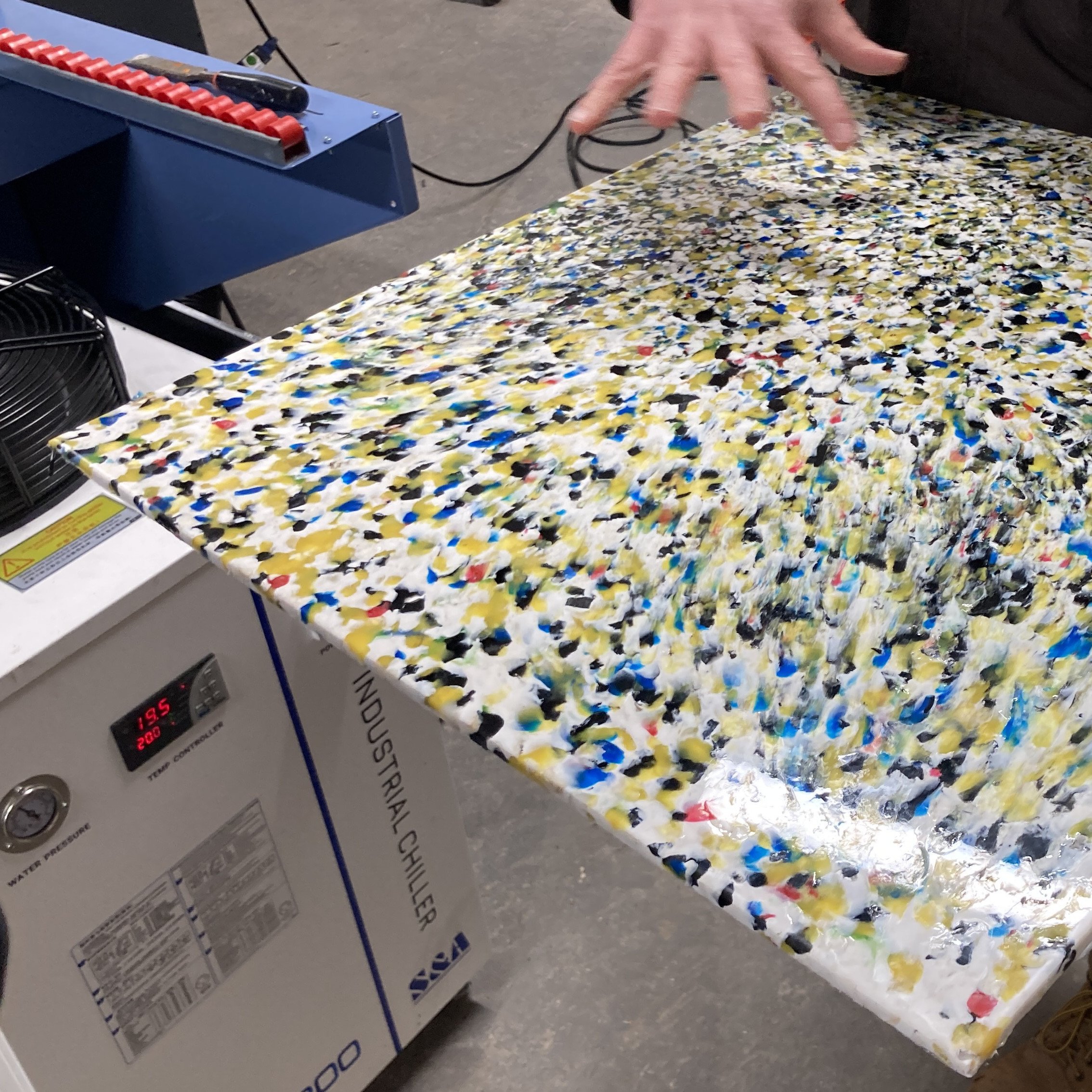
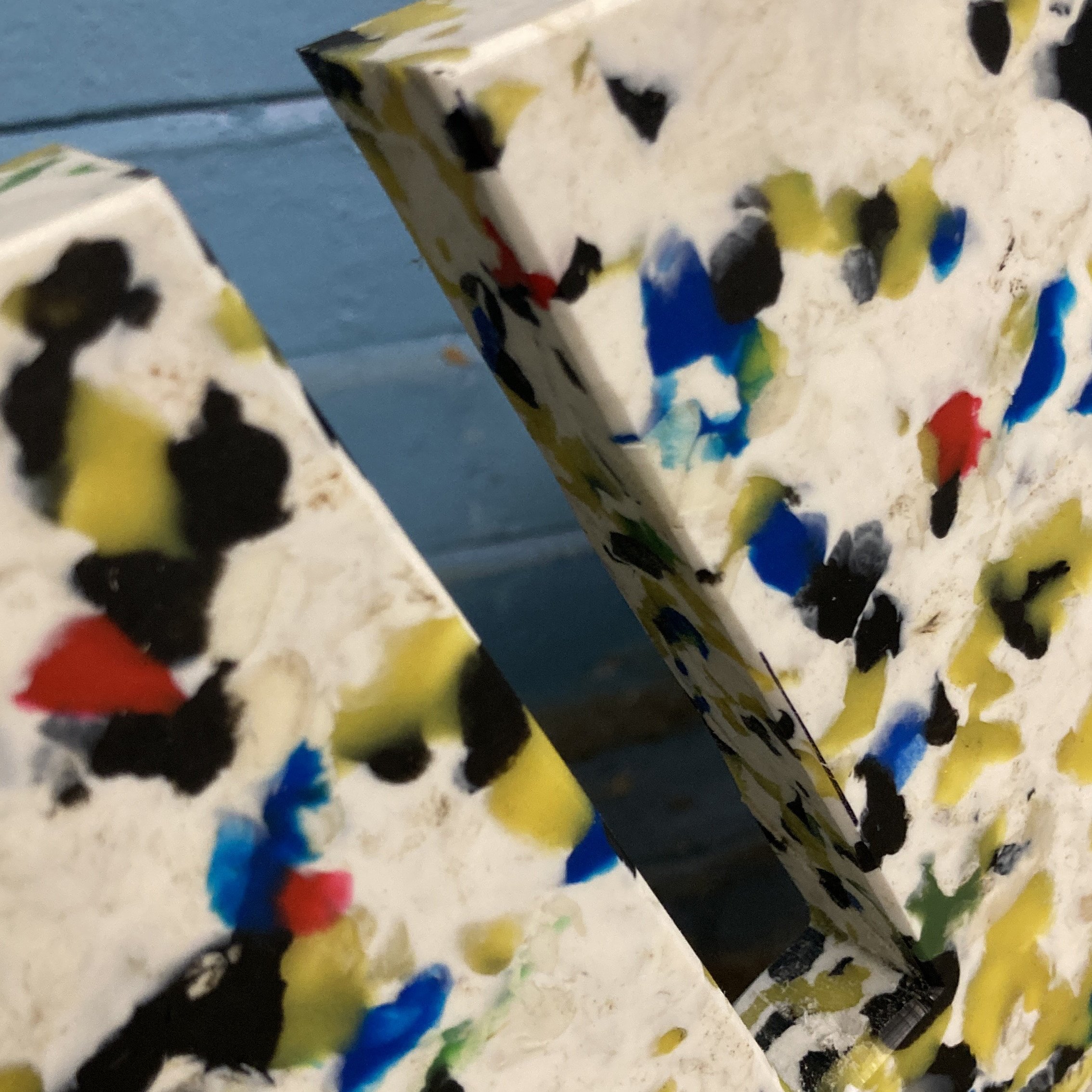
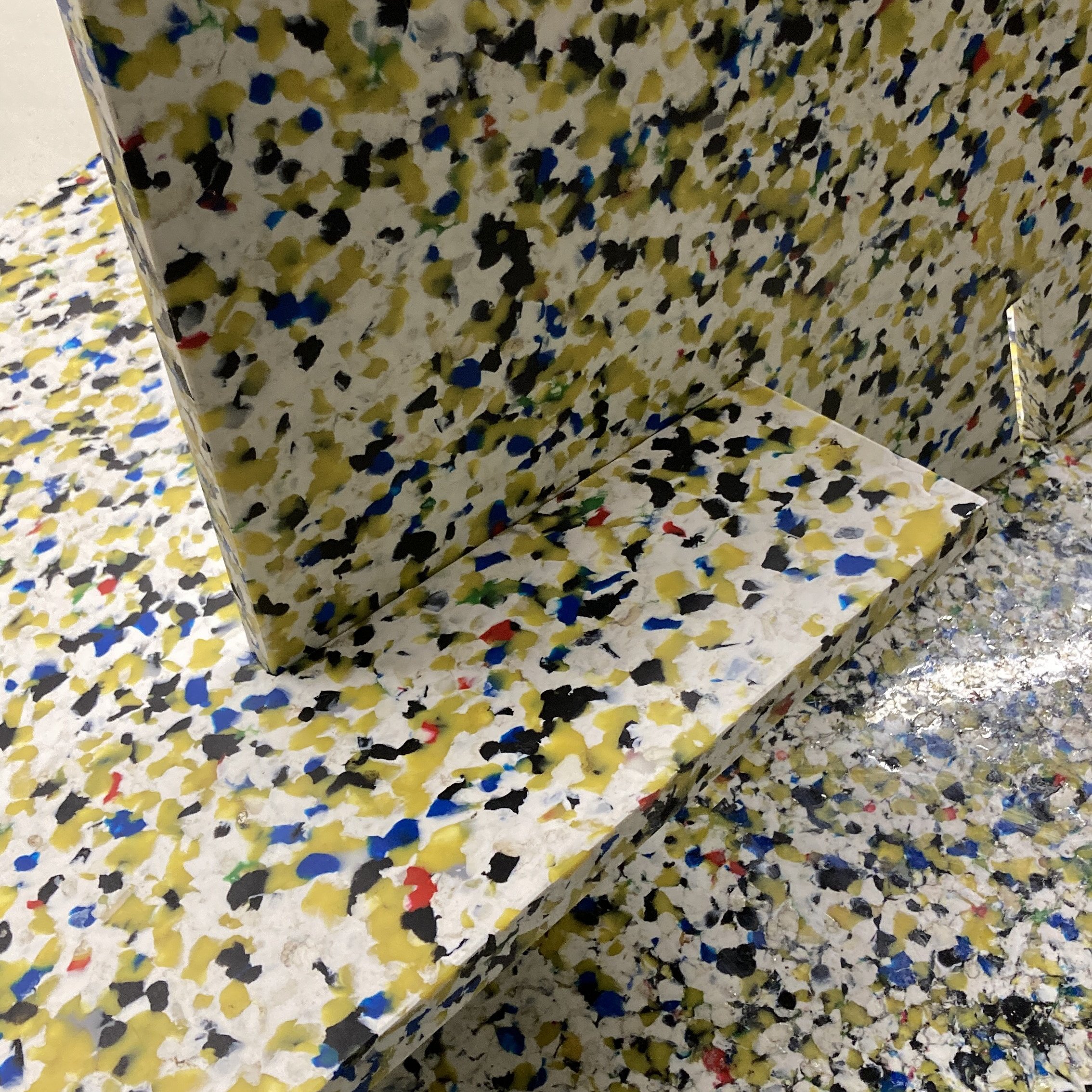
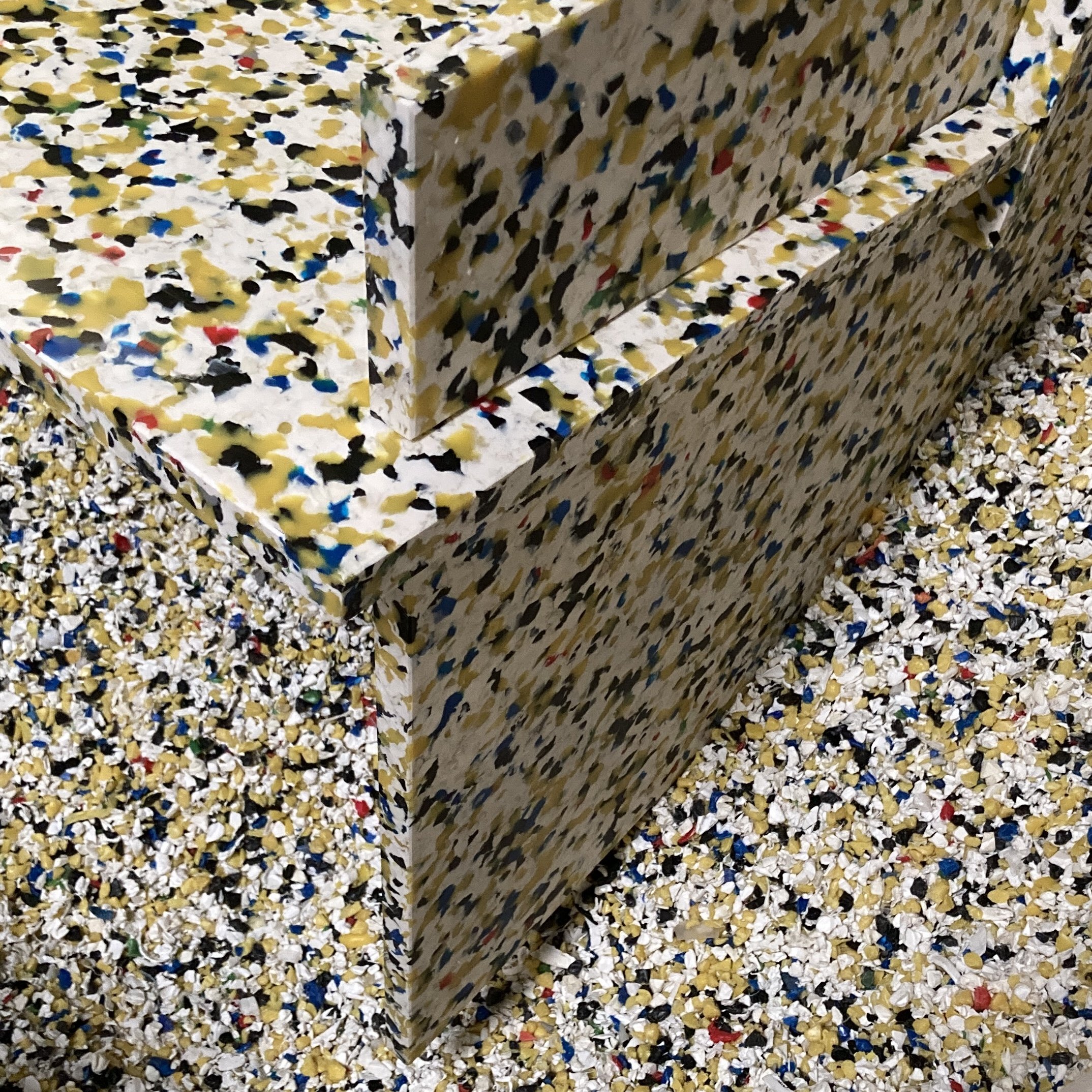
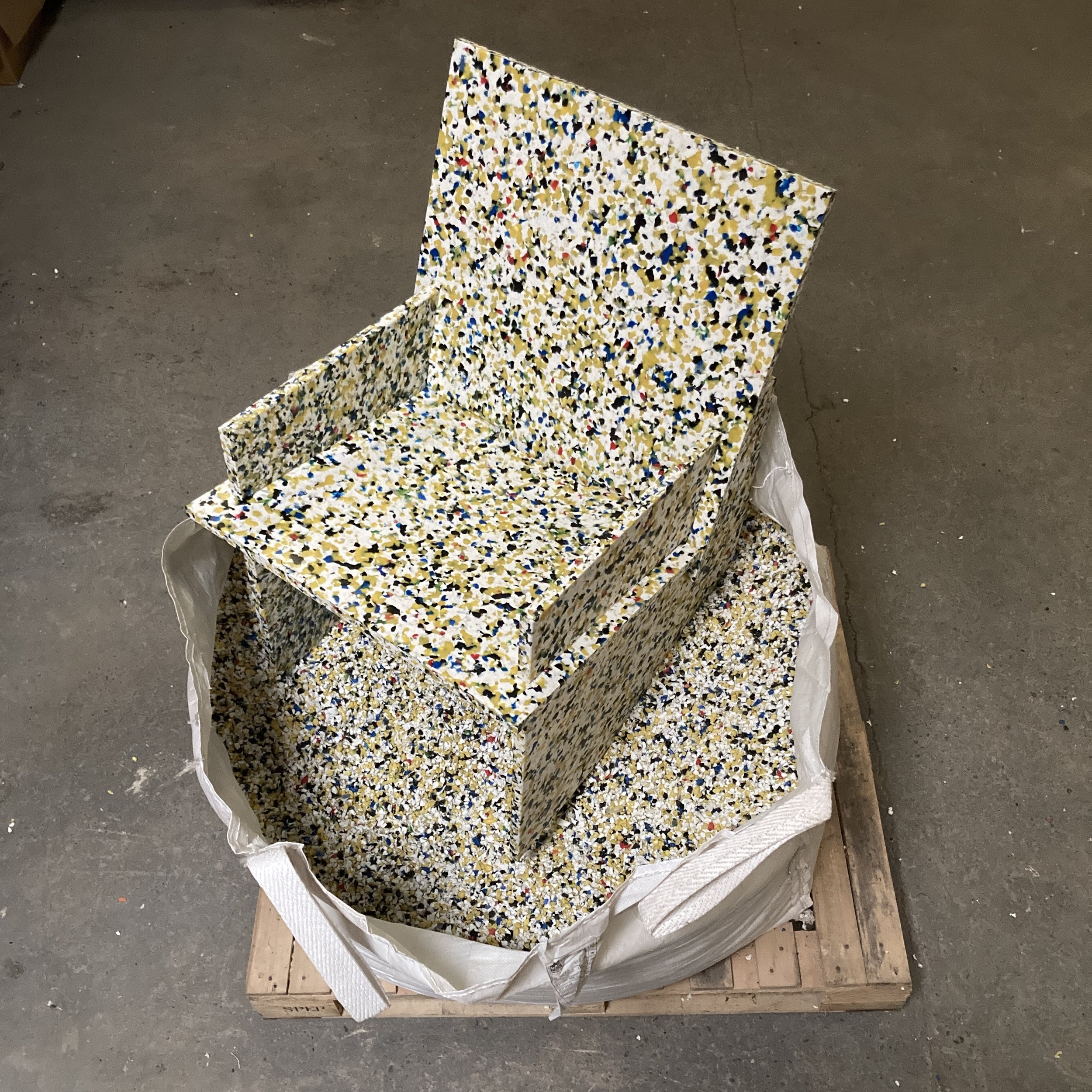
Importantly, there is an economically sustainable approach. New ideas aren’t just conceived as one-off experiments, instead they build the knowledge and experience required to create viable commercial opportunities. In this spirit we were commissioned to work with the initial, terrazzo-style production run from Future Makers’ industrial sheet press, to create some simple-to-build furniture pieces.

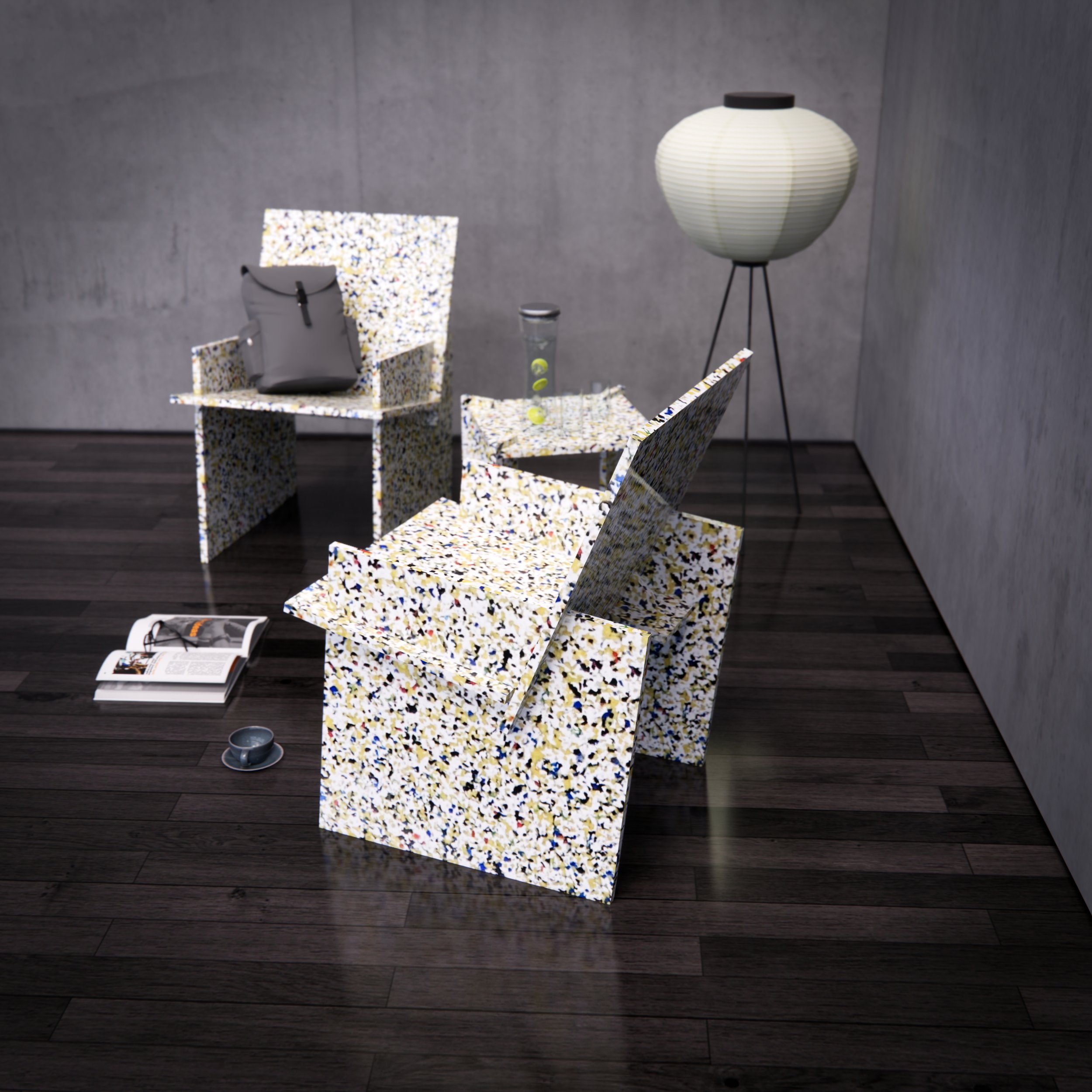
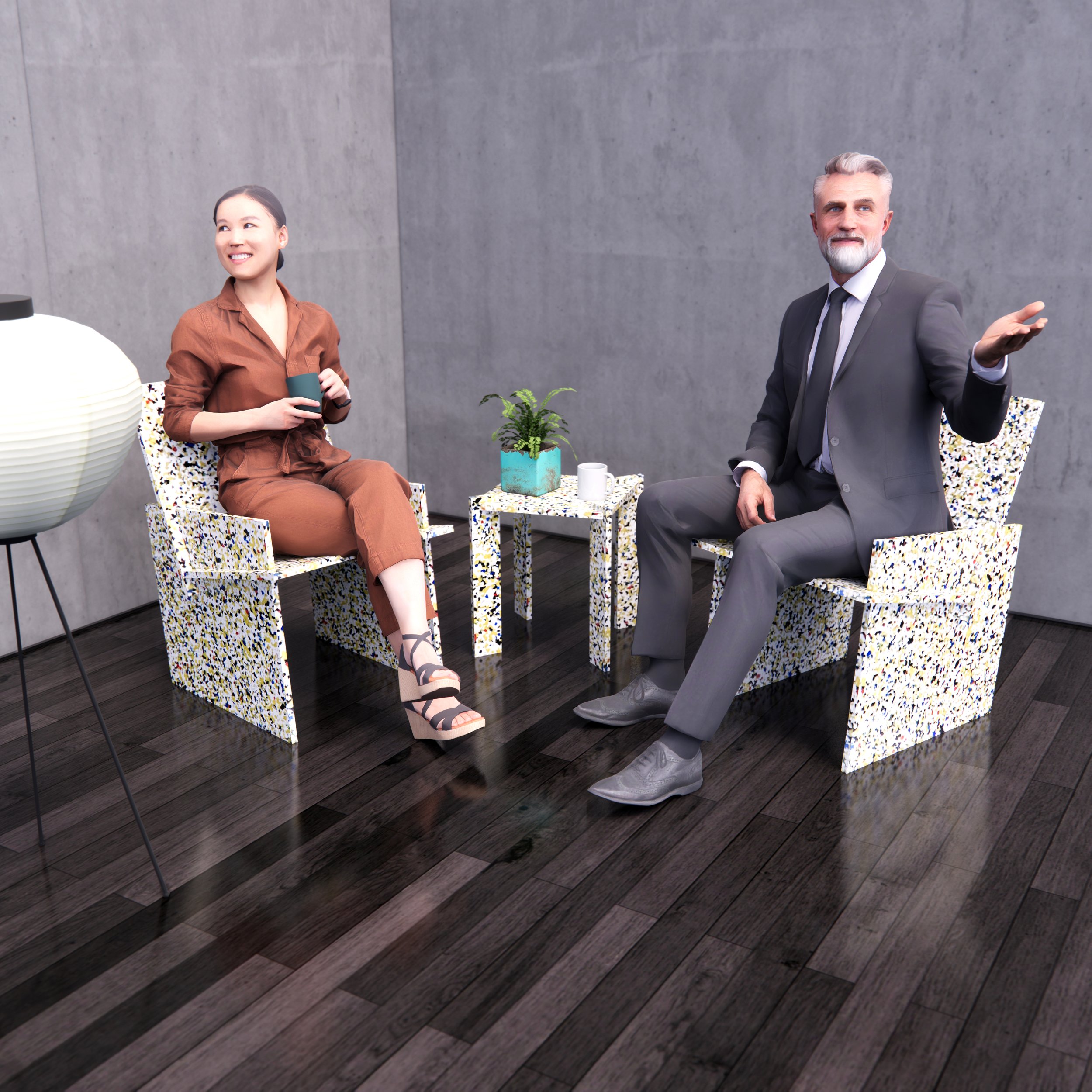
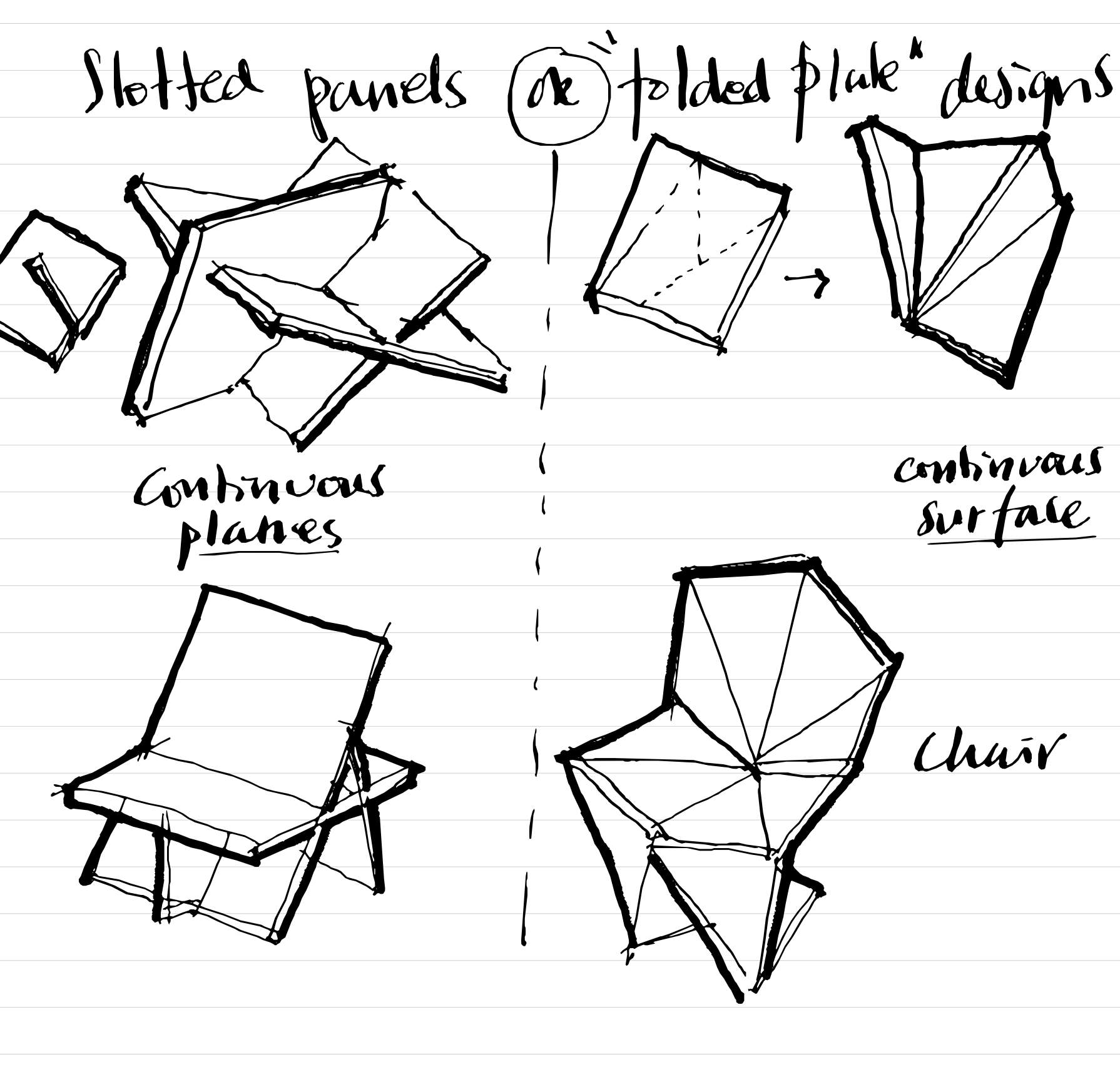
Using the HDPE sheets, made with waste left over from artist Joshua Sofia’s 2001 Regulated Exhibition at Backlit, and in collaboration with Marcus Rowlands (Sheltered Spaces), we designed a slot-together furniture system for an armchair and coffee table. Easy to assemble and disassemble, without fixings or complex brackets, this can be transported to exhibitions and events. As a product, it could be mass produced and shipped, flat-packed to customers. As a single type plastic, it is recyclable again at the end of its useful life as furniture.

In itself not THE solution to the problem, but hopefully another piece of evidence that plastic waste has value. And a thoroughly rewarding project to be involved in!


Portfolio project
Yellow Brick Road #6 installation

Thibaut Devulder

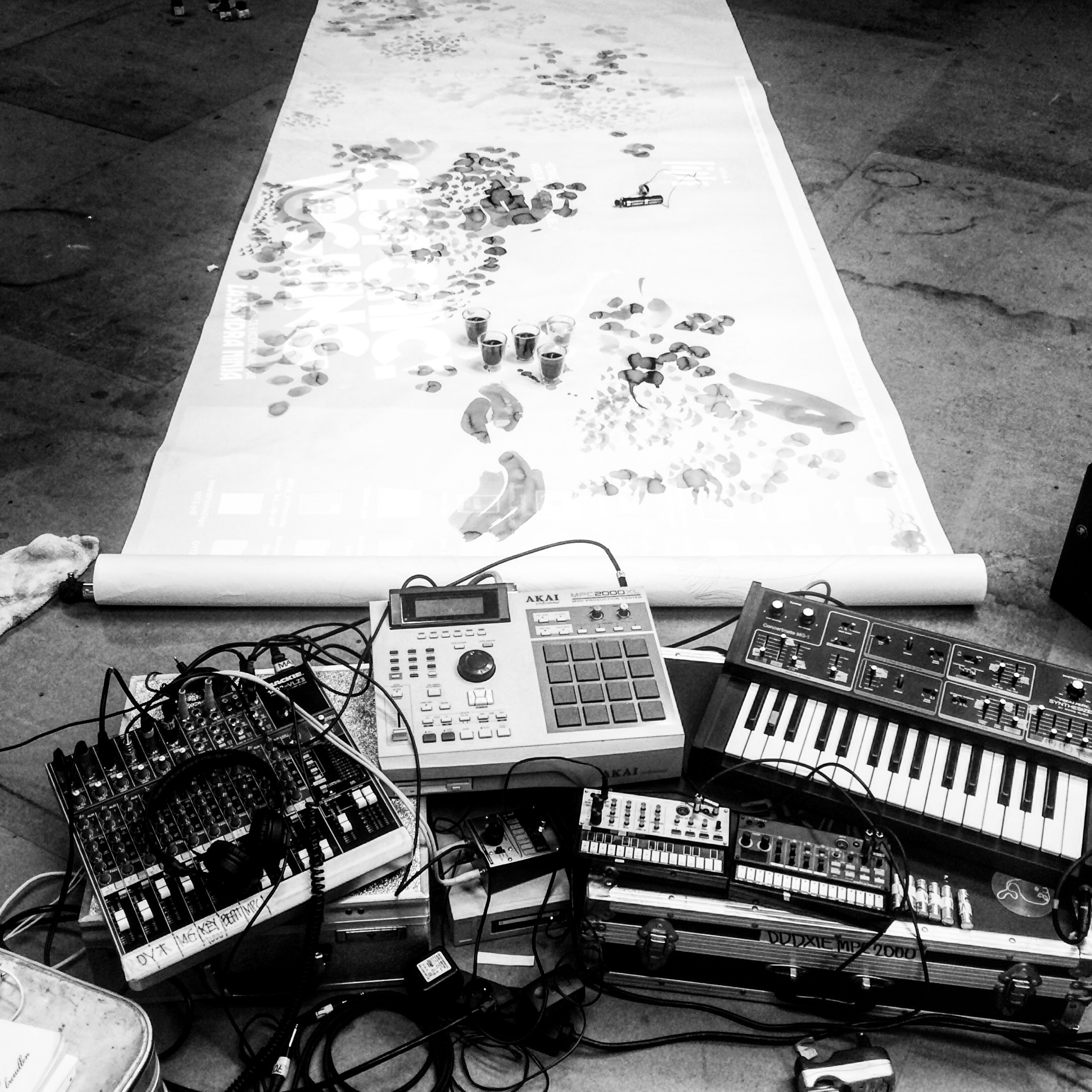
Continuing our collaboration with artist Morgan Dimnet, of French art collective QuboGas, we developed an interactive installation that explored the relationship between of visual artwork and electronic sound composition.

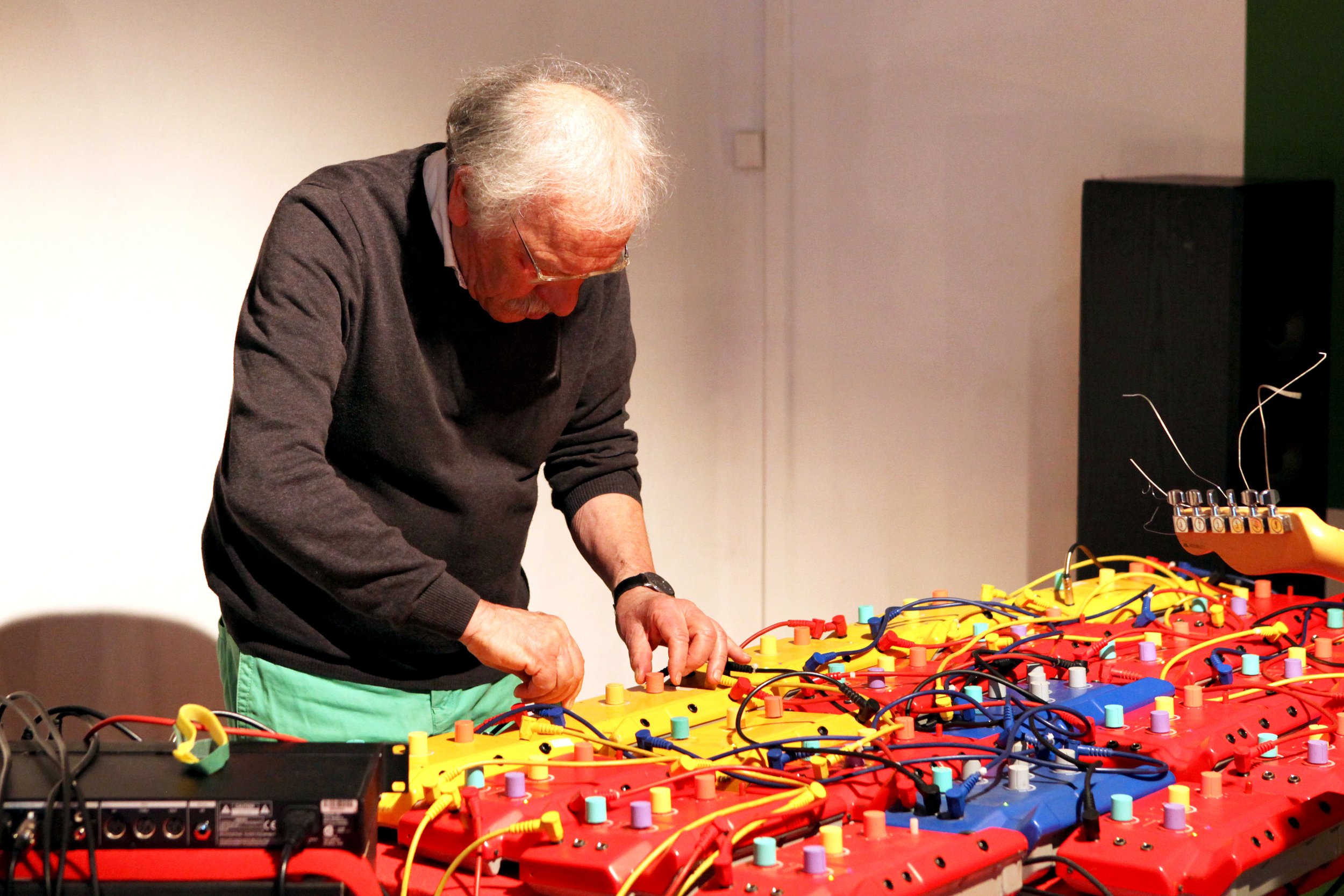
The Yellow Brick Road #6 installation/workshop at the Frigo (Albi, France)

The project was inspired by the Mélisson, an educational modular sound synthesizer developed in the 1980s at the GMEA — Centre National de Création Musicale Albi-Tarn (France).

Initially created to introduce children to the fascinating world of sound synthesis through experimentation and collaboration, these playful instruments were also used by experienced electronic musicians to create complex soundscapes and compositions.

Morgan Dimnet wanted to place the Mélisson at the centre of his new installation/workshop, inviting pupils of local primary schools to use its intuitive physical interface as a composition tools for not only sound, but also for visual art.

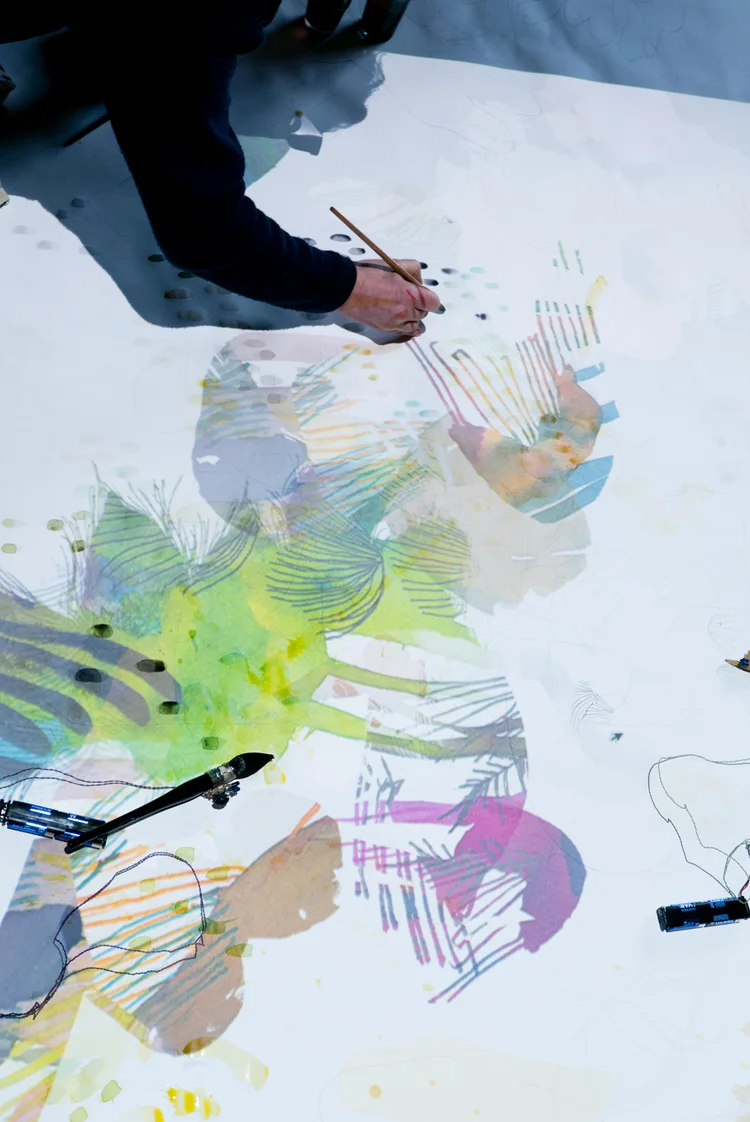
Exploring infinite variations of sounds and visual compositions, the visitors are then invited to create a physical vinyl disc cover for their own musical creation.

Collaborative sound creation with the Mélisson modules (© GMEA)

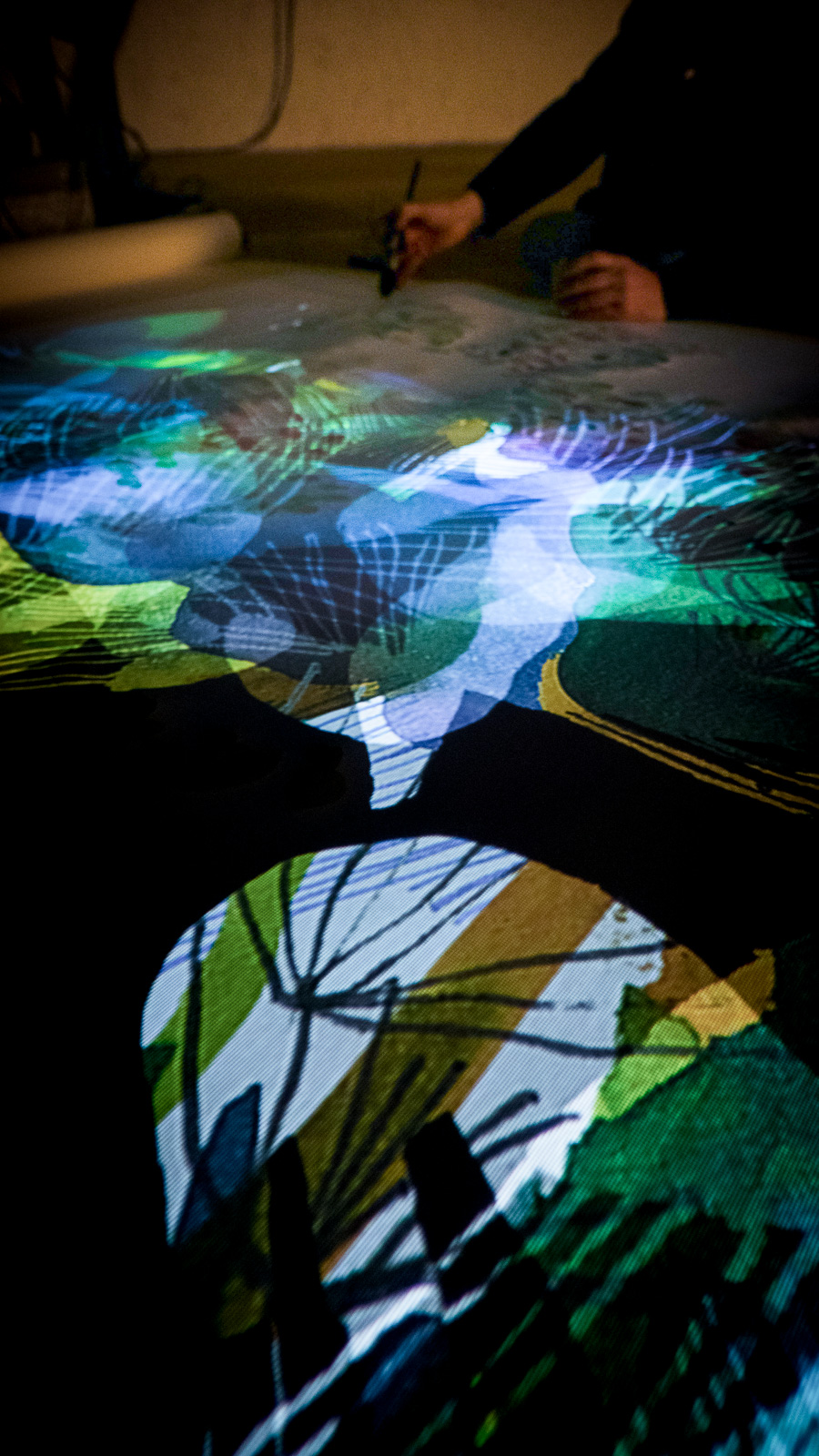
As the knobs of the Mélisson modules are tweaked to create unique sounds and effects, this soundscape is translated into similarly unique composition of shapes and colours, projected onto the workshop’s wall — ready to be reproduced by the visitors on mini stamping workshops designed by the artist for the exhibition.

We developed for this installation a hardware interface that could “listen” to the Mélisson synthesizers, and a custom computer program that translated the sound creations into unique visual artwork, following the artist’s visual language and aesthetics.

The project took place in 2022 with several primary schools in Albi, and concluded by a public exhibition at the collaborative cultural centre Le Frigo.


Project credits:

  • Visuals and furniture design: Morgan Dimnet

  • Hardware interface and electronics: 2hD Architecture Workshop, with Jean-Jacques Devulder

  • Programming (Processing): 2hD Architecture Workshop

  • Music composition (vinyl edition): Roland Ossart

Portfolio project
The kitchen is the heart

Thibaut Devulder

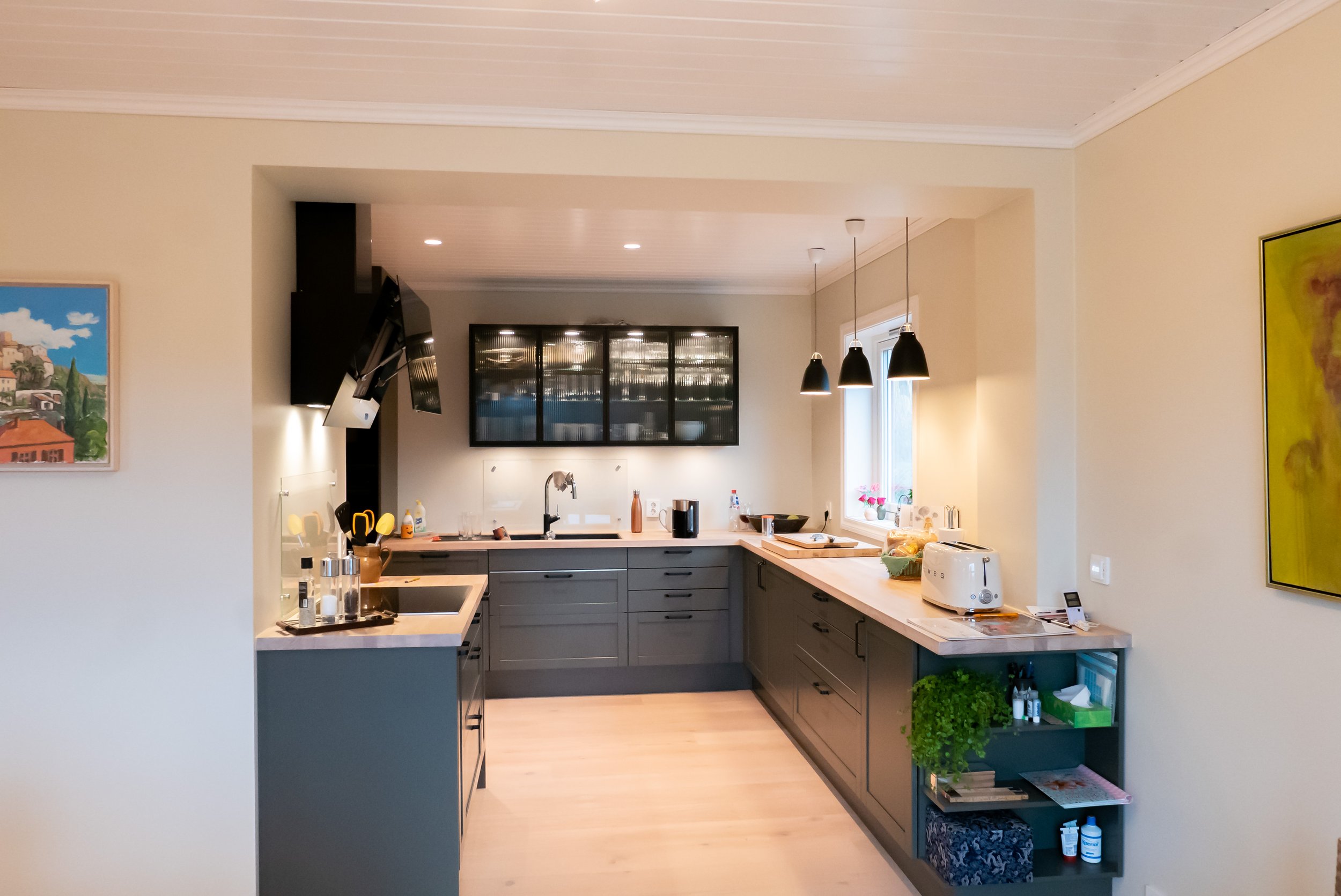
For this project, we helped our clients remodel their home to create a vibrant and flexible social space at its heart, where the whole family could share meals, be creative, work and entertain friends around a large communal table.

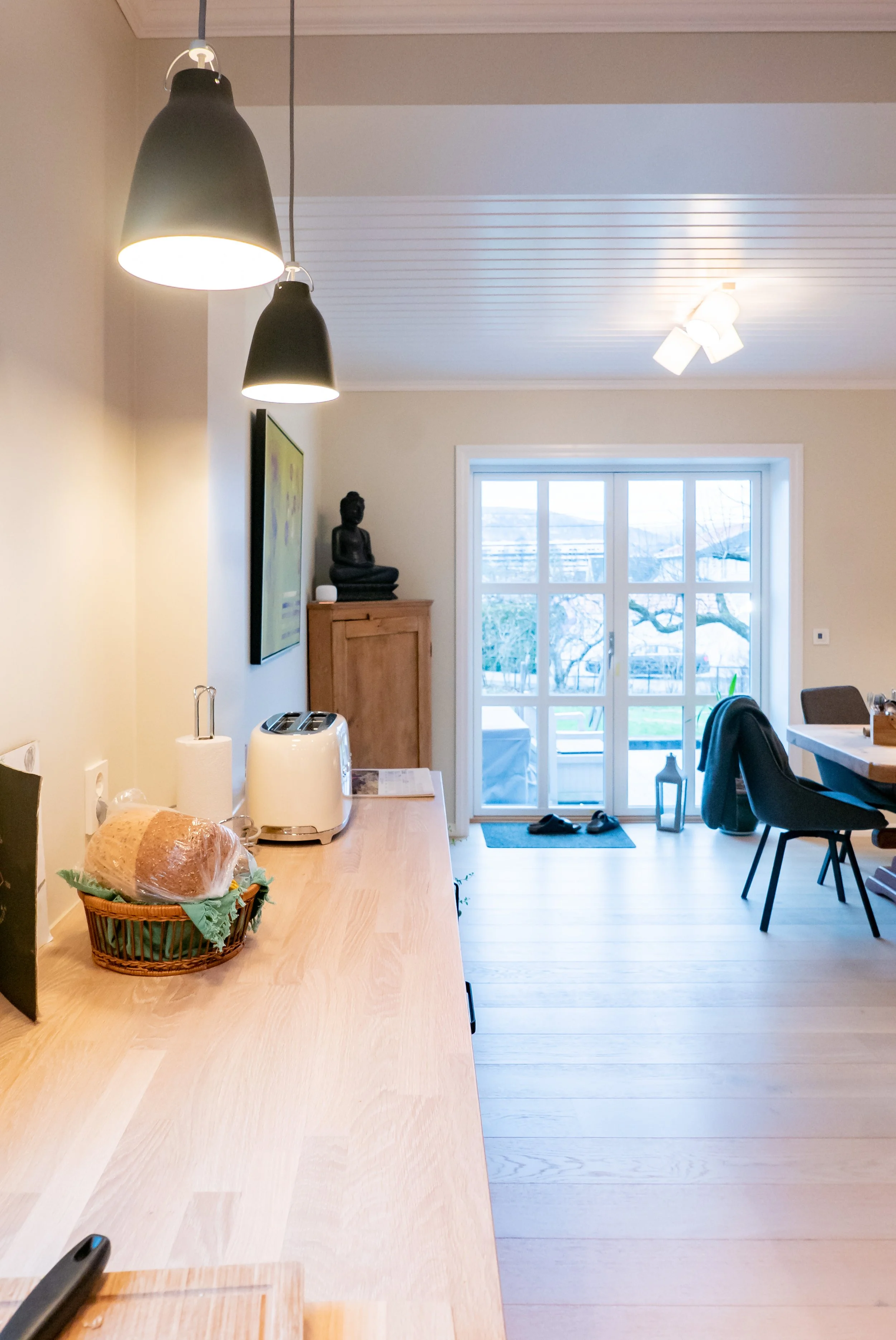
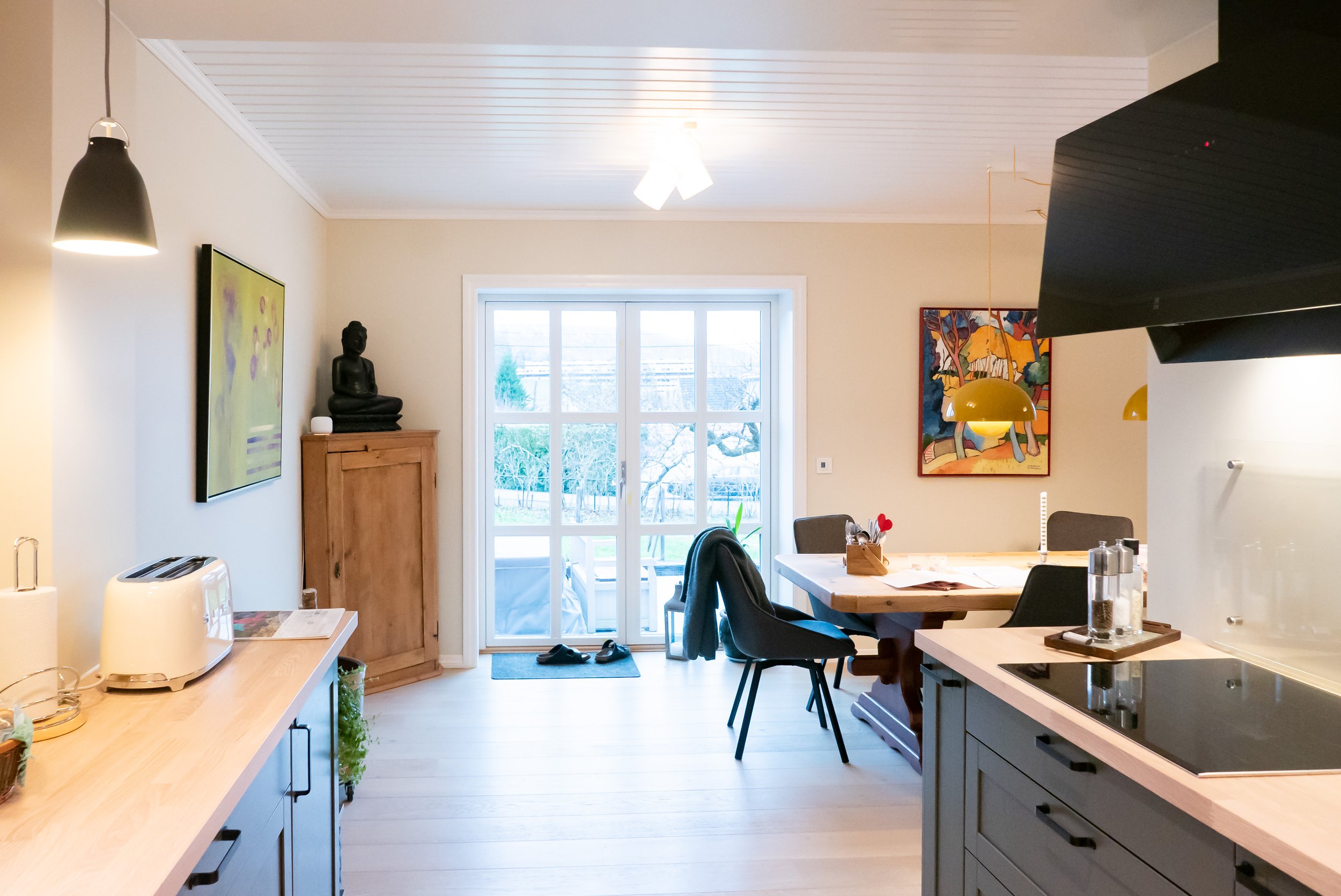
The remodelled kitchen, with its large communal table and views to the garden

Getting to know the existing house

The couple with their twin daughters had lived in this house, located in Bærum — not far from another remodelling projects of ours, for six years before they decided to remodel. Originally built in 1921 as a log house, it had been extended and altered several times over the course of a century.

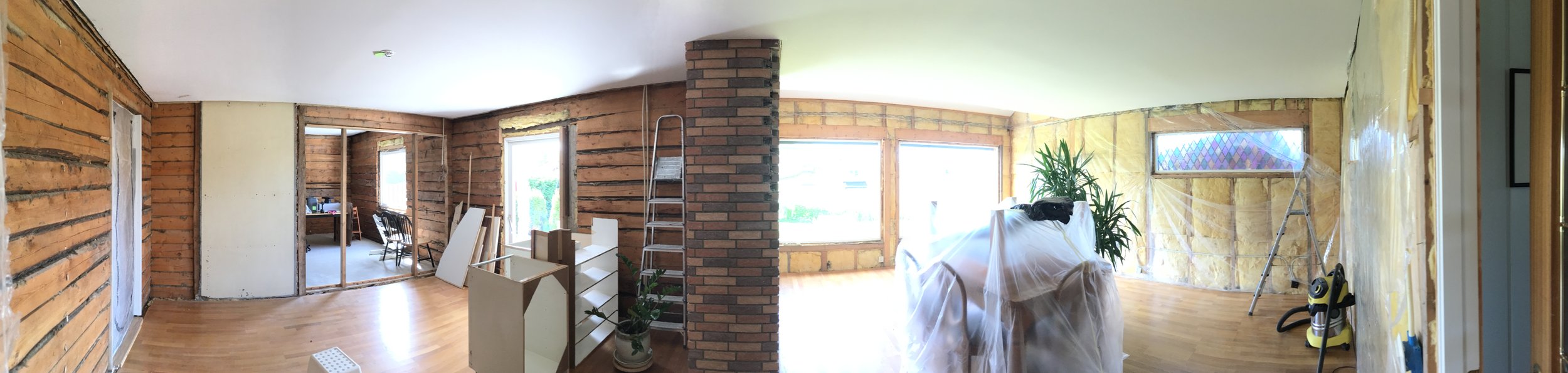
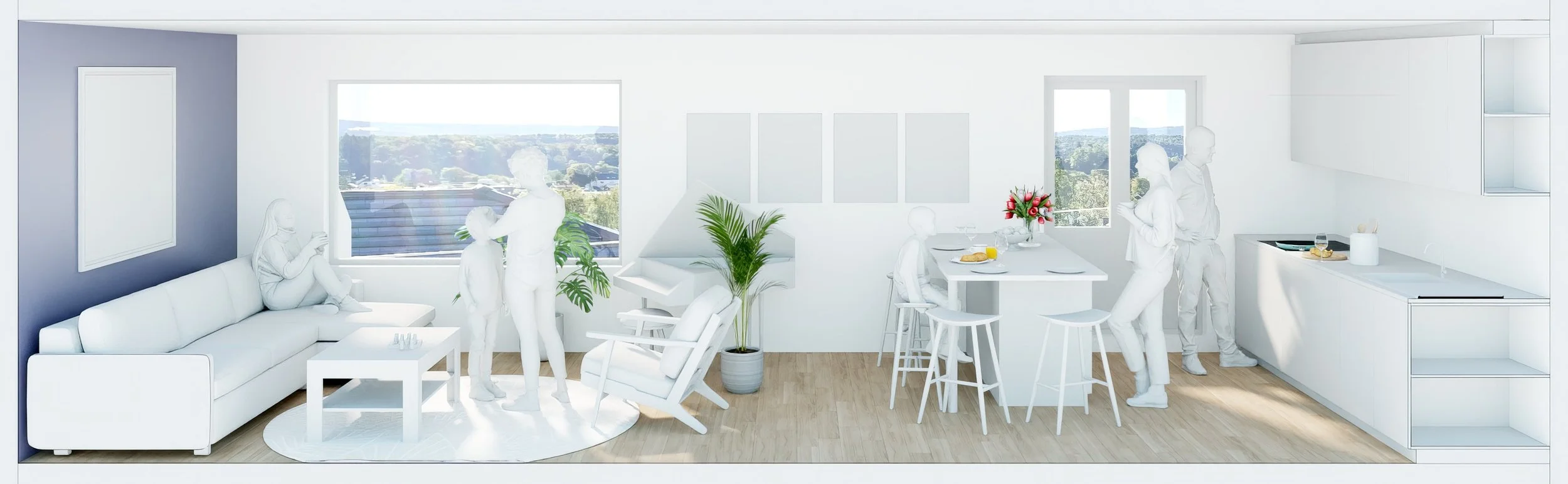
The most recent of these extensions had caused the sole window of the existing small kitchen to be closed off, so that the only daylight was coming through an adjacent playroom. The neighbouring living-room, with its large windows towards the garden, was mostly used as a TV and music room. Despite its comfortable size, this room was surprisingly difficult to furnish, in part due to an awkwardly placed door to the outdoor terrace, and the large dining table at its centre was only used for occasional festive occasions.

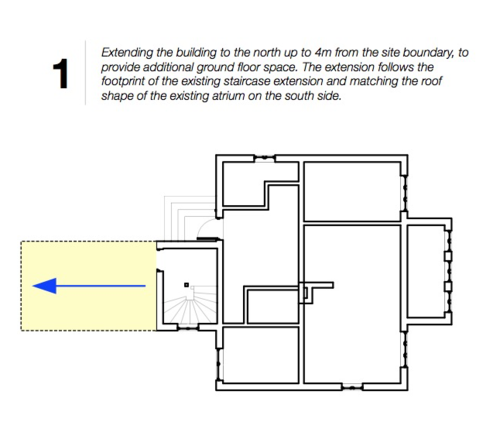
Our analysis of the existing ground floor of the house

Developing a design brief

We sat down with the family to explore their needs and aspirations for their home, bringing in fond memories of former homes they inhabited and loved, and created together a concise brief for this project. Concentrating on three rooms on the ground floor, we were to create an attractive social space at the centre of the house, well connected to the beautiful garden and filled with daylight, to be shared by all members of the family for their daily activities: making food, sharing meals together and with guests, handicraft, playing the piano, doing homework (or home work!), etc. Occasionally, the family should also have the possibility to close off part of the ground floor when multiple activities should be kept separate.

Transforming the house

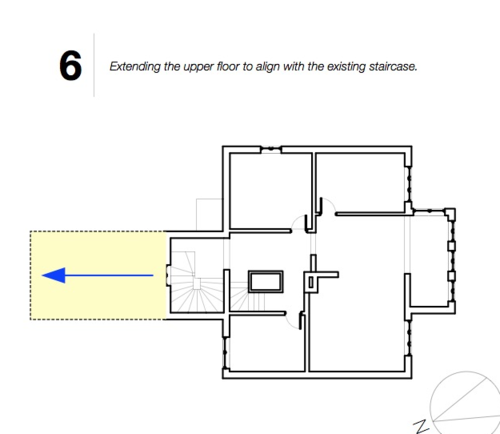
… and our design strategy to transform the spaces, explained step-by-step

With a clear brief defined, and the house carefully analysed, a solution to unlock the potential of a home can be sought. A seemingly simple change can thoroughly transform the way the home is being inhabited.

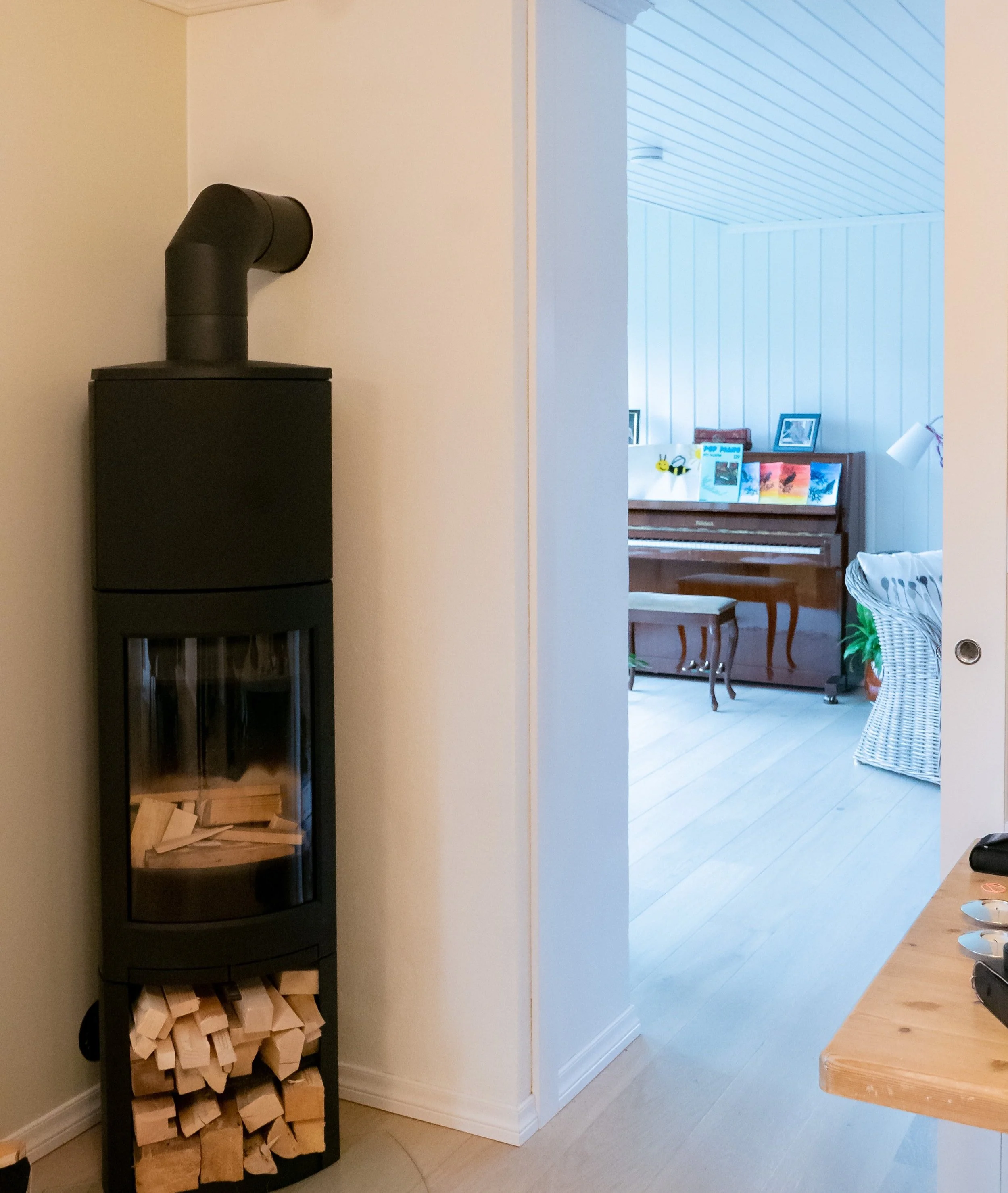
With minimal structural changes to the house, we reorganised the internal partitions and windows to create a spacious room with a large communal table as its centrepiece, wrapping the kitchen area around an existing chimney. This creates a unified space while maintaining a gradation of privacy between the more discrete food preparation workbenches of the kitchen, the central table and the desk area close to the new wood stove.

A large French door, aligned with the kitchen benches, opens views and easy access to the garden, seamlessly extending the dining area onto the large terrace outside.

The fully shelved partition, which accommodates on the kitchen side the bookshelves and communal desk space, and on the living-room side the television, creates a soft boundary between the social kitchen and more private living-room, which can be fully shut off by a hidden sliding door when required.

Our proposed new ground floor layout

With the large TV screen discretely tucked out of the way into the new partition, the space in front of the large living-room windows becomes a sort of winter garden overlooking the green areas outside, with a breakout sitting space filled with daylight and plants.

Between this interior “garden room” and the open terrace outside is the covered porch, now free of circulation and transformed into a sheltered sitting corner. Whatever the weather, there is always a comfortable place to sit and enjoy the garden!

And as with most of our projects, the remodelling work was also the opportunity to upgrade the comfort and energy efficiency of the building in a cost-effective manner, allowing for further external insulation of the walls when the external cladding needs changing in the future.

2hD approached our ideas with a completely fresh eye. They came up with a solution which, in retrospect, feels simple and natural, and yet completely changed the way we use our home to be together!
— Benedicte Kaltenborn

Portfolio project
Care Leavers' Accommodation

Tom Hughes

In August 2022, 2hD was involved in the early stages of a project for new care leavers’ accommodation, collaborating with Simon Middlecote Architecture. Our contribution was focussed on the research process and feasibility stage; with the ultimate aim of developing the design brief.

One of the several diagrams we produced for the study, here illustrating alternative accommodation types

Care leaves are young people aged 16 - 18 who have previously been in foster care, but have now chosen to live more independently. Care leavers’ accommodation acts as a bridging space where these young people can be self-sufficient and live alone, whilst being supported.

We researched case studies of many accommodation types, both past and present and found that most existing models have been found wanting.

One important issue in particular was that many are excessively institutional because of the way they foreground security, whilst others sacrifice safety measures to provide a more adult, independent environment. It was essential that we move on from these established patterns, in order to pinpoint the design challenges in the context of today’s social care.

Timeline for care leavers

Diagram illustrating the layering of security in accommodation

Their housing needs to have a careful balance between public, shared and private areas to provide security without seeming institutional.

Furthermore there is a wide range of support needed within this group that adds further complications. For example, some care leavers need provision that is similar to that of a childrens’ home, and on the other end of the spectrum some need near-total independence.

We arranged visits to existing care leaves’ accomodation to have meetings with staff and care leavers themselves to understand their needs and their views on how the accommodation could be improved. All the stakeholders of this project (such as the care leavers, social workers, staff and the local community) were consulted on their opinions and lived experiences.

The outcome of our work was a briefing document for Simon and his client that clearly identified the needs of the project stakeholders and the current context in which the project design will develop.


Portfolio project
Vertical living in a former boiler house

Tom Hughes
A pod-like extension provides services, daylight and ventilation.

A pod-like extension provides services, daylight and ventilation.

This intriguing little project is now under construction in Nottingham. Our client’s town house occupies part of a former builder’s joinery workshop in a Conservation Area. Entry to the main house is through the ground floor of a free-standing former boiler house, complete with an 11m high brick chimney. Our challenge was to re-purpose this special, tiny building to contain a home working office and guest accommodation.

We stripped out and redesigned the boiler house interior to fit a mezzanine level under the opened-up roof structure, and used ‘space saver’ stairs to maximise the floor area. The tiny floor plan is offset by an impressive vertical connection between the levels- with everything needed for occupation accessed off a vertical circulation route culminating in the bed platform.

Careful organisation of the section creates space for a mezzanine level

Careful organisation of the section creates space for a mezzanine level

The temptation is to cut lots of holes in an existing building to let in light, provide ventilation and create new service routes, but in this case we decided to preserve the integrity of the boiler house by adding a highly-serviced pod to the exterior. This provides the necessary service connections, and brings light and ventilation to the interior. The addition is anonymous, in keeping with the industrial heritage of the building whilst creating intrigue and mystery of its own.

Design Team:

Need some creative input to transform an old historical building into a living space?

Portfolio project
A birdwatching 'eyrie' to hover over Wicken Fen

Tom Hughes

We recently achieved Planning Permission for a new birdwatching hide and observation deck for the National Trust at Wicken Fen, Cambridgeshire.

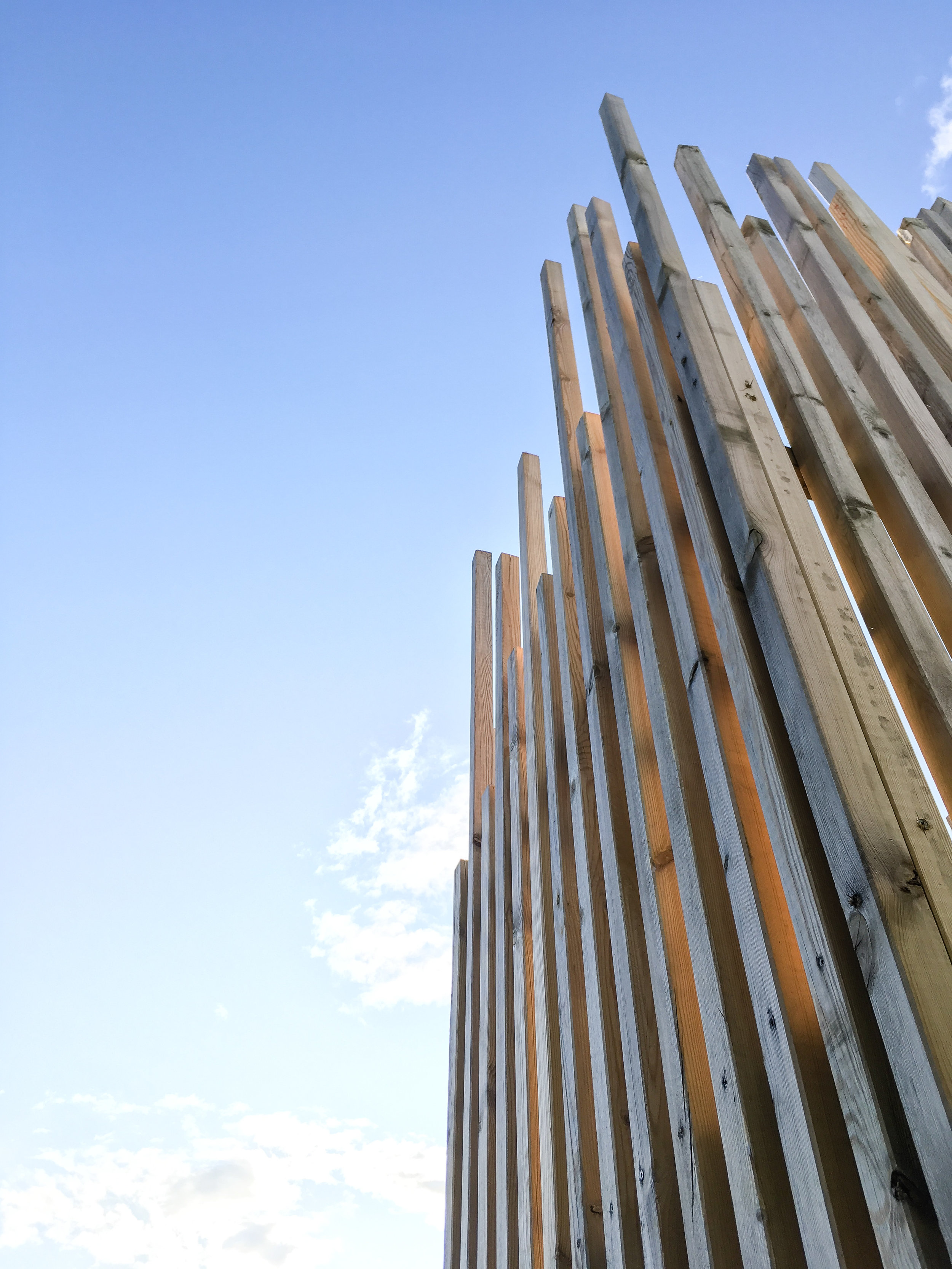
Set at the edge of the fen, the structure was inspired by the singular setting of the SSSI site. The fully accessible birdwatching hide is nestled like a cocoon inside a screen of undulating timber battens. The observation deck above gives view over Sedge Fen, roosting site for Marsh and Hen Harriers. A final eyrie-like observation level gives 360° views ,which take in the whole of Wicken Fen nature reserve and the big skies for which it is famed.

The building nestles into the Carr (tree scrub) at the edge of the Fen.

The highly sensitive eco system of the site is based on 3 meters depth of peat soil, so the structure is designed in collaboration with Canham Consulting Engineers to “touch the earth lightly”, elevated above the Fen on piles so that the habitat can flow underneath. A gently ramped boardwalk, designed for wheelchair accessibility, connects the hide to the existing boardwalk footpath some 30m away.

A fully accessible bird hide at the entry level floats 1.5m above the fen, upper levels can be explored via a triangular staircase to the rear.

Wicken Fen is the National Trust’s oldest nature reserves and one of the most important wetlands in Europe, supporting over 9000 species including a spectacular array of plants, birds and insects. 2hD won the commission via a competitive interview in partnership with Sheltered Spaces, with whom we went on to design the timber cladding and the public consultation process. It is a great privilege to be entrusted with such a sensitive site and to be supported by a client keen to think afresh about how visitors might experience and understand the Fen’s sense of place.

Project team:

Timber screen experiments with Marcus of Sheltered Spaces

Portfolio project
A log cabin in Sjusjøen

Thibaut Devulder

The south gables of the completed log cabins, on the snowy fields of Sjusjøen (Photos by Simon Stende)

For this project, we were tasked to design a new winter retreat on the snowy slopes of Sjusjøen, a popular cross-country skiing resort close to Lillehammer, Norway.

Our clients — a family of five — wanted to create a place to gather their extended family and friends for winter vacations and celebrations, accommodating up to three large families simultaneously — up to 16 people.

Unusually, when our clients approached us, they had already selected  a contractor to prefabricate and erect their future cabin, using the traditional log house technique. As they were not satisfied with their existing design solutions, they asked us to develop a custom design, tailored to their specific needs, which would also follow the contractor’s prefabricated construction method.

Our sketch plans of the cabin’s ground and upper floors

At the centre of our design, the large kitchen and the sunken fireplace lounge act as the two main gathering places, where guests can congregate around the main focal points of the cabin: the communal dining table and the large open fireplace. In contrast, each family enjoys its own private accommodation wing, branching off from these main spaces, with the sleeping quarters tucked away from the vibrant social rooms.

Between these two extremes, we intentionally convoluted the internal circulations to create gradients of privacy and strings of informal sitting spaces along them, where guests could interact throughout the day, but also giving opportunities for more quiet, private activities.

Each wing can be used independently, so that the effective size of the cabin can easily be adapted to the number of guests.

The exterior of the newly completed cabin, showing the use of the traditional materials and details of Norwegian log construction (Photo by Simon Stende)

While the interior of the cabin is intricate and spacious, its exterior maintains the compact aesthetics and typology of traditional log architecture — with its multiple interconnected volumes cascading down the sloped site, each visually expressing the different functions of the spaces they enclose.

Three distinct outdoor spaces are tucked around the wings of the building, anchoring further the cabin onto the site: the sheltered main entrance on the north side with access to ski storage, a sunny south courtyard linking the dining space to the open views, and a private terrace to the west, on which an outdoor bath can be enjoyed in the evening sun.

Our design served as the basis for the detailing and production of the hand-sawn logs that were produced and installed on site by the specialist contractor. The result is a very personal cabin, perfectly suited to the needs of its owners and embracing the tradition of Nordic log construction.

Would you like a cabin that really fits your needs and the nature around it?

Portfolio project
A family home in Jar

Thibaut Devulder

Long perspective across the living spaces in the remodelled home

We have just completed the extension and remodelling of a family apartment in Jar, a close suburb of Oslo.

Our clients wanted help to expand their family apartment on the upper floors of a two-family unit that had become too tight for their growing family. In particular, the main living space, which served as a kitchen, dining-room and living-room was over-crowded and awkwardly placed next to bedroom of their three year old daughter. Ancillary spaces were also impractical and a separate washroom was needed to free up space in the bathroom.

Having analysed the existing spaces, we understood that this small extension project could really unlock the potential of the whole house: creating a welcoming and accessible entrance, activating the unused circulation spaces and restoring the connection to the garden — all without increasing our clients’ initial budget.

Our design approach

The remodelled home

We wanted to create a feeling of spaciousness and diversity inside the apartment. This is achieved by opening long perspectives across the whole house, visually linking strings of distinct spaces along them.

A new porch shelters the approach to the house and frames the entrance to the new hallway, now with level access from the exterior. This view extends across the high ceiling space and through a glazed door, all the way to the pergola in the garden. To the side, a more subdued space links the wardrobes to the new washroom.

With the extension of the house, the preserved staircase is now located at the centre of the house and acts as a vertical axis serving four different sub-levels, between the ground and upper floors. These help breaking up the height into a series of separate, yet connected spaces, so that the different floors feel more unified into a whole.

This feeling of diversity is further echoed on the horizontal axis, with a long perspective across four distinct spaces on the upper floor — through the dining-room and the staircase, the new study and TV-room, eventually opening up to the evergreen vegetation outside.

The exterior of this extension integrates seamlessly with the existing structure of the house, both in volumes and materials. Yet, despite its modest scale, the addition of the extension restructures the house to give a sense of spaciousness and spatial diversity to the interior, creating a more flexible home for this family.

2hD really listened to our needs and ideas. And they managed to integrate them in their design thinking to completely transform our apartment.

We didn’t expect this project to have such an impact on how we experience our home. It used to feel like a small apartment. Now it feels like a spacious house!
— Per Noring, client

Portfolio project
Housing development in the Arctic

Thibaut Devulder

We have just completed the feasibility study of our first project above the Arctic Circle, in Harstad, Northern Norway!

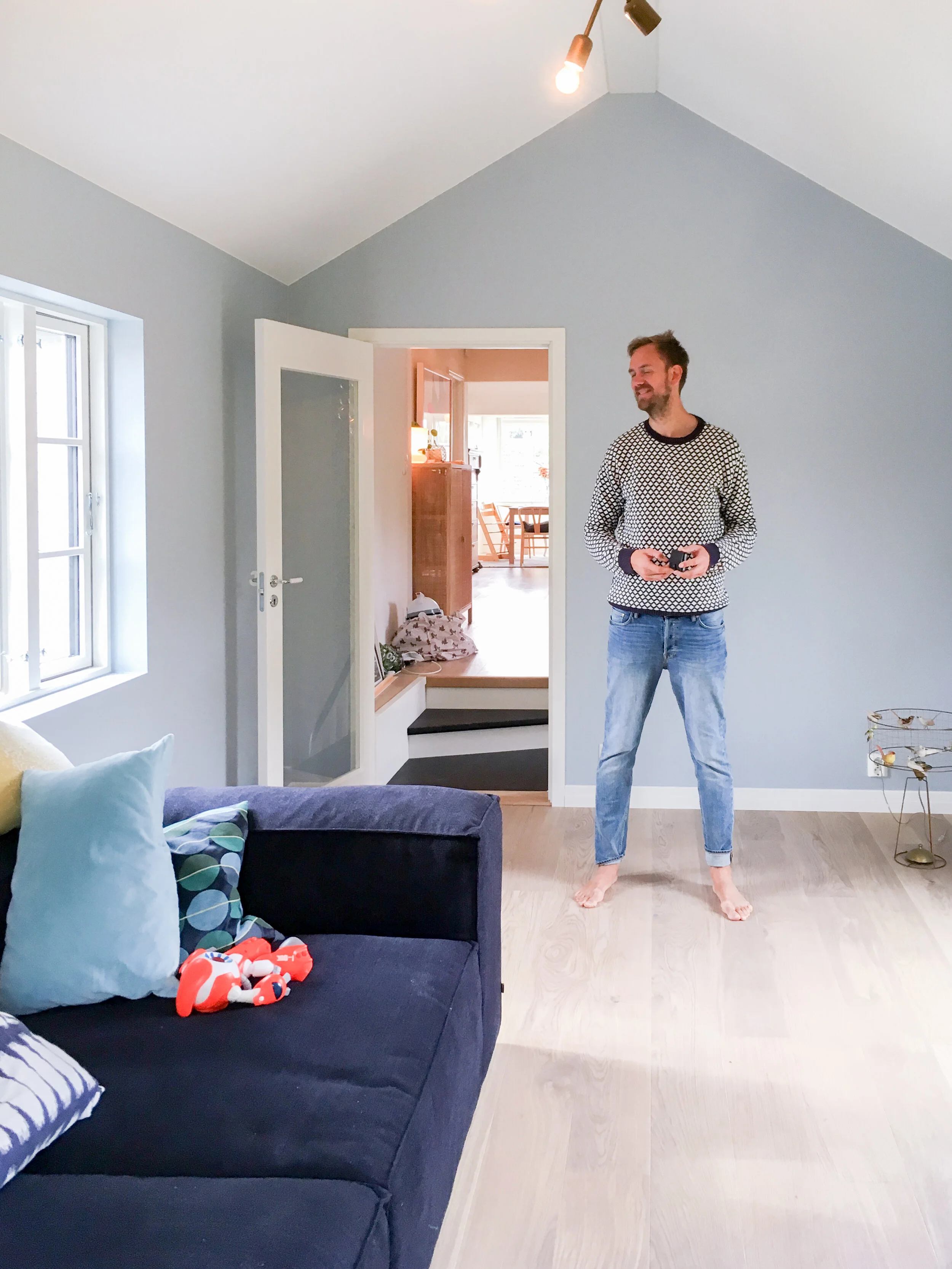
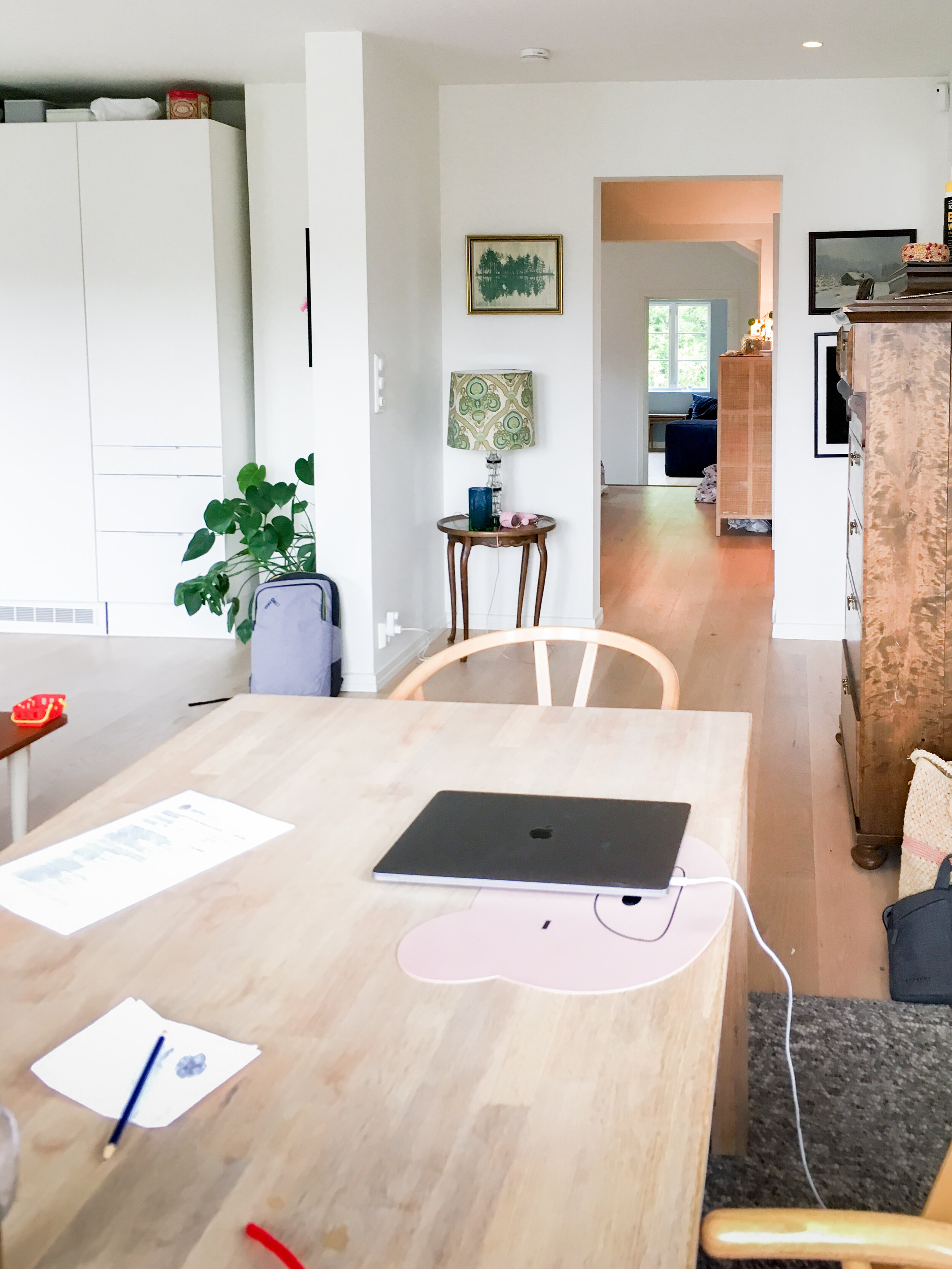
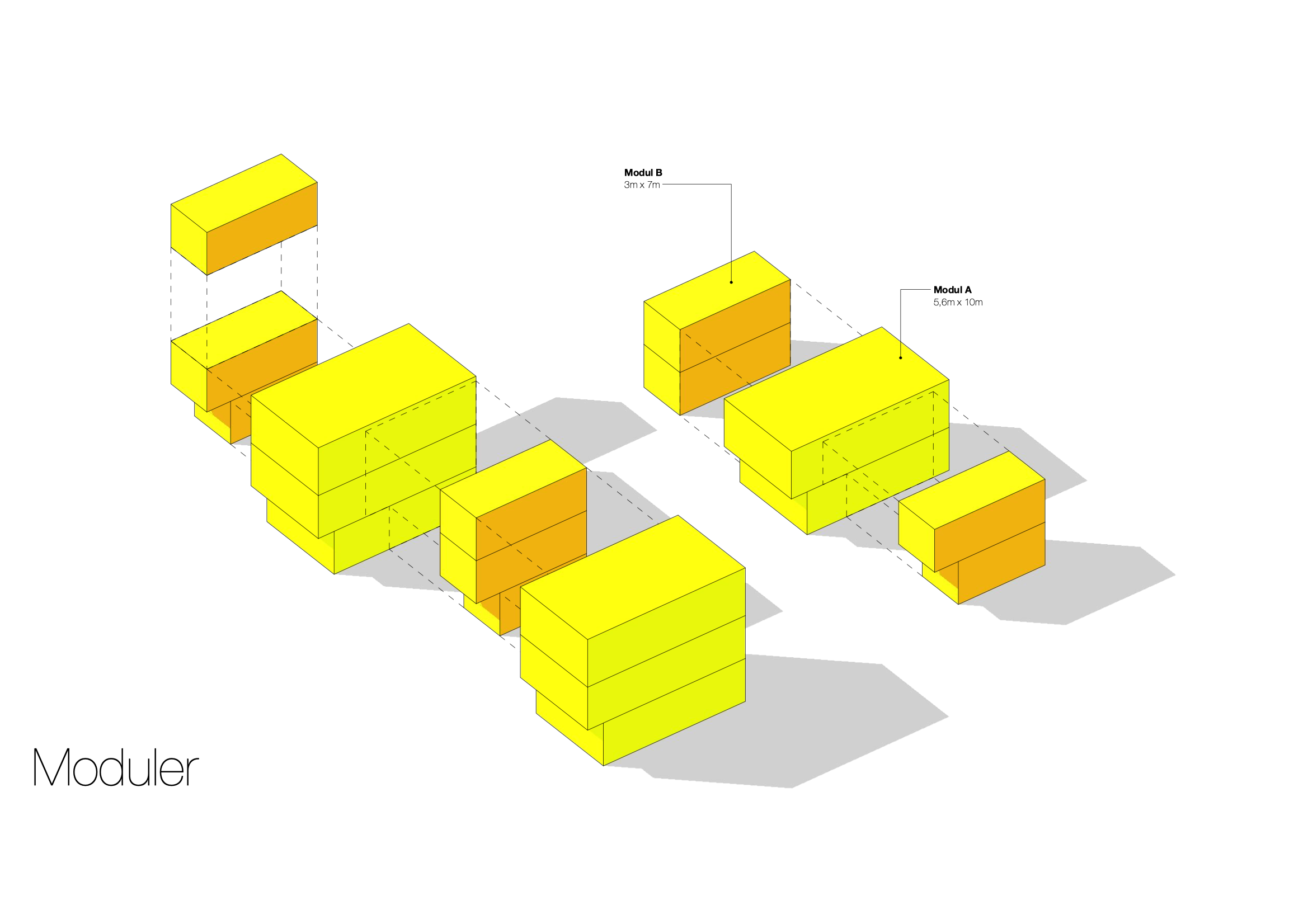
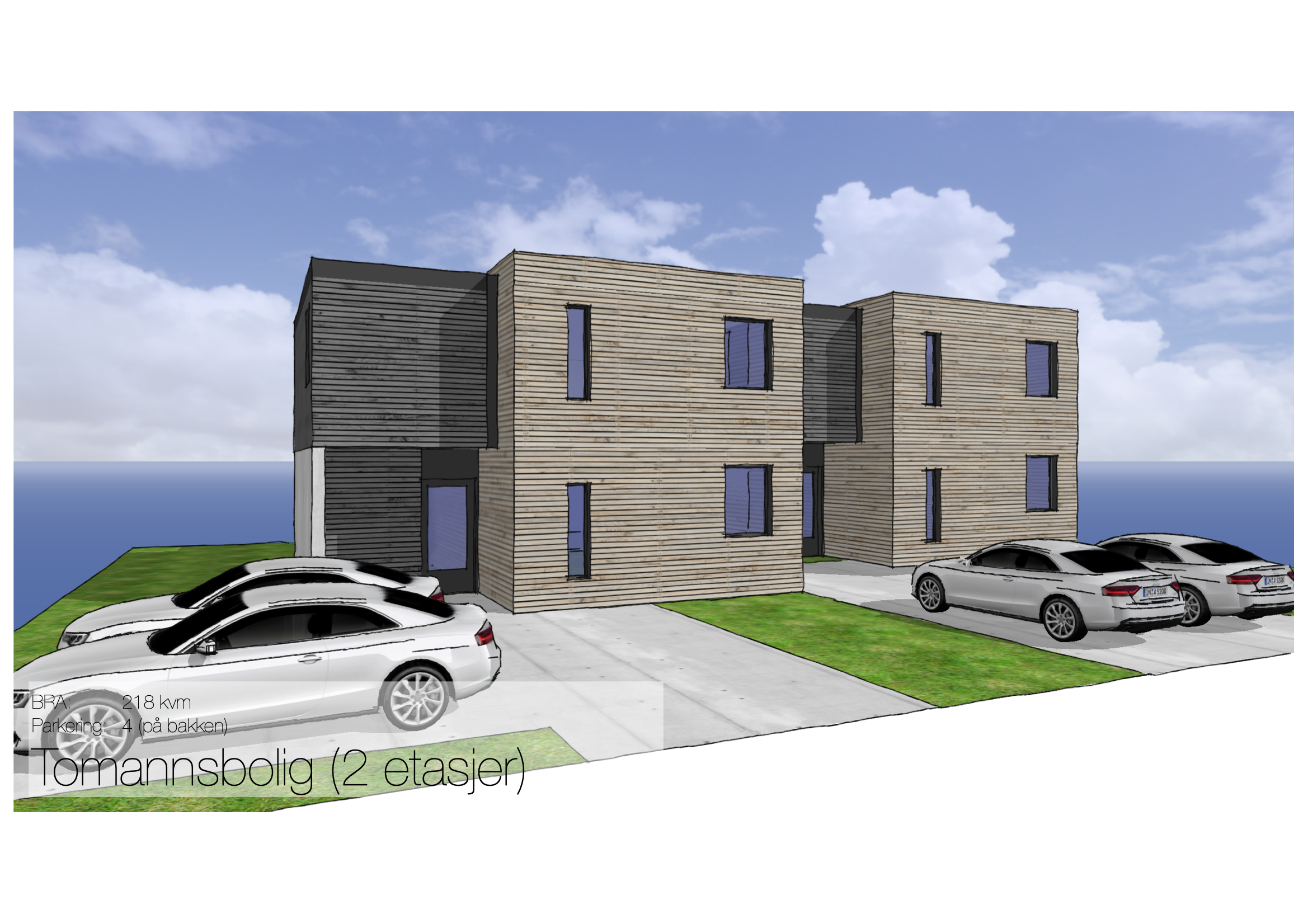
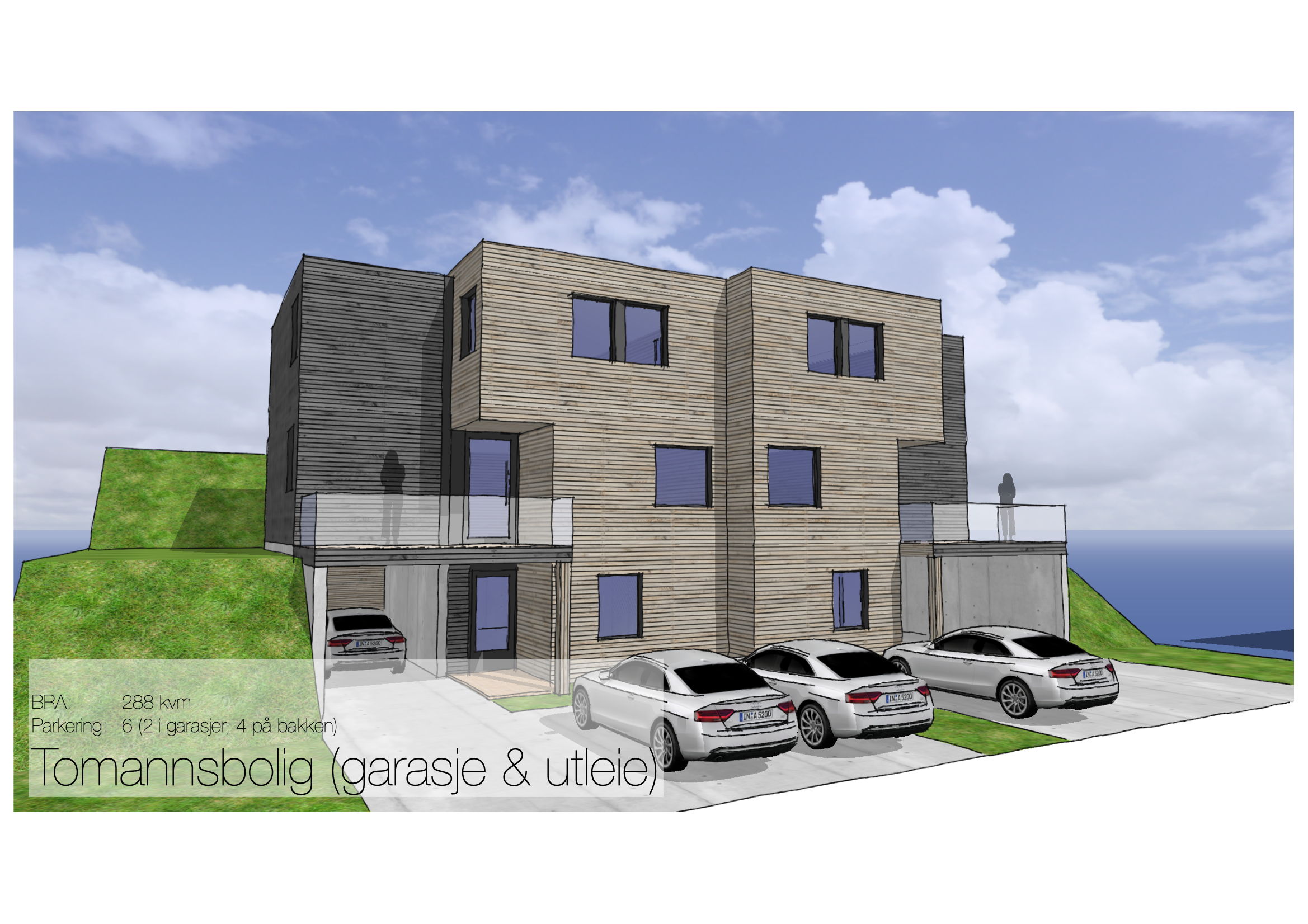
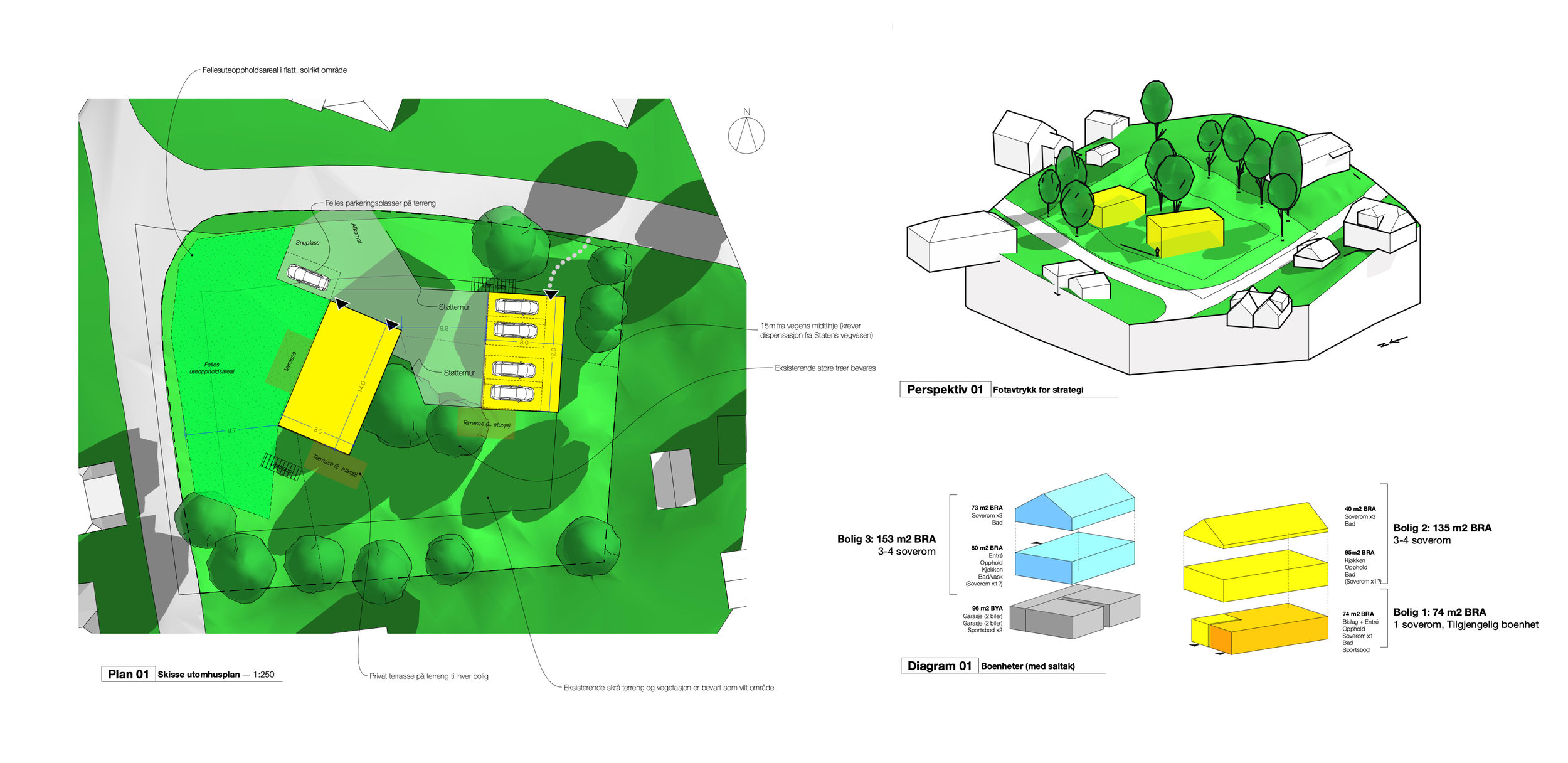
Massing concept for the first prototype houses (6 living units) of our proposed modular construction system for the housing development.

Massing concept for the first prototype houses (6 living units) of our proposed modular construction system for the housing development.

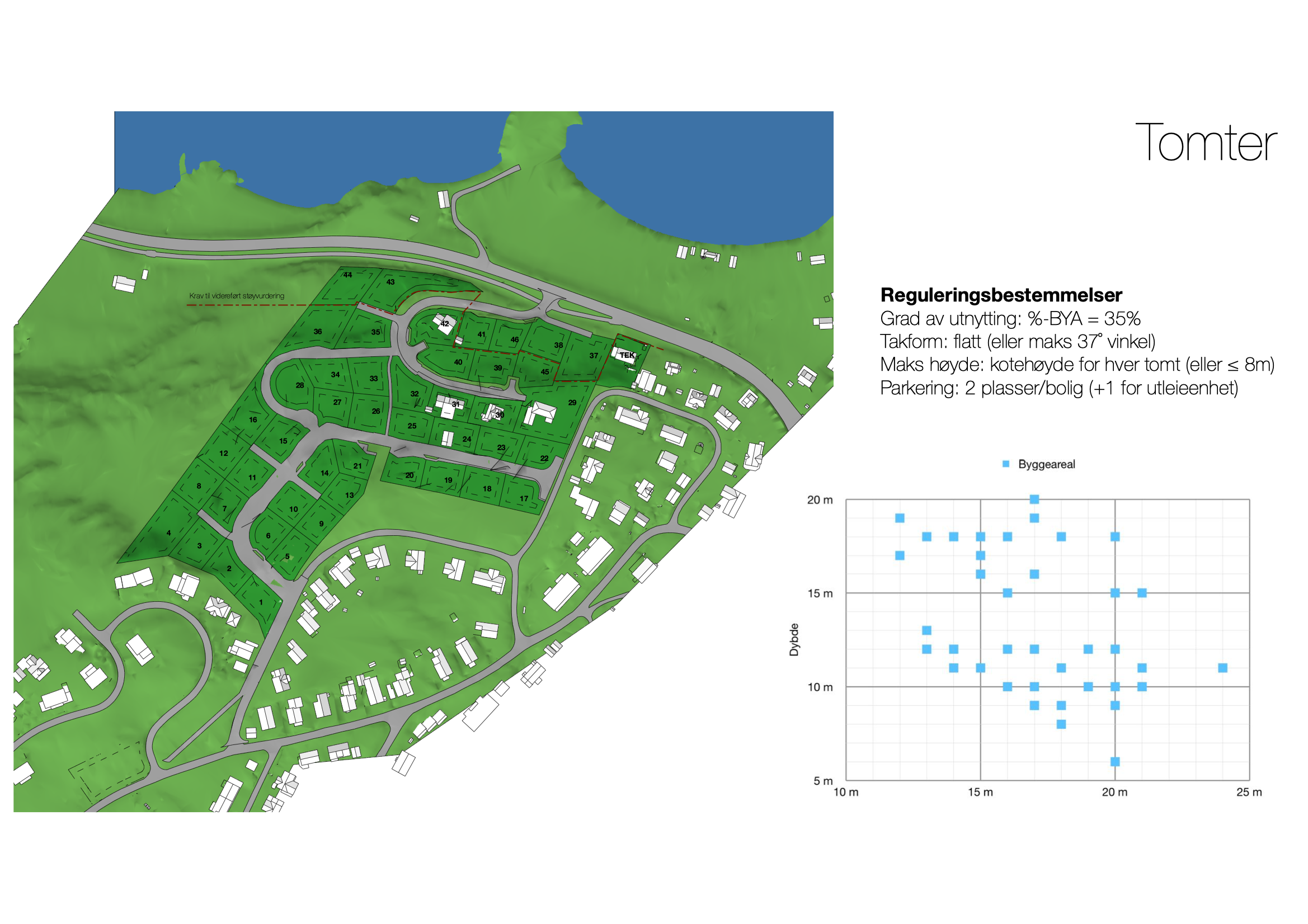
Working in collaboration with a building company, we were tasked by a local land owner and developer to prepare a design strategy for a large housing development on 35,000 m2 of newly zoned area overlooking Vågsfjorden, a fjord just north of the beautiful Lofoten archipelago.

The site had been earmarked for fairly dense housing development by Harstad city council and our client wanted to meet this vision while creating a visually harmonious housing community that integrated well with the natural beauty of the site. Pre-fabricated solutions was also a preferred to keep the project cost-effective and limit site constructions times in difficult climatic conditions.

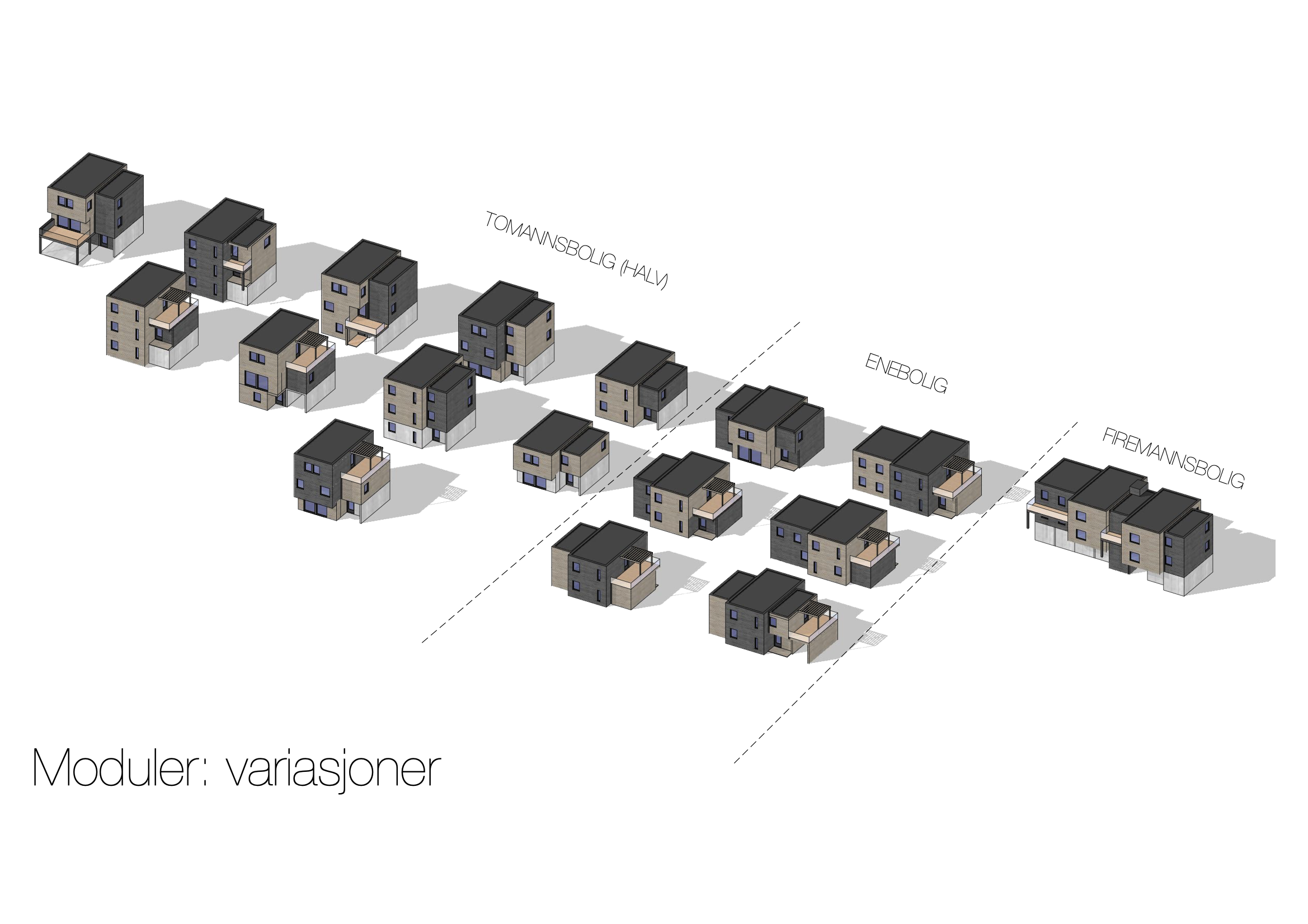
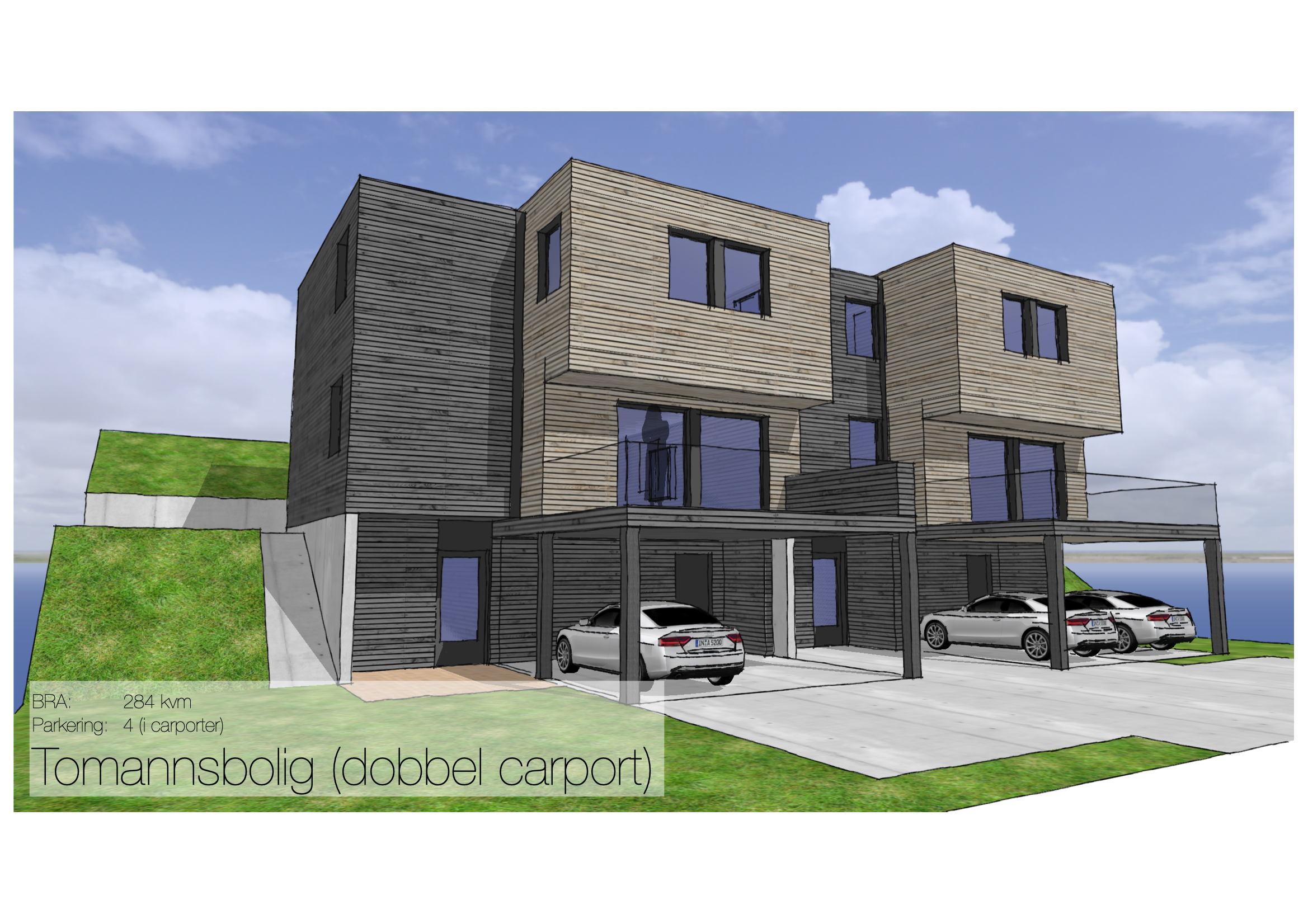
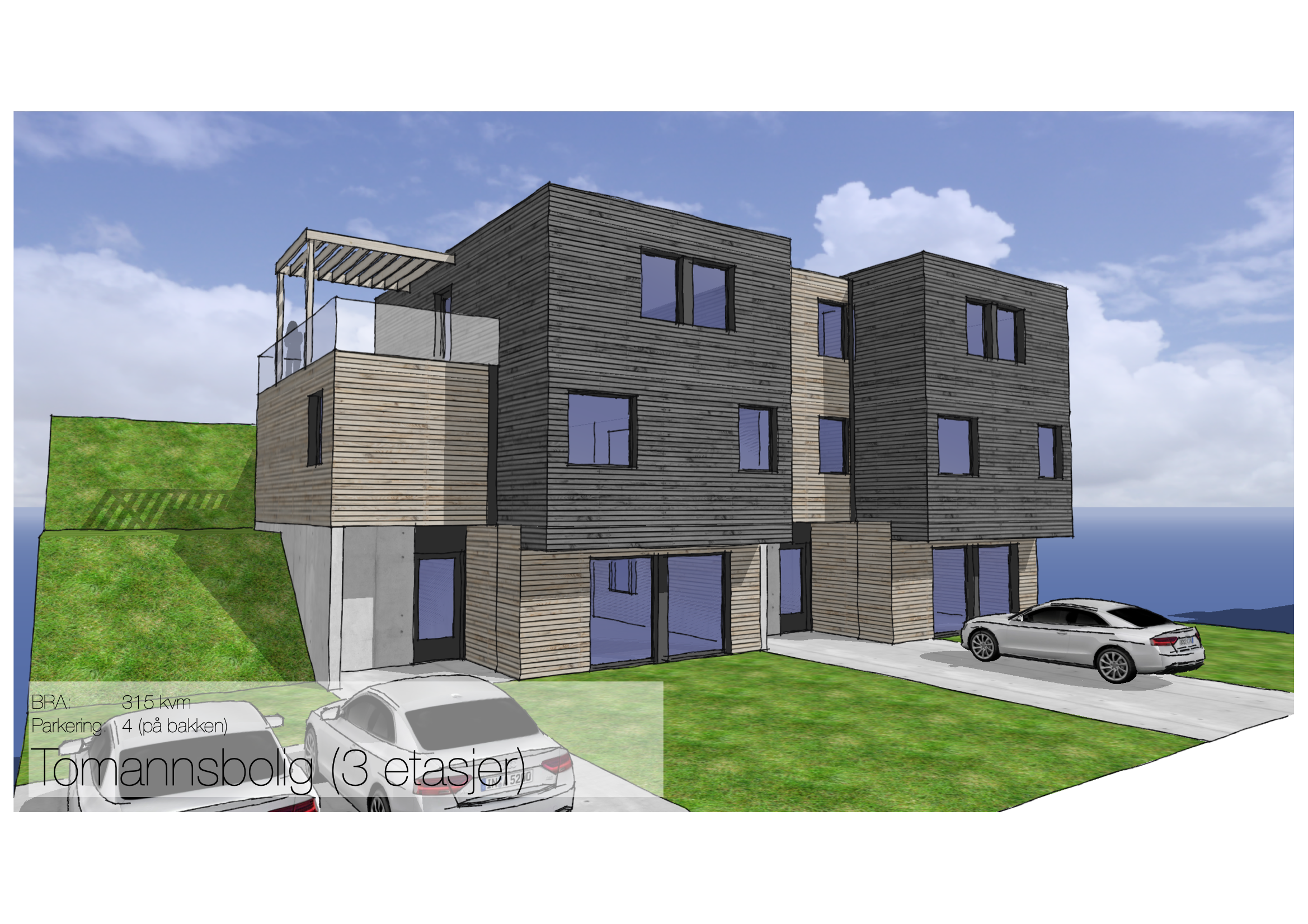
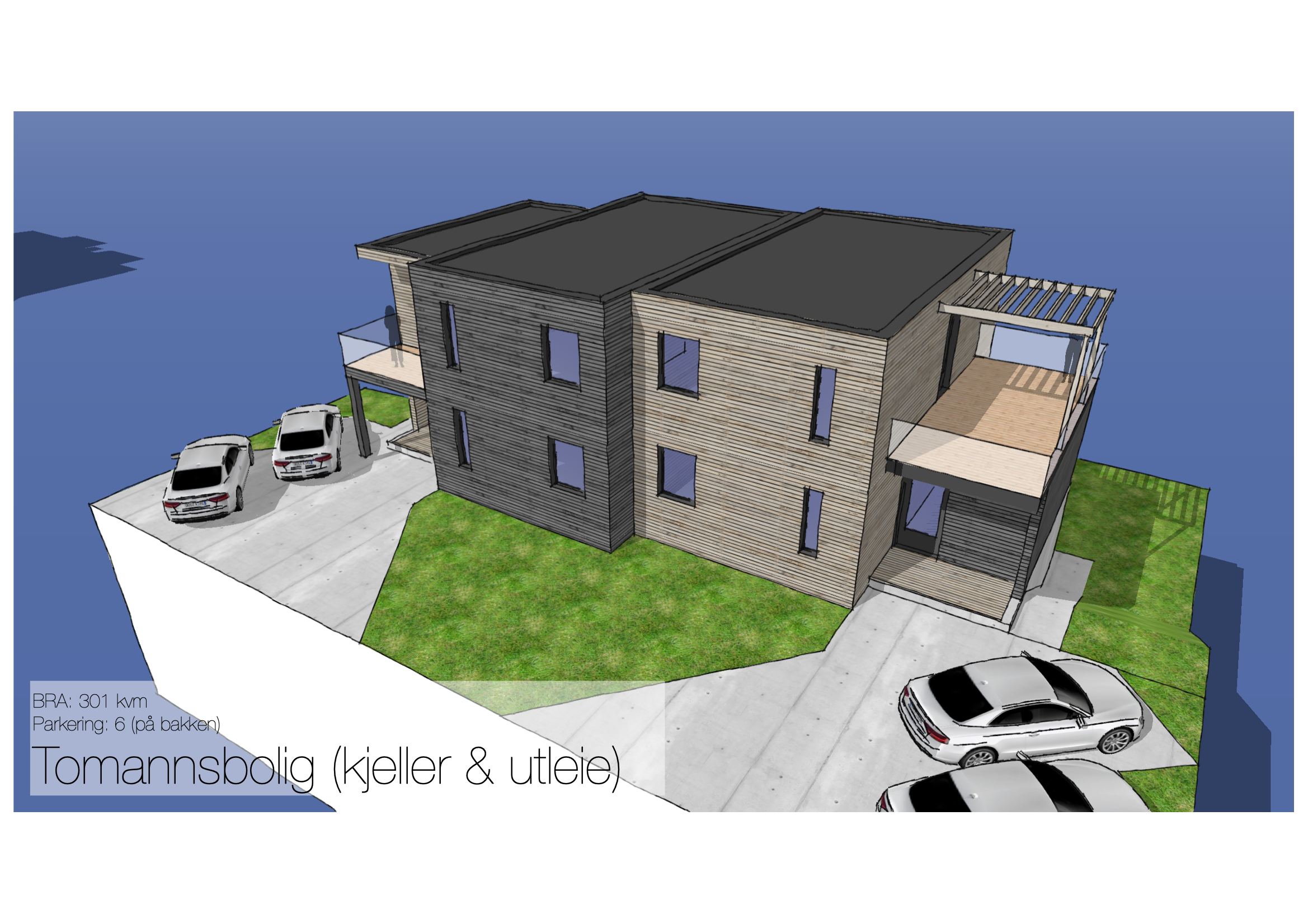
Following a detailed analysis of the site configurations, we developed a custom modular construction system for the houses, tailored specifically to the needs of the project. Our solution took the form of two prefabricated core modules that could be combined in a wide variety of configurations to adapt to the topography, access orientation and size of each plot to maximise the use of the site. In addition, we created a number of variations based on these two modules to combine dwellings — catering for the local housing market demand as well as meeting the development density that the local authorities were calling for.

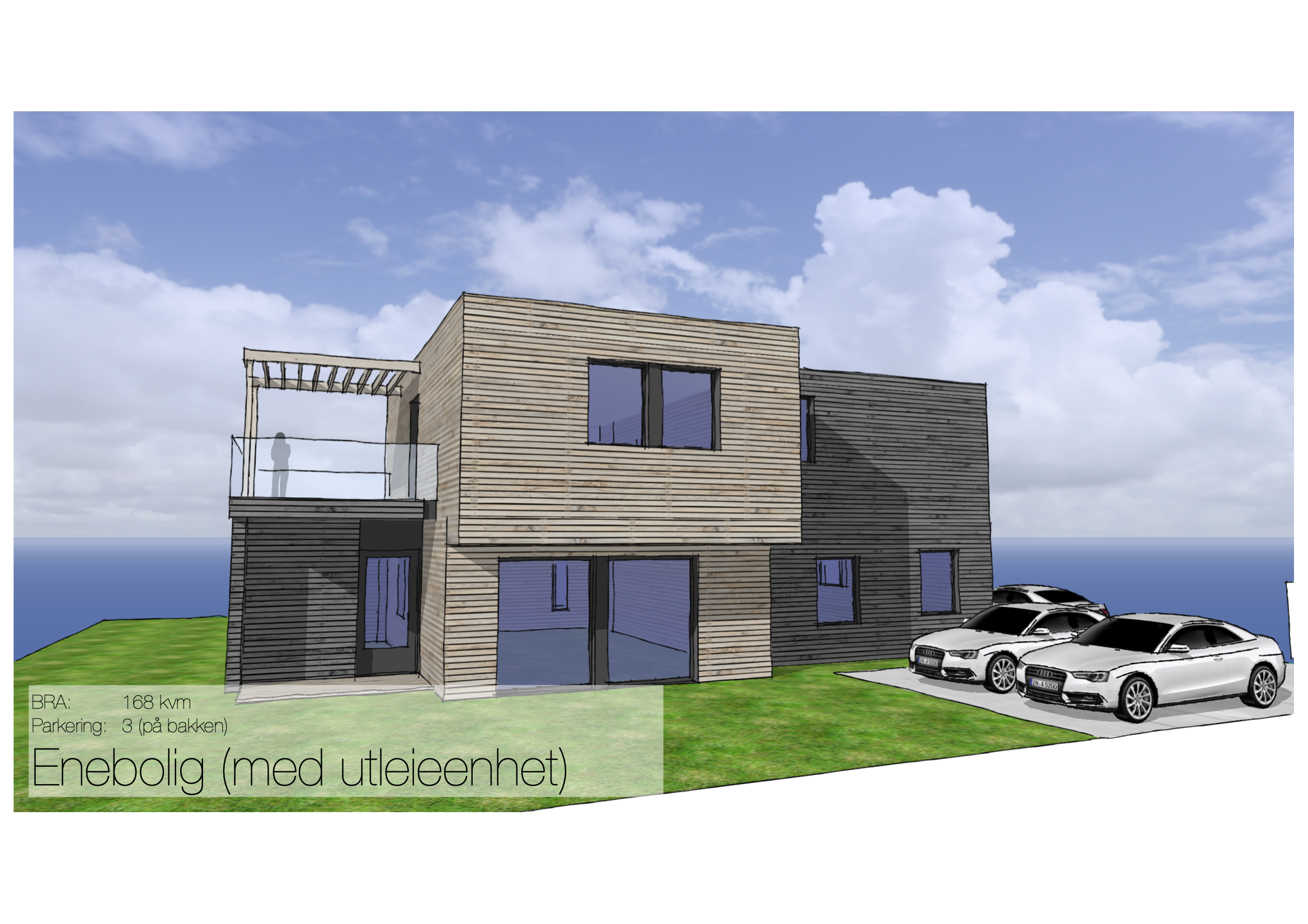
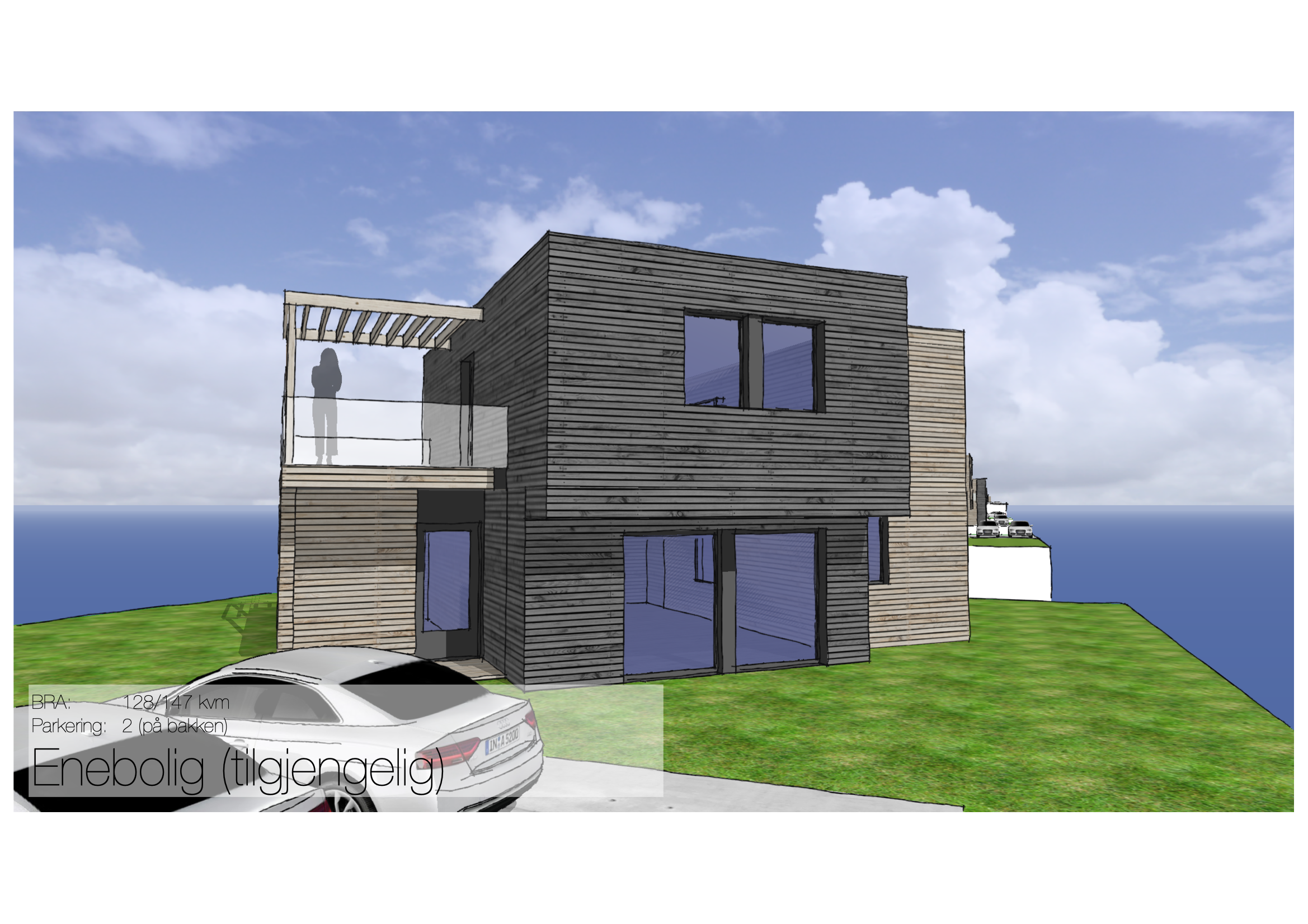
Using this modular approach, we initially designed 18 different configurations, complete with interior layouts, parking options and external spaces — including single-family houses (with and without rental units), two-family houses, terrace houses and small apartment blocks — that would allow more than 80 living units (9,000 m2 ) to be developed on the site.

We are now starting the detailed design for this modular system, ahead of the construction of four prototypes (for a total of 12 dwellings) on site next year, as well as visualisations and customisation options for marketing the project .

Portfolio project
Creating a roof garden in central Oslo

Thibaut Devulder

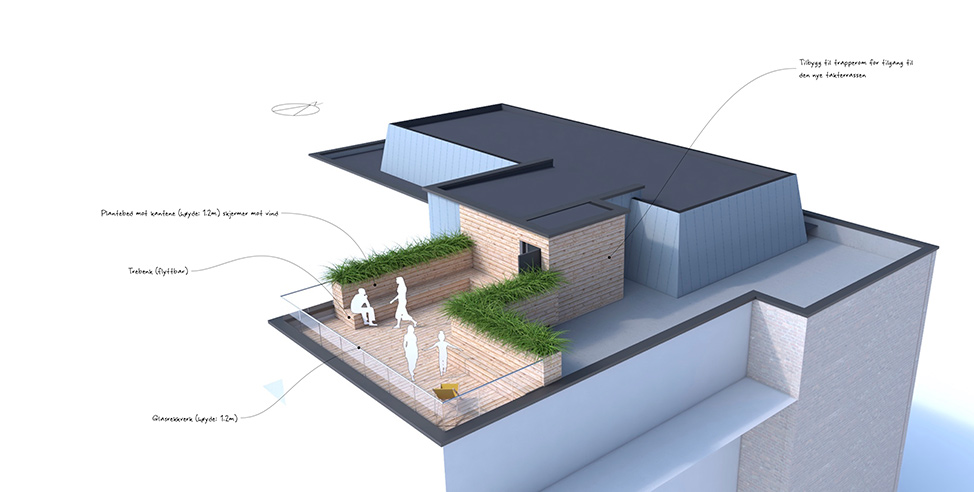
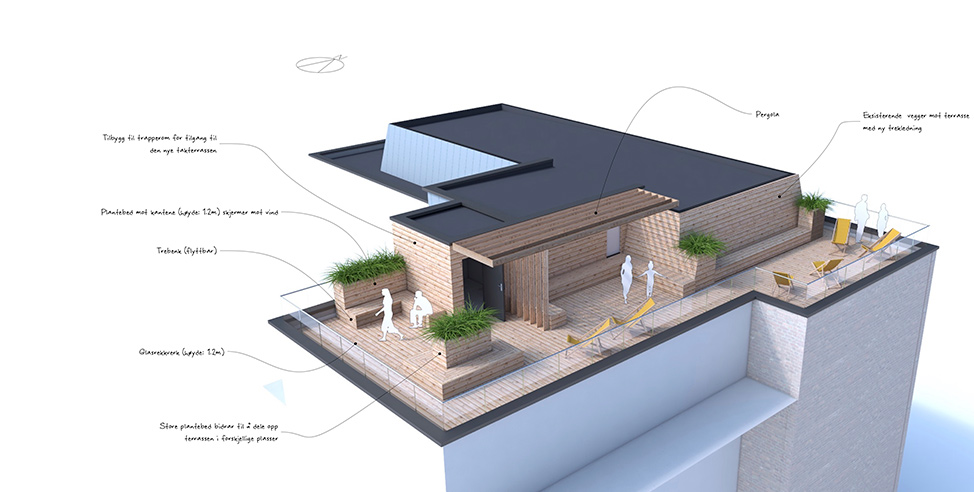
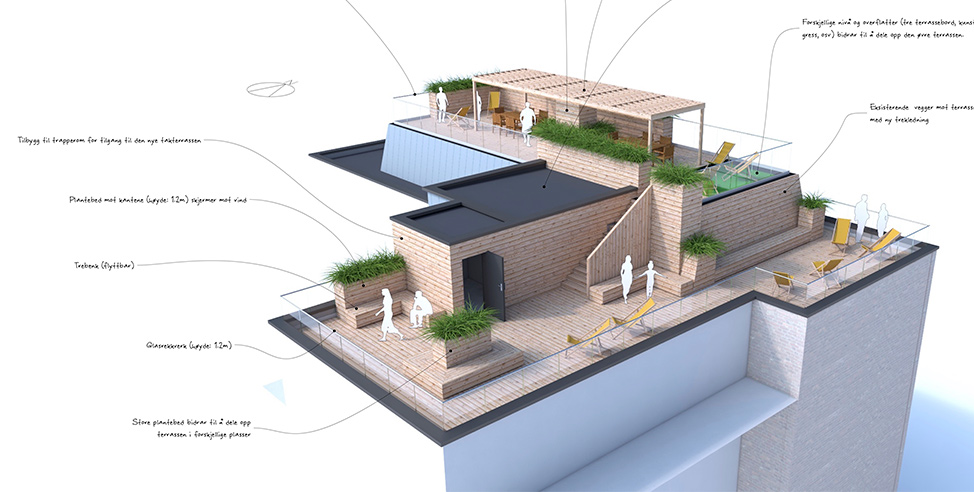
We have just been exploring alternative options to create a terraced garden on the roof of an existing residential block in central Oslo. Our clients — a housing cooperative — wanted to create outdoor social spaces that could be used by all residents and accessed with minimum alterations to the existing building.

Coordinating with the builder, a structural engineer and a fire engineer, we developed three alternative sketch design approaches with various level of complexity and size, each complete with an outline budget, scope of work and timescale.

These design approaches will be reviewed on their annual meeting by the residents and, once a preferred options is selected, we will be proceeding with the detailed design and planning application for the project over the summer.

The existing roof terrace, currently not accessible.

The existing roof terrace, currently not accessible.


Portfolio project
Symétriades: visualising contemporary music

Thibaut Devulder

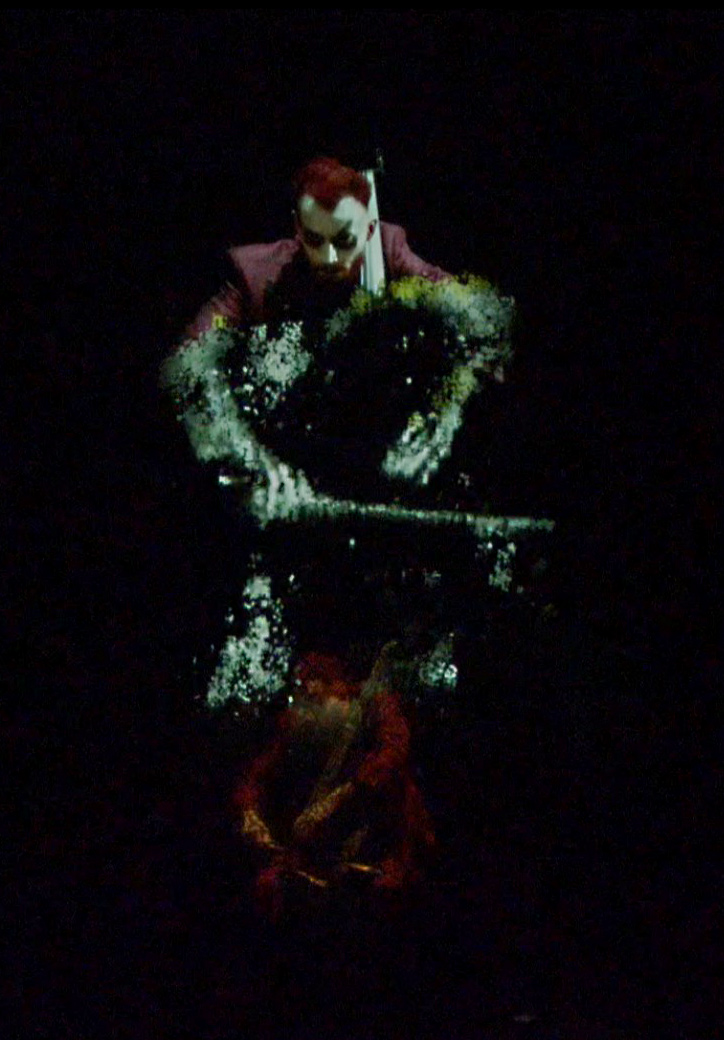
View of our live projection mapped onto the performance stage

Symétriades/Extension is a visual experience that we created for an eponymous contemporary music piece for solo double bass and musical artificial intelligence.

Commissioned by Le Fresnoy - Studio National des Arts Contemporains in France, this art performance was presented at a contemporary music festival in October 2018.

In this project, art director Alain Fleischer and music composer Yann Robin wanted to express the idea of an abstract immolation of the soloist through the performance of this powerful musical piece, “plunging the audience into an immersive experience of engulfment” and “a fusion between the worlds of the seen and the heard.”

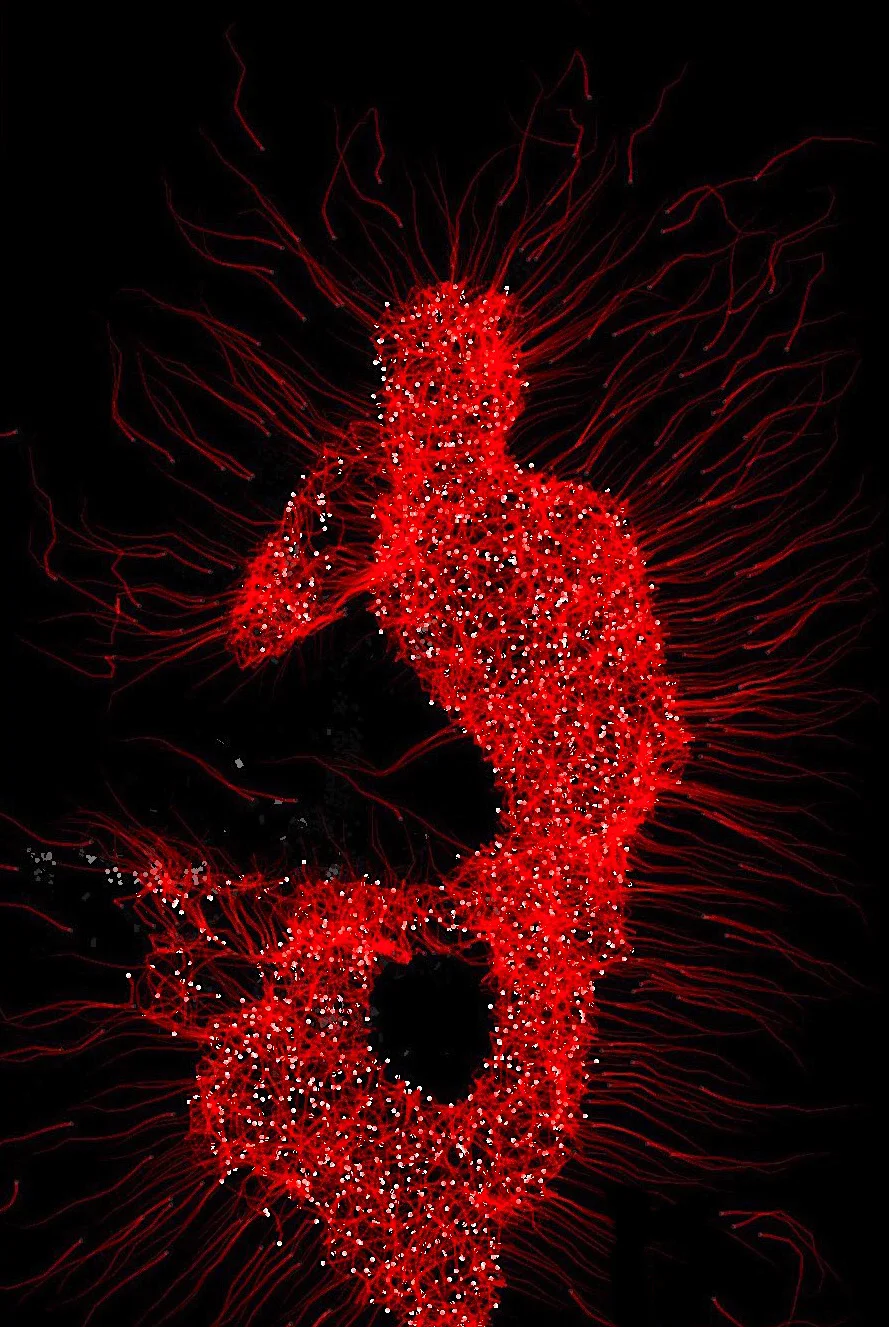
We developed with the artists a scenography and live video projections generated in real-time by the sounds and movements of the musician on stage, merging the expressionist visual universe of Alain Fleischer with poetic elements from Stanislaw Lem’s book Solaris.

This is what I call an immersive experience! It was incredible to witness my own avatars being destroyed in real time, as I performed the piece.

2hD’s work, under the artistic benevolence of Alain Fleischer, gave an exponential dimension to Yann Robin’s composition, merging the visual and musical architectures into one.
Nicolas Crosse, soloist in the performance
 

Extract from Yann Robin’s musical score, codifying the complex movements of the soloist on the double bass (image © Yann Robin)

Symétriades as a musical piece

Composed in 2013 by Yann Robin, Symétriades is the second opus of three abstract compositions, all titled after the incomprehensible architectural formations described in Lem’s fictitious discipline of solaristics.

Inspired by and written for Nicolas Crosse’s double-bass powerful playing technique, the composition of the musical piece also includes an artificial intelligence that reprocesses in real-time the soloist’s live performance. This electronic system, developed at the Institute for Research and Coordination in Acoustics/Music (IRCAM), distorts, filters and reconfigures the music into a network of 8 loudspeakers and 4 sub-woofers that spatialise the sounds around the audience.

Extract from Symétriades (© Yann Robin)
Yann Robin (composer), Nicolas Crosse (double bass)
 

The visual experience

The artists wanted to visually express the contained ferocity of the music, using the metaphor of the bass as an instrument of self destruction.

Echoing some of the themes from Lem’s enigmatic book, we constructed the visual narrative of the performance as a succession of digital incarnations of the bass player.

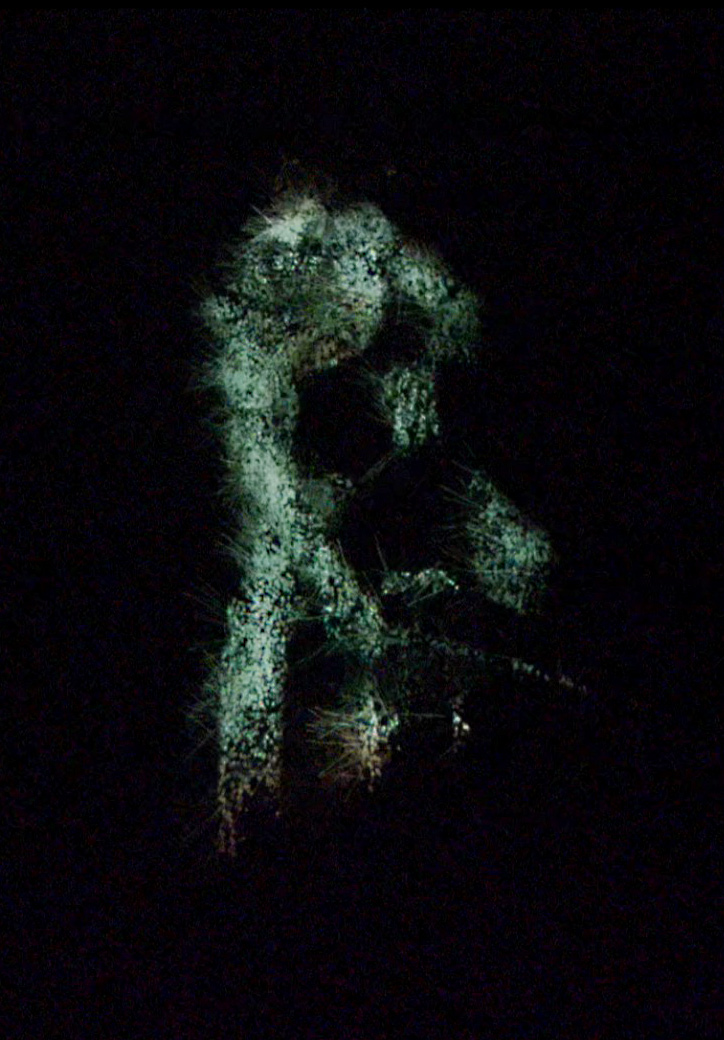
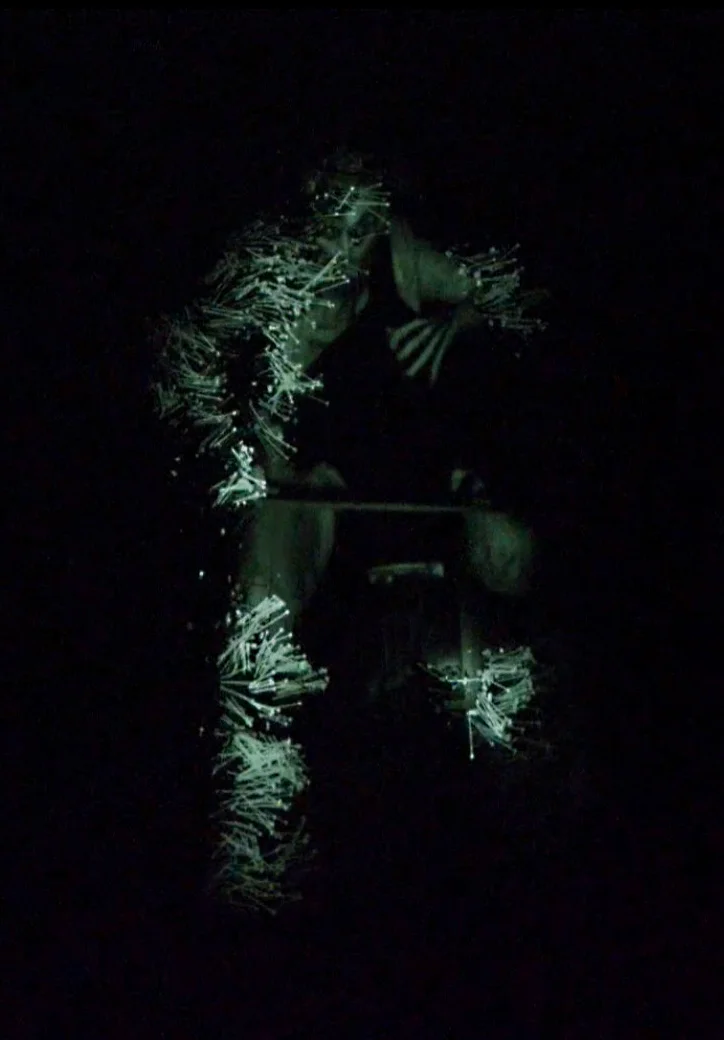
Overlaid onto his physical presence on stage as video projections, each of these “doppelgänger” gets corrupted and eventually destroyed under the assaults of the sounds and movements of the musician on stage. Progressively turning into an abstracted version of his image, it finally recomposes itself into a purely abstract visual representation of the music.

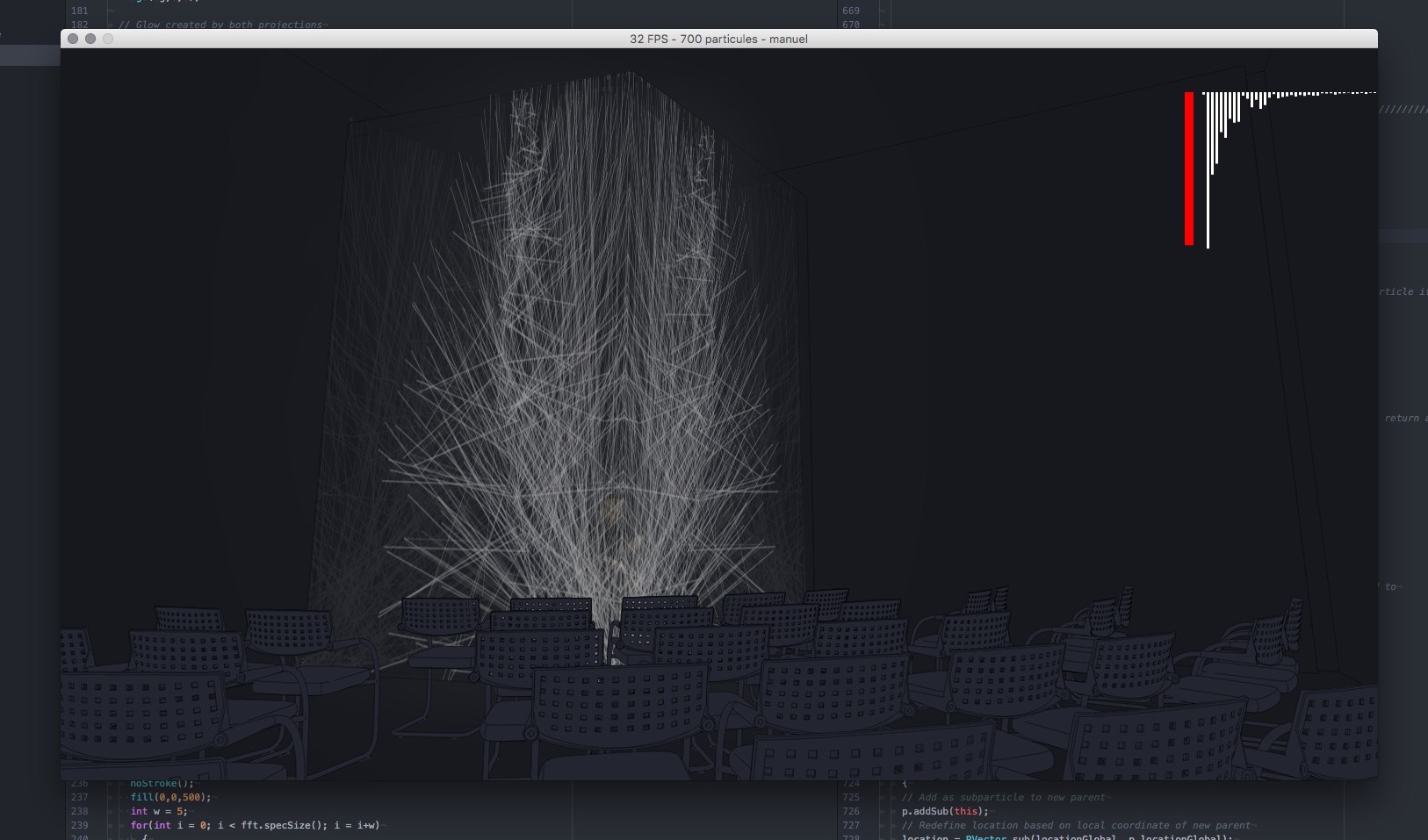
To achieve this, our approach mixed real-time filming, 3D motion analysis of the musician on stage and sound analysis. We coded a custom computer program that could dynamically create and composite layers of animations over the image of the musician being projected onto the stage and coordinate them with the electronic sound processing.

The dynamic nature of our system allowed the video projections to adjust to the improvisations of the musician during the performance — something that the musical score specifically encourages during certain parts of the piece!


Double-bass solist Nicolas Crosse during rehearsals, seen through the shifting moiré of the translucent projection screens of our scenography.

The scenography

In parallel to the visual effects, we also designed a stage scenography for the performance.

From an early stage, we wanted to keep the powerful delivery of the soloist at the centre of the visual experience. Its perception by the audience should therefore be altered not only by the means of digital video projections, but also through the physical, direct medium of the scenography.

Playing with the perception of depth, we shrouded the stage with multiple layers of finely meshed black fabrics. These translucent surfaces create the screen for the video projections superimposed onto the stage and blur the projection into an elusive volumetric presence.

Positioned between the audience and the stage, they further distort the direct sight of the bass player through shifting patterns of moiré, adding to the expressionist makeup and costume of the performer, and echoing the liquid nature of the book’s protoplasmic being. Modulating the contrast between stage lighting and video projections, we could also shift the audience’s focus between the performer on stage and his abstract projected doubles.


The creative process

As we developed and refined the effects over the course of the production phase, we produced a series of video prototypes that precisely simulated the effects, based on high-definition videos and 3D captures taken during the first rehearsal. This allowed the involved artists to visualise the performance in real conditions at each design iteration, keeping the artistic discussion open and adjustments to the system simple.

We also took care of sorting out the technical solutions for the performance, selecting adequate equipment and producing detailed 3D models of the scenography and technical workflows, so that its feasibility could be checked with the technical team as the project developed.

Credits for the project

Art direction: Alain Fleischer
Music composer: Yann Robin
Double bass soloist: Nicolas Crosse
Electronic sound treatment: Robin Meier
Scenography & live video projection system: 2hD
Production manager: Bertrand Scalabre
Stage manager: Alexis Noël
Sound setup: Geoffrey Durcak
Production: Le Fresnoy - Studio National des Arts Contemporains, in co-production with L’Ensemble Multilaterale


Are you an artist working with interactive installations or performances?